

Note: This site is moving to KnowledgeJump.com. Please reset your bookmark.
Skills and Performance
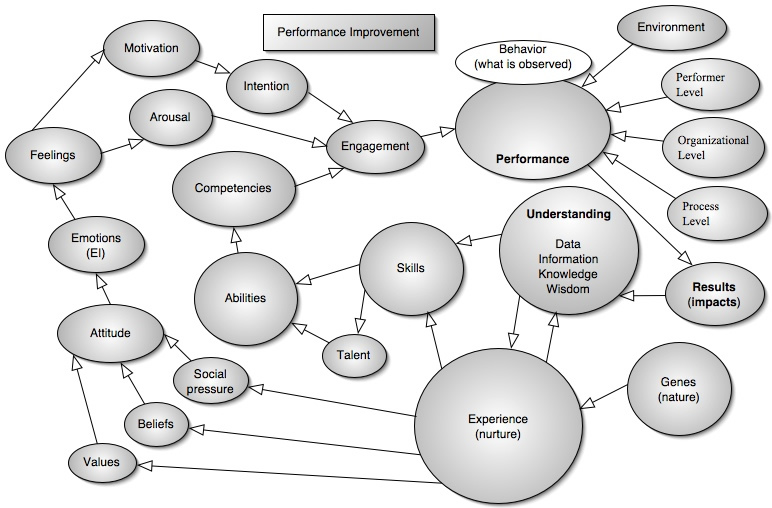
Skill (techne in Greek) is used to denote expertise developed in the course of training and experience. It includes not only trade and craft skills acquired by apprenticeship, but high-grade performance in many fields, such as professional practice, the arts, games, and athletics. (Gregory, 1987, p715)
The common factor in all these types of skills is that the performer has to match the demands of a task. This is accomplished by applying a strategy of performance. For example, a craftsperson will select the tools and manipulate them to meet the requirements of the task. Note that these strategies are NOT normally concerned with a single response, but rather with chains or programs of action to obtain a result. Some strategies are more efficient than others. Skill consists of choosing and implementing the most efficient strategies.
There are three main parts to a skill:
- Perception of object or events - perceiving all relevant factors.
- Choice of response - making a decision.
- Execution of the choice made - normally requires motor coordination and timing.
Peter Drucker (1993) argued that a skill could not be explained in words, it could only be demonstrated. Thus, the only way to learn a skill was through apprenticeship and experience.
Social Skills
Social Skills are the interaction of one person with another. It includes the perception of needs and desires of others, and of one's effect upon others (Gregory, 1987, p716). This is quite similar to Emotional Intelligence and Social Pressure.
Skill Gaps
The required performance minus the present performance equals the skill or performance gap.
A skill gap analysis compares the performers skills with the skills required for the job in order to identify future performance improvement opportunities.
Notes
Also, see KSA.
References
Drucker, Peter F. (1993). Post-Capitalist Society. Oxford: Butterworth Heinemann.
Gregory, Richard L. (1987). The Oxford Companion To The Mind. Oxford: Oxford University Press.