

Note: This site is moving to KnowledgeJump.com. Please reset your bookmark.
Engagement and Performance
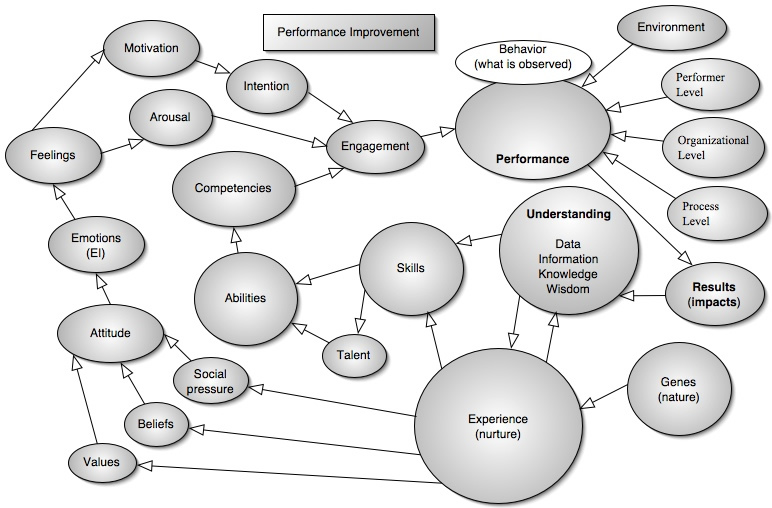
Part of a person's intention has to do with his or her's level of engagement. There are normally four levels when it comes to engagement (Loehr and Groppel, 2004):
- Physical energy - engaging the body
- Emotional energy - engaging the heart
- Mental energy - engaging the mind
- Spiritual energy - engaging the spirit
In emotional intelligence (Matthews, Zeidner, & Roberts, 2002), task engagement normally represents a transactional theme of commitment to effort to a task or activity. "Engagement" is the construct while "commitment" is generally the variable. This commitment to effort is normally seen through two states, subjective and cognitive:
Subjective:
- Energetic arousal
- Task interest
- Success strivings
- Concentration
Cognitive:
- Challenge
- Task-focused coping
- Low avoidance coping
There are a number of engagement surveys on the market; however, there are only ten common themes that are found in these blanket-wide engagement surveys (Vance, 2006):
- Pride in employer
- Satisfaction with employer
- Job satisfaction
- Opportunity to perform well at challenging work
- Recognition and positive feedback for one's contributions
- Personal support from one's supervisor
- Effort above and beyond the minimum
- Understanding the link between one's job and the organization's mission
- Prospects for future growth with ones employer
- Intention to stay with one's employer
Gallup calculates the percentages within the total United States workforce for three categories of employees: 27% are engaged, or loyal, productive, and psychologically committed to their work; 56% are not engaged employees who aren't psychologically committed to their roles; and 17% are actively disengaged, or disenchanted with their work places.
However, a study by McBassi (2008) examined engagement data in the financial sector and colleges and concluded:
There is little consistency in the specific elements that drive employee engagement across the different organizations examined, despite the fact that the organizations were for the analysis precisely because of their similarity to one another, (and further, within each of the four colleges, the Top 5 lists for teaching staff and non-teaching staff were quite different.)
While we know engagement exists in organizations, there are no easily defined factors or similarities that can be used across the board for measuring engagement levels. This should not be too surprising as we know that each organization has its own set of dynamics and culture that drives it. Thus, trying to measure engagement levels with a small set of factors will produce inaccurate results in most cases.
Reference
Gallup survey - Few Employees in France Are Engaged in Their Work, Gallup Study Reveals (note: contains metrics for other countries, to include USA)
Gallup survey - Measuring and Improving Employee Engagement
Loehr, J. & Groppel, J. (2004) "Full Engagement." In Chief Learning Officer, Feb, 2004 p.12.
Matthews, G., Zeidner, M., & Roberts, R. (2002). Emotional Intelligence: Science & Myth. Cambridge, Massachusetts: The MIT Press.
McBassi, L. (2008). A Cross-Organizational Examination of Similarities (and Especially Differences) in Drivers of Employee Engagement. Retrieved March 2, 2009 from http://www.mcbassi.com/documents/DriversOfEmpEngagementAcrossOrganizations.pdf
Vance, R. J. (2006). Employee Engagement and Commitment. A guide to understanding, measuring and increasing engagement in your organization. Alexandria: SHRM Foundation