

Note: This site is moving to KnowledgeJump.com. Please reset your bookmark.
Social Interactions and Performance
Thorndike (1920) distinguished three classes of intelligence:
- Abstract/Scholastic - the ability to understand and manage ideas.
- Mechanical/Visuospatial - the ability to understand and manipulate concrete objects.
- Social - the ability to understand and manage people and act wisely in social contexts.
Since then, many a researcher has failed in their attempts to define and measure social intelligence. It has become one of the subjects that drifts in and out of favor as a hot research topic, such as emotional intelligence (Matthews, Zeidner, Roberts, 2002).
Power lasts ten years; influence not more than a hundred. - Korean proverb
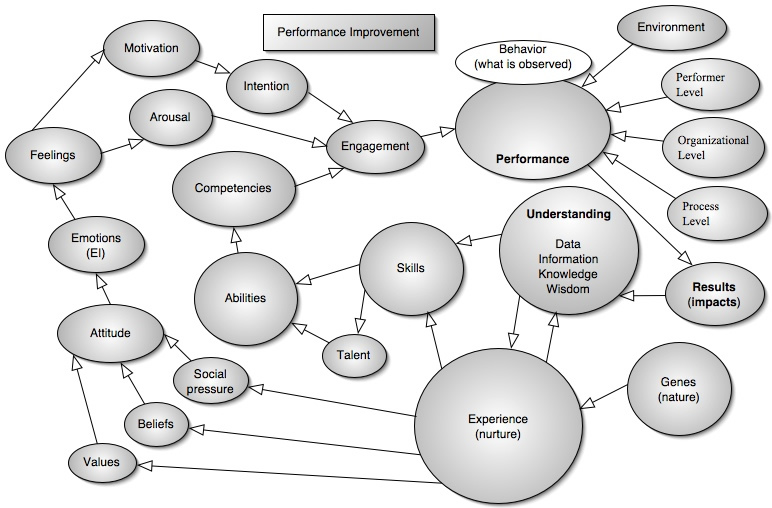
However, it does seem clear that people are able to influence others by pressuring them to act in a desired manner. Peer pressure is one example. However, this is mostly a youth phenomenon. The older we grow, the less influence our peers have over us.
As we grow older, we move into a new form of social pressure — organizational culture or corporate culture — the collective programming of the mind which distinguishes the members of one organization from another (Hofstede, 1997). The term organizational culture first appeared casually in the 1960s as a synonym for climate. The equivalent corporate culture was coined in the 1970s.
Organizations with strong cultures tend to have better control of their employees:
Without exception, the dominance and coherence of culture proved to be an essential quality of excellent companies. Moreover, the stronger the culture and the more it was directed toward the marketplace, the less need was there for policy manuals, organization charts, or detailed procedures and rules. In these companies, people way down the line know what they are supposed to do in most situations because the handful of guiding values is crystal clear. — Peters and Waterman
Norms
These cultures, social pressure, etc. are guided by norms -- rules or laws that members of a group follow. There are two forms:
- Informal norms: unwritten rules or standards that govern the behavior of a group. For example, drug cultures and peer pressure.
- Formal norms: official standards or laws that govern behavior. For example, traffic signals and safety codes.
References
Hofstede, G. (1997). Culture and Organizations: Software of the Mind, p. 180. New York: McGraw-Hill.
Matthews, G., Zeidner, M., Roberts, R. D. (2002). Emotional Intelligence: Science & Myth. Cambridge, Massachusetts: The MIT Press. p.151.
Thorndike, E. L. (1920). Intelligence and its uses. Harper's Magazine, 140, 227-235.