
Note: This site is moving to KnowledgeJump.com. Please reset your bookmark.
Organizations and Performance
The organization is part of an economic system. It responds to the marketplace, competition, fluctuating resources, etc. The survival of the organization depends upon its ability to adapt to the demands of this external system.
Geary Rummler and Alan Brache (1990) designed an overview of the means that could be used to improve the performance of an organizational. A matrix is used to show the overview:
The Three level Framework
| Goals | Design | Management | |
| Organization Level | Organization Goals | Organization Design | Organization Management |
| Process Level | Process Goals | Process Design | Process Management |
| Job/Performer Level | Job Goals | Job Design | Job Management |
Organizations are divided into three levels, Organizational , Process, and Job or Performer. At each level,you need to define goals and measures, indicate what was to be done (Design), and determine what level of management is responsible for making sure the change happens.
Organization Goals
At the organization level, goals are strategic in that they identify the organization's:
- Product and services
- Market (customer)
- Competitive advantage
- Priorities
Organization Design
The design of an organization allows the goals to be met. The main tool used is a relationship map that looks at the flows among major groups, rather than specific activities. That is, it creates a broad picture of the organization. The map is constructed by identifying the various units, functions, departments, or individuals expected to participate in or impact the process. below is an example of one:
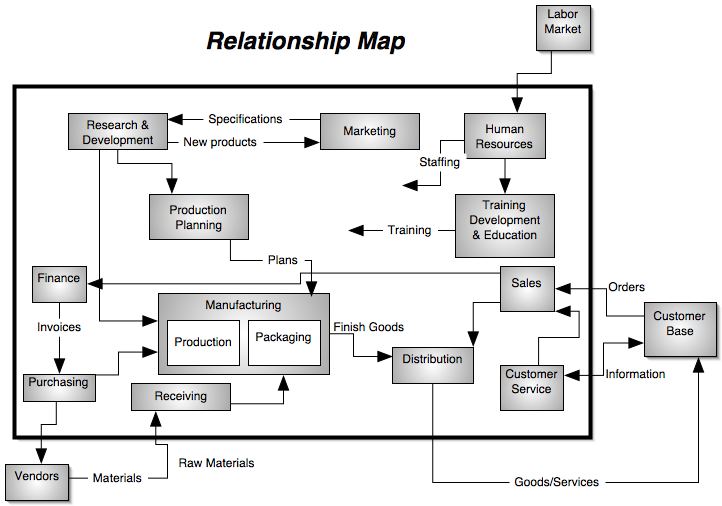
The relationship map is used to help understand how the work is currently getting done so that "disconnects" can be discovered and fixed. Disconnects are missing, confusing, unneeded, or misdirected inputs or outputs.
Organization Management
Once the goals and design or structure has been identified, then the organization needs to be managed in four dimensions:
- Goal - manage function sub-goals so that organization goals get accomplished.
- Performance - getting customer feedback, tracking actual performance, comparing the performance to set targets, taking corrective action where needed, and resetting goals.
- Resource - manage people, equipment, and money.
- Interface - manage the "white space" between the various functions or business units.
For more information, see the Leadership Guide.
Reference
Rummler, G. & Brache, A., (1990). Improving Performance: How to Manage the White Space on the Organization Chart. San Francisco: Jossey-Bass.