
Note: This site is moving to KnowledgeJump.com. Please reset your bookmark.
Experience and Performance
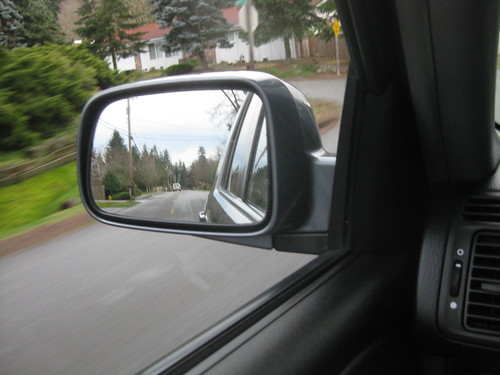
The past went that-a-way. When faced with a totally new situation, we tend always to attach ourselves to the objects, to the flavor of the most recent past. We look at the present through a rear-view mirror. We march backwards into the future. — Marshall McLuhan & Quentin Fiore in The Medium is the Massage: An Inventory of Effects
Body/Mind Dichotomy
We tend to separate the mind from the body, which is often referred to as the Cartesian split or dualism.
I think, therefore I am. — Descartes
Descartes assumed that the thinking self is independent of body or matter, thus true knowledge can only be obtained by the mind, not the body. However, the most powerful form of learning is by bodily experience. For example, we learn to eat, walk, and talk through experiences. Learning by doing is equivalent to internalization, which is the conversion of explicit knowledge into tacit knowledge.
The oneness of mind and body. — Eisai (one of the founders of Zen Buddhism)
The Mind/Brain Connection
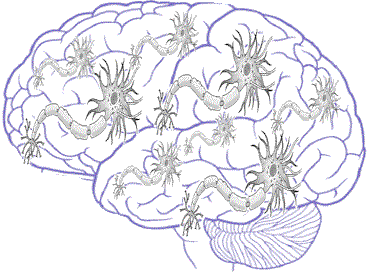
The adult human brain contains about 11 billion cells called neurons and each neuron may have up to 10,000 connections with other neurons called synapses. One of the main theories held by neuroscientists, psychologists, and even some philosophers is that all knowledge and skills is a function of neurons and their synapses. Our brain captures certain aspects of each experience by eliminating certain neurons and synapses. That is, it works backwards when compared to a production factory. For example, to make a radio, you assemble components, while the brain works more like an artist sculpturing from a rock — certain pieces are chipped away.
Psychologist William Greenough of the University of Illinois has found that there is a rapid spurt of synapses during the first couple of months during a rat's life that occurs regardless of the amount or type of sensory experience. This period of synaptic blooming is followed by a period of sharp decline. This is, there is a pruning of synapses that occur based upon the activity of the brain. This is called experience-expectant learning (Cziko, 2000)
Experiential or Experimental
Is it experiential or experimental? The learning/training/performance community seems to use the words almost interchangeably. However, they do have different, but similar meanings:
- Experiential - relating to or resulting from experience (this seems to be the more popular expression)
- Experimental - relating to or based on experiment
Kolb mainly uses the term “experiential” as his theory is based more on reflection of experiences. While others use “experimental” when referencing experimental-inquiry techniques that requires learners to test hypothesis (experiment) about content knowledge.
References
Cziko, Gary (2000). The Things We Do. Cambridge, Massachusetts: The MIT Press. (free download - http://faculty.ed.uiuc.edu/g-cziko/twd/pdf/index.html)