
Note: This site is moving to KnowledgeJump.com. Please reset your bookmark.
Roots and Connections of ISD - 1940s to 1960s
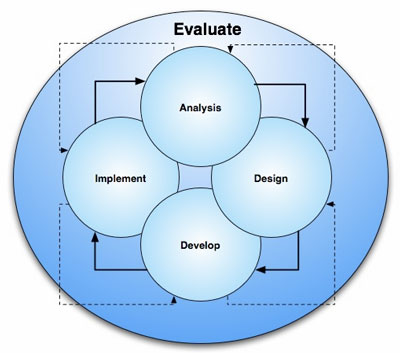
While Ludwig von Bertalanffy created the general systems theory in the 1950's, it took several others to create a few basic instructional, learning, and training concepts that tied system theory to the ISD or ADDIE model that we know today.
Robert Gagnè - Instruction Design - 1965
The direct theoretical basis of ADDIE or ISD is the cognitive theory of Robert Gagnè in that it classified learning outcome into five domains of learning (Hannum, 2005; Gagnè, Briggs, 1974):
-
Verbal information: 1) labels and facts, 2) bodies of knowledge
-
Intellectual skills: 1) discrimination 2) concrete concept 3) rule using and 4) problem solving
-
Motor skills: bodily movements involving muscular activity
-
Attitudes: an internal state which affects an individual's choice of action toward a person or object
-
Cognitive strategies: an internal process by which the learner controls his/her own ways of thinking and learning
In addition, Gagnè's Nine Steps of Instruction's provides ISD with instructional techniques::
-
Gain attention: Present a problem or a new situation.
-
Inform learner of Objective - Allows the learners to organize their thoughts and around what they are about to see, hear, and/or do.
-
Stimulate recall of prior knowledge. Allows the learners to build on their previous knowledge or skills.
-
Present the material - Chunk the information to avoid memory overload and blend the information to aid in information recall.
-
Provide guidance for learning - This is not the presentation of content, but rather the instructions on how to learn.
-
Elicit performance - Practice by letting the learner do something with the newly acquired behavior, skills, or knowledge.
-
Provide feedback - Show correctness of the learner's response, analyze learner's behavior.
-
Assess performance - Test to determine if the lesson has been learned.
-
Enhance retention and transfer - Inform the learner about similar problem situations, provide additional practice, put the learner in a transfer situation, review the lesson.
B.F. Skinner - Behaviorism and Programmed Instruction - 1940s
While ISD is now mainly based on cognitive theory as noted above, it still somewhat influenced by behaviorism. Although John B. Watson founded behaviorism, B. F. Skinner refined and popularized it. His book, Walden Two, shows how behaviorism's principles could be applied to society. His later book, Beyond Freedom and Dignity, is an analysis of culture and becomes a best seller.
Skinner's main principle, operant conditioning differs from classical conditioning in that operant conditioning applies to voluntary behavior, while classical conditioning applies to reflexes. Its influence on ISD in that behavior, in this case learning, can be influenced by manipulating the environment. That is, put the correct system or process in place and you can provide an environment for learning.
Skinner's second contribution is programmed learning that is characterized by clearly stated behavioral objectives, small frames of instruction, self-pacing, active learner response to inserted questions, and immediate feedback regarding the correctness of a response. Individualized instruction in essence replaces the trainer with systematic or programmed materials.
Benjamin Bloom - Taxonomy of Intellectual Behaviors - 1956
Bloom's (1956) Taxonomy of Educational Objectives is also a popular cognitive theory that is often used by instructional designers.
For more information, see Bloom's taxonomy.
Robert Mager - Learning Objectives - 1962
Robert Mager's (1962) learning objective is perhaps the key cornerstone of ISD as it gives the system a purpose. A learning or performance objectives allows everyone involved with the learning process know what the learners must be able to perform once they have completed the learning process. It is composed of three parts:
-
Observable Action (task) - This describes the observable performance or behavior. An action means a verb must be in the statement, for example “type a letter” or “lift a load.” Each objective covers one behavior, hence, only one verb should be present. If the are many behaviors or the behaviors are complicated, then the objective should be broken down into one or more enabling learning objectives that supports the main terminal learning objective.
-
At Least One Measurable Criterion (standard) - This states the level of acceptable performance of the task in terms of quantity, quality, time limitations, etc. This will answer any question such as “How many?” or “How well?” For example “At least 5 will be produced,” “Without error.” There can be more than one measurable criterion. Do not fall into the trap of putting in a time constraint because you think there should be a time limit or you cannot easily find another measurable criterion. Use a time limit only if required under the normal working standards.
-
Conditions of performance (usually) (condition) - Describes the actual conditions under which the task will occur or be observed. Also, it identifies the tools, procedures, materials, aids, or facilities to be used in performing the task. This is best expressed with a prepositional phase such as “without reference to a manual” or “by checking a chart.”
Robert Glaser - Testing - 1962
Robert Glaser was the first to use the term criterion-referenced measure. Glaser indicated that such instruments could be used to assess student entry-level behavior and thus, determine the extent to which students had acquired the needed behaviors or objectives. Such measurements not only allowed one to test the learners, but also test the system.
Next Steps
Next Section: Ludwig von Bertalanffy - General System Theory - 1950
Return to: History of Instructional System Design
See the ADDIE Timeline
Reference
Bloom B. S. (1956). Taxonomy of Educational Objectives, Handbook I: The Cognitive Domain. New York: David McKay Co Inc.
Gagnè, R.M. (1965). The Conditions of Learning. New York: Holt, Rinehart & Winston.
Gagnè, R.M. and Briggs, L J. (1974). Principles of Instructional Design (2nd ed.). Holt, Rinehart, and Winston.
Glaser, R., & Klaus, D. J. (1962). Proficiency Measurement: Assessing Human Performance. In R.M. Gagnès (Ed), Psychological Principles in System Development. New York: Holt, Rinehart and Winston.
Hannum, W. (2005). Instructional Systems Development: A 30 Year Retrospective. Educational Technology, 45(4), 5-21.
Mager, R. F. (1962). Preparing Instructional Objectives. Palo Alto, CA: Fearon Publishers.