
Note: This site is moving to KnowledgeJump.com. Please reset your bookmark.
Bela Banathy - Instructional Systems - 1968
In 1968, Bela Banathy writes one of the first books totally dedicated to Instructional System Design. His model edges closer to the present ADDIE or ISD model by providing the following concepts:
-
Formulate Objectives
-
Develop a Criterion Test
-
Analyze Learning task
-
Design Training or Learning System
-
Implement and test output
-
Change to Improve
Banathy's Model of the Design of Instructional Systems Model (p .83)
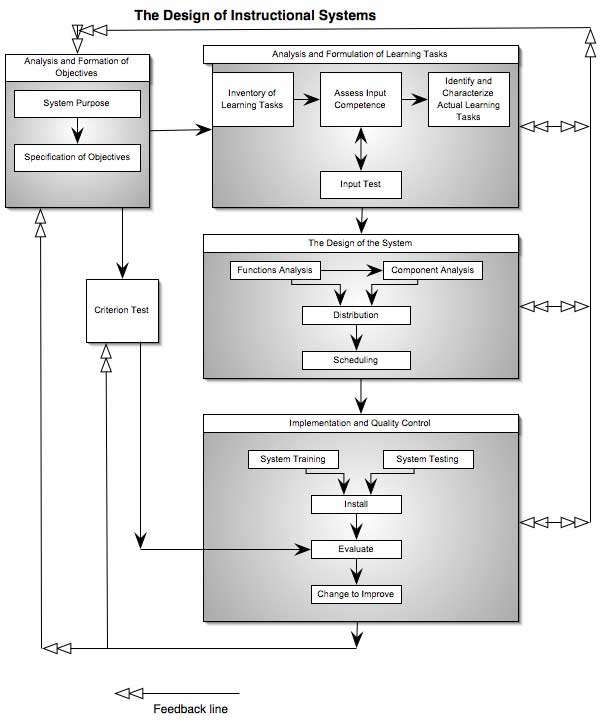
What is interesting about this early model is that just like the ADDIE model, developing the test is performed immediately after the objectives are built. In addition, although he does not use the same ADDIE terms, it has a similar flow to it in that it follows most of the same phases and steps.
Banathy writes that systems have:
-
Purpose: What has to be done.
-
Process: The operations and functions that are engaged to accomplish the purpose
-
Content: The parts that comprise the system.
Note that the sequence of purpose, processes, and content is important because it implies priorities.
Banathy also recognizes that the purpose of the instructional system is learning (p.24), rather than instruction. He writes that if a learning environment was the true focus, then rigid scheduling would be eliminated because we learn at different time rates. In addition, the learner would be on stage, rather than the teacher (who is there to help manage the learning environment) — or as we now say, a guide on the side rather than a sage on the stage.
Banathy continues with this active learner role by describing Hedegard's juxtaposition of two educational systems
-
In the first, the learner reacts to the teacher's active role. The teacher selects content and experience and the learner reacts to them. The teacher's thought processes involve organization, while the learner passively connects them. In addition, a learner's unique motives are rarely accepted or encouraged.
-
In the second system, the learner plays an active role in selecting content and learning experiences while the learner's thought processes involves organization.
Banathy further writes (p. 61) that a systems approach is multi-directional, in that it not only allows feedback, but it also has feed-ahead or feed-forward strategies for selecting learning experiences. Thus, instructional systems are dynamic, rather than linear as some people would like us to believe.
Next Steps
Next chapter: ADDIE Timeline
Return to the History of Instructional System Design:
- Roots of Instructional System Design
- Ludwig von Bertalanffy General System Theory
- Psychological Principles in System Development
- Robert Glaser - Instructional System
- The Air Force's Five Step Approach
- Saettler's History of Instructional Technology
- George Odiorne - A System Approach to Training
- Bela Banathy - Instructional Systems
- ADDIE Timeline
- The Dick and Carey Model of ISD
- The ABCs of ISD
- ADDIE the Acronym
- The Attack on ISD
- A Hard Look at ISD
- ISD at Warp Speed
Reference
Banathy, B. (1968). Instructional Systems. Palo Alto, California: Fearon Publishers.
Notes
A few of the more interesting references that Banathy cites in his book that are directly related to ADDIE or ISD:
Gagne, R.M. (1965). The Conditions of Learning. New York: Holt, Rinehart & Winston.
Mager, R.F. (1962). Preparing Instructional Objectives. Palo Alto, CA: Fearon Publishers.
Odiorne, G.S. (1965). A Systems Approach to Training. Training Director's Journal,19,10,11-19.
von Bertalanffy, Ludwig (1950). An Outline of General Systems Theory. British Journal of Philosophical Science, 1:148.