
Note: This site is moving to KnowledgeJump.com. Please reset your bookmark.
The Air Force's Five Step Approach - 1965
According to the U.S. Air Force's Instructional System Development manual (1993), they developed its first major instructional system in 1965. In 1970 it evolved that system into the Five-Step Approach that provides providing feedback, constraints, and flexibility.
While it is not ADDIE, it comes very close to having the look and feel of it as shown in the model below:
The Five-Step Approach Model
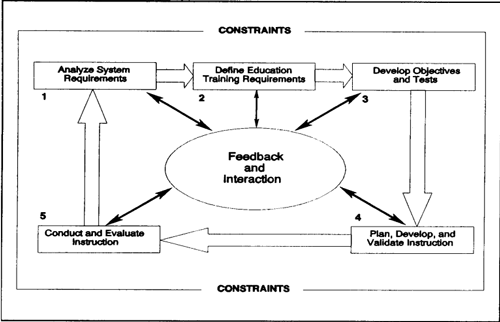
Major Phases of the Five Step Approach
-
Analyze System Requirements: This is done through occupational, job, and task analyses which result in statements of behavior, conditions, and standards for task performances.
-
Define Education and Training Requirements: This step includes a needs analysis to determine if training is needed, assessment of target population characteristics, and selection of tasks for instruction through consideration of such factors as criticality, learning difficulty, and frequency of performance.
-
Develop Objectives and Tests: The developer writes the three-part objectives that define what the students should be able to do after instruction, the conditions under which they may perform, and the acceptable standard of performance. The developer then writes test items to measure student performance on each objective.
-
Plan, Develop, and Validate Instruction: In this step, the developer designs and produces course materials. The developer tries these materials out on students using the criterion test items to ensure that the students can achieve course objectives.
-
Conduct and Evaluate Instruction: The course is fielded. Evaluation of instructional effectiveness continues for the life of the course and identifies needs that may develop for improving or updating the instruction.
Feedback and Constraints
The model shows 1) how the ISD process uses feedback and interaction among the functional blocks of activities to allow for continuous improvements to the products, and 2) how environmental constraints limit the designers' choices to what is possible.
Flexibility
The process allowed instructional developers to enter or reenter the steps of the ISD process as necessary to develop, update, or revise the instructional system. The Air Force model worked well and was considered adequate. It supported an instructional system that was focused primarily on classroom education and technical training delivered by an instructor using the lecture/demonstration method.
Next Steps
Next section: Saettler's History of Instructional Technology - 1968
Return to the History of Instructional System Design
Reference
U.S. Air Force (1993). Instructional System Development. AFM 36-2234.
U.S. Air Force (1970). Instructional System Development. AFM 50-2. Washington DC: U.S. Government Printing Office.