
Note: This site is moving to KnowledgeJump.com. Please reset your bookmark.
The ABCs of ISD - 1982
In the December 1982 edition of Training and Development Journal, Marc J. Rosenberg pens an article titled The ABCs of ISD in which he makes four interesting observations.
Front-End Analysis
There are often alternative methods to solving organization problems, such as organizational redesign, motivation strategies, and changes in reward structures, that may be more effective and cheaper than training. Thus, it is vital that a front-end analysis is performed in order to determine the best solution, rather than just selecting a learning program because it was the first idea generated.
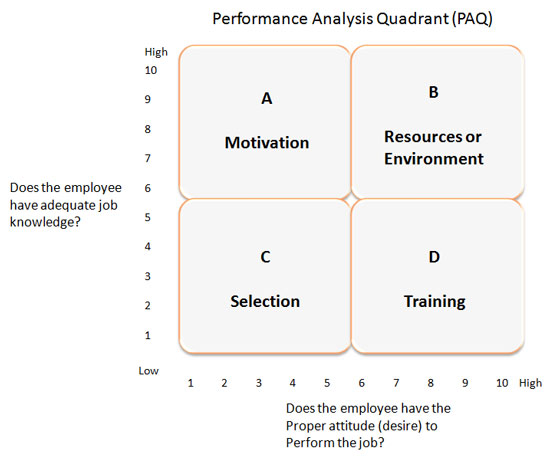
In addition, managers will often say they have a training problem even though it might be a different performance problem. A good tool for identifying the type of performance the problem falls under is the The Performance Analysis Quadrant.
Organization, Learner, and Job Needs
The ISD or ADDIE model requires that potential training problems be analyzed to determine their exact nature. And while there may be a variety of factors to consider, the ISD model centers around three needs:
- Organizational needs are normally the most nebulous to assess because they are often quite vague or global in nature, such as “improve production” or “be a leader in our market.” However, they can affect decisions about the learning program, such as who gets trained and the resources allocated to training, thus they provide an important perspective for the rest of the ISD process.
- Learner needs are more specific, such as assessing previous experience and determining present performance deficiencies.
- Job needs are analyzed to determine the exact performance requirements (task analysis).
In 2002, Phillips and Phillips identified four needs.
Prototypes
In the development phase, developmental testing or prototyping (Iterating) is used to test the instructional material to ensure they work as intended and to pinpoint if any process improvements can be made.
Relationship of Events
The ISD model is more than a sequence, rather it is a relationship of events.
It is this relationship which makes the model so effective in its application to training development. It ensures that a decision to develop training is based upon the realistic and identifiable needs of the organization, the learner, and the job. - Marc J. Rosenberg Training and Development Journal (Dec 1982).
Next Steps
Next section: ADDIE the Acronym - 1995
Return to the History of Instructional System Design:
- Roots of Instructional System Design
- Ludwig von Bertalanffy General System Theory
- Psychological Principles in System Development
- Robert Glaser - Instructional System
- The Air Force's Five Step Approach
- Saettler's History of Instructional Technology
- George Odiorne - A System Approach to Training
- Bela Banathy - Instructional Systems
- ADDIE Timeline
- The Dick and Carey Model of ISD
- The ABCs of ISD
- ADDIE the Acronym
- The Attack on ISD
- A Hard Look at ISD
- ISD at Warp Speed
Reference
Phillips, J., Phillips, P. (2002). Reasons Why Training & Development Fails... and What You Can Do About It. Training Magazine, September 2002, pp.78-85.
Rosenberg, M.J. (1982). The ABCs of ISD. Training and Development Journal, 36(9), 44-50.