
Note: This site is moving to KnowledgeJump.com. Please reset your bookmark.
Task Analysis in Instructional Design
A task analysis is a systemic collection of data about a specific job or group of jobs to determine what an employee should be taught and the resources he or she needs to achieve optimal performance (DeSimone, Werner, Harris, 2002).
In the Backwards Planning model shown below, the first step in the Analysis phase, Business Outcome, identified the Business Need, the second step, Performance Analysis identified the performance that is needed to obtain that objective, and the third step, Needs Assessment, identified the various Learning and Training Needs.
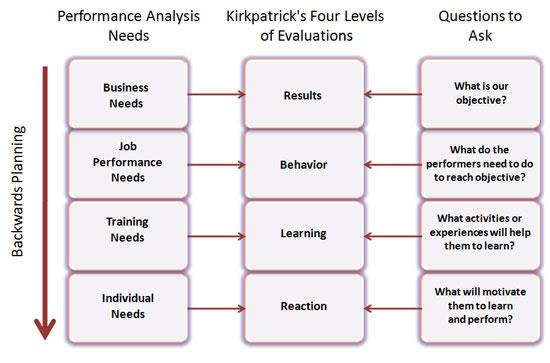
The Task Analysis performed in this phase further defines the Training or Learning Needs by supplying the required process and/or steps to perform a task. In addition, it should focus on how important the task is to both managers and performers, who will aid in the last backwards planning step — Individual Needs. Learners are mainly motivated by both by what they see as important AND what their managers see as important.
While the previous steps in the Analysis Phase helped you determine the performance requirements and formal and informal learning needs, this step supplies the basic information for designing and building the learning platform, which are discussed in the Design and Development phases.
Information Supplied by a Task Analysis
The Task Analysis sequences and describes measurable behaviors involved in the performance of a task. It also provides a detailed analysis of each task in terms of frequency, difficulty and importance. The analysis normally begins by observing and interviewing an exemplary performer (a person who is presently an expert performer) performing the task or by discussing the problem with other experts as discussed in the Needs Assessment.
Items to Capture
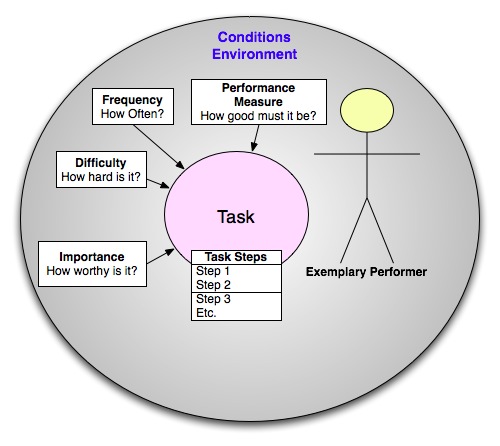
The following must be captured during this step of the Analysis Phase:
- Conditions: Tools or equipment needed and the environment the task is performed in.
- Performance Measure: How well must it be performed? Note that this sub-step is discussed in more detail in the next step, Build Performance Measures.
- Frequency: How often is the task performed (hourly, daily, weekly, etc.)?
- Difficulty: Use a standard scale, such as from one to five.
- Importance: What place of importance is this task as compared to the performer's other tasks?
- Steps: Logical steps for performing the task.
Drivers of Performance
To increase the effectiveness of a task analysis, focus on the driver of performance (Rossett, Sheldon, 2001):
- Focus on Individuals
- skills, knowledge, expectations, information
- motivation
- Focus on Culture
- environment
- incentives
When selecting tasks to be trained, consider the following factors:
- What will happen if we do not train this task?
- What will be the benefits if we do train this task?
- If we don't train it, how will the employees learn it?
- How will the learning platform help to achieve our business goals?
- Is training needed to ensure their behavior does not compromise the company's legal position, i.e., Occupational Safety and Health Act, Equal Employment Opportunity, labor relations laws, or state laws?
- Can people be hired that have already been trained?
Listed below are some suggested questions that might need to be asked:
- How critical is the task to the performance of the job?
- To what degree is the task performed individually, or is part of a set of collective tasks?
- If it is part of a set of collective tasks, what is the relationship between the various tasks?
- What is the consequence if the task is performed incorrectly or is not performed at all?
- To what extent can the task be trained on the job?
- What level of task proficiency is expected following training?
- What information is needed to perform the task? What is the source of information?
- Does execution of the task require coordination between other personnel or with other tasks?
- Are the demands (perceptual, cognitive, psychomotor) imposed by the task excessive?
- How much time is needed to perform this task?
- What prerequisite skills, knowledge, and abilities are required to perform the task?
- What behaviors or outcomes distinguish good performers from poor performers?
Next Steps
Go to the next section: Build Performance Measures
Read more about Tasks
Read Task Analysis Tools: Various Approaches for Analyzing Tasks
Analysis Templates (contains several analysis templates)
Return to the Table of Contents
Pages in the Analysis Phase:
-
Task Analysis
References
Rossett, A., Sheldon, K. (2001). Beyond the Podium: Delivering Training and Performance to a Digital World. San Francisco: Jossey-Bass/Pfeiffer
U.S. Army Field Artillery School (1984). A System Approach To Training. ST- 5K061FD92
U.S. Department of Defense Training Document (1975). Pamphlet 350-30. August, 1975.
DeSimone, R.L., Werner, J.M., Harris, D.M. (2002). Human Resource Development. Orlando, FL.: Harcourt, Inc.