
Note: This site is moving to KnowledgeJump.com. Please reset your bookmark.
Instructional, Learning, and Performance Design
Welcome to Big Dog and Little Dog's guide to Instructional Design, Learning Processes, and Performance Support
Instructional Design

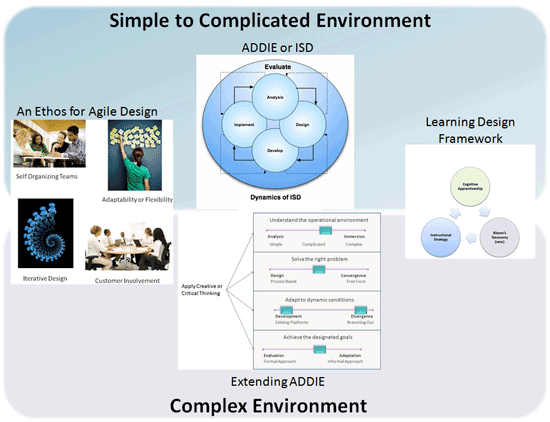
Instructional System Design Manual (ISD) — A complete guide to ISD or ADDIE method (analysis, design, develop, implement or delivery, and evaluation).
Instructional Design Framework — A framework for designing learning environments.
Agile Design: An Ethos for Creating Learning Platforms — Rapid instructional design for agile, blended learning.
Extending Instructional System Design — How to move beyond ISD.
The above four guides compose an effective framework for designing learning environments. To learn how they fit together, it is recommended that you read A Framework for Designing Learning Environments (it's a short read):
Instructional Design — Includes difference between ISD (Instructional System Design) and ID (Instructional Design).
Cognitive Task Analysis in Instructional Design: Mapping the Performance
A Table of Five Design Models: ADDIE, Design Thinking, Agile Design, System Thinking, and X Problem?
ADDIE Backwards Planning Model — An interactive map for using ADDIE to reach your performance and learning goals
Bloom's Taxonomy of Learning Domains
A guide to eLearning
Without any training
It's pouring, it's raining
Training or a trade
Hey you bet I'm afraid
Unequipped with a skill
But I'm thrilled with the thrill
Under skilled, unprepared
Hey, who wouldn't be scared?
— The Mighty Mighty Bosstones —
Noise Brigade — Let's Face It
Learning
Mapping Pedagogies in Learning/Instructional Design
Media, Strategies, and Methods:
Learning through Researching: Adaptive and Adoptive Learning Methods
Performance Tools

Two Dimensional Performance Modeling
A Trainer's Toolbox of Templates and Outlines
Learning Organization Profile (for information, see The Learning Organization)
Icebreakers, Reviewing, and Motivation Activities
Eclectic Collection
History of Learning and Instructional Design:
-
ISD Timeline — The growth of ISD
-
ADDIE Timeline — The growth of the ADDIE model
Learning Statistics, Myths, and Benchmarking
Estimating Design Cost and Development Times
Left Brain, Right Brain Metaphor
What Does the "A" in KSA Really Mean (Knowledge, Skills, Attitude)?
Karl Popper's the Three Worlds of Knowledge
Examples of Instructional Design Activities
Using matched example/non-example pairs - Positive Reinforcement
Role Play - Counseling
Fishbowl - Appraisals
Self-reflection surveys and questionnaires for critical thinking:
Definitions
Reading Lists
Other Useful Pages
Train-the-Trainer Degrees, Certificates, Workshops, and Courses