
Note: This site is moving to KnowledgeJump.com. Please reset your bookmark.
Performance Analysis in Instructional Design

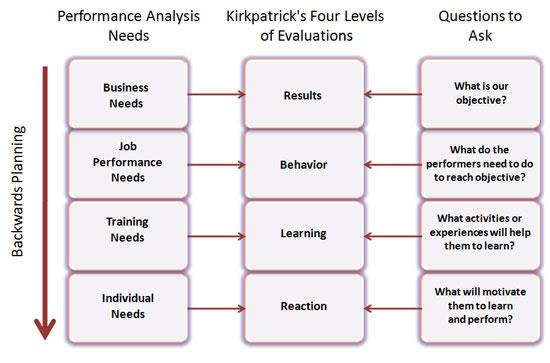
While the first step in the Analysis Phase, Business Outcome, determined the desired goals to improve the organization, this step, Performance Analysis, determines the exact cause of the performance deficiency that is preventing the organization from reaching its objectives and then identifying the performance required to reach the objective. This is shown in the backwards planning model (the second level from the top):
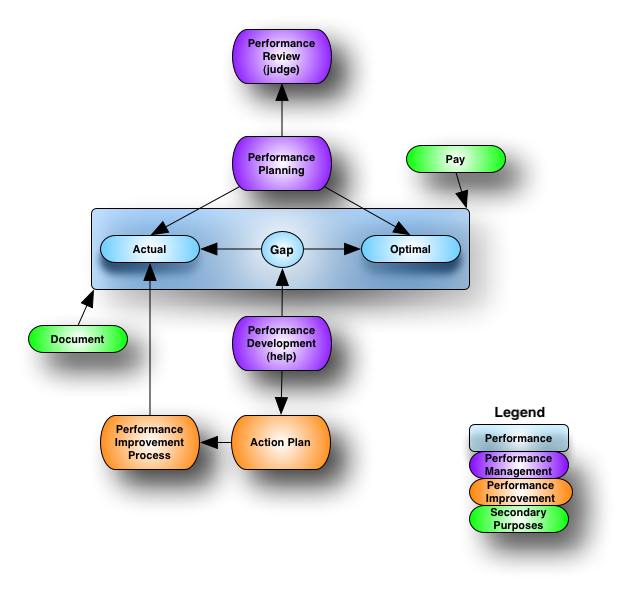
The Business Outcome or Business Linkage is used to spell out how a learning initiative supports the organization's initiatives, strategies, or goals (Garnevale, Gainer, Villet, 1990). That is, the learning initiative needs to correct a performance gap — the difference between the present performance and the desired or optimal performance:
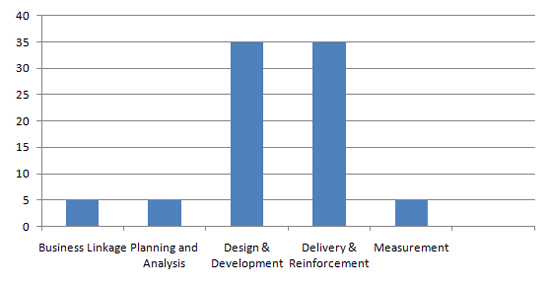
Business linkage is a “high value add”, which is defined as the difference-making in a business that it adds value. Yet, defining how learning initiatives link to other business units is one of the activities that designers normally spend the least amount of time on. We normally spend an enormous amount of time on designing and delivering our learning programs, but conversely, we often fail to determine exactly how it impacts the organization. Thus, we spend the least amount of time on the most important activity seen by our customers who want to know how the resources spent on learning and training platforms will help them?
The chart below shows the average percent of time for creating a learning platform. As shown, most training activities spend very little of their time showing their customers how their efforts add value to their clients (Trolley, 2006).
Since each customer is different, you have to ask them what their expectations are and how they would measure success (Trolley, 2006). If they do not see the learning programs benefiting them, then they are going to start picturing your department as a consumer of the organization's resources rather than a resource that produces valuable assets.
The Performance Analysis Quadrant
Customer or clients will often present a performance problem as a training problem, thus the need to fully analyze the problem in order to determine its root cause. The tool shown below helps to narrow the root cause of a performance problem. When facing a performance problem, two questions are asked:
- “Do the employees have adequate job knowledge?”
- “Do the employees have the proper attitude (desire) to perform the job?”
Next, a numerical rating between 1 and 10 is given for each answer (one is the lowest rating, while ten is the highest). This will place the employees in one of the four performance quadrants:
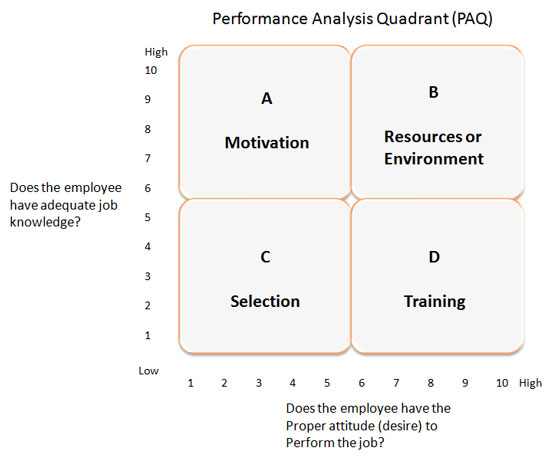
The quadrant that they land in informs you of the performance initiative required:
- Quadrant A (Motivation): If the employee has sufficient job knowledge, but has an improper attitude, this may be classed as motivational problem. The consequences (rewards) of the person's behavior will have to be adjusted. This is not always bad as the employee just might not realize the consequence of his or her actions.
- Quadrant B (Resource/Process/Environment): If the employee has both job knowledge and a favorable attitude, but performance is unsatisfactory, then the problem is out of control of the employee. Some examples are, a process or procedure needs to be improved, lack of resources or time, or the work station is not ergonomically designed.
- Quadrant C (Selection): If the employee lacks both job knowledge and a favorable attitude, that person may be improperly placed in the position. This may imply a problem with employee selection or promotion, and suggests that a transfer or discharge be considered.
- Quadrant D (Training): If the employee desires to perform, but lacks the requisite job knowledge or skills, then learning needs to occur, such as performance aids, training, coaching, etc.
If the problem lies in Quadrant D, Training, then this guide on ISD (ADDIE) can be used. If not, then you need a different performance solution model.
Note: The four quadrants are based on Jones' (1993) description of the four factors that affect job performance.
Is it a Training Problem?
The performance problem chart shown below can also be used to help determine if the problem is a training or another performance problem (Laird, 1985, p63).
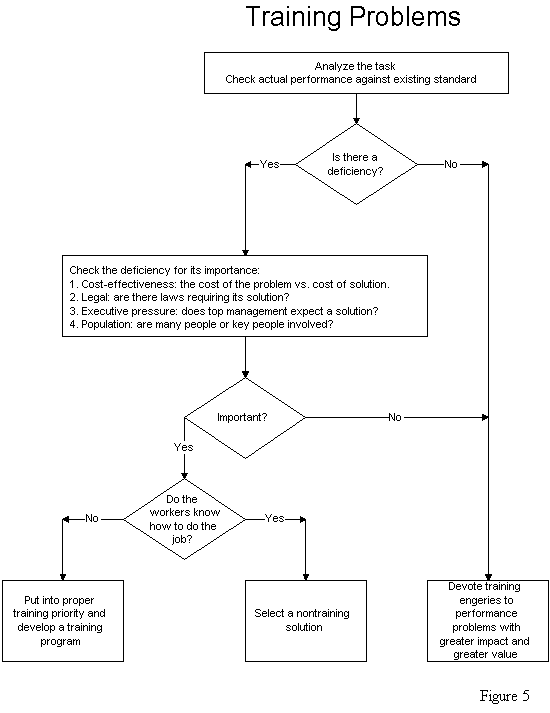
Yes, it is a Training /Learning Problem
When developing training solutions, base your decisions on the appropriate analysis techniques discussed in this chapter. The urgency of the problem might lead you to curtail all design and development techniques, however, this should not be done as you could end up with a bigger problem than what you started with. Follow the model and adjust it as your instinct and experience tells you to. Once you have a solution designed and implemented, evaluate it, and then fine-tune it. As Seth Godwin wrote:
Here's what we used to do:
Create —> Edit —> Launch
Here's what happens now:
Create —> Launch —> Edit —> Launch —> repeat
Scope
You should also understand the scope of the system or process. The scope of a system is the system's boundaries. For example, you are analyzing a production department and you notice that it takes many supplies to keep it operating, such as raw material to make the product, cleaning supplies, maintenance supplies, etc. Don't get led off into studying the inventory control department, unless you are sure it is the source of the problem. They are probably two entirely different systems or processes. Stay within one process at a time until you thoroughly understand it.
A process is a planned series of actions that advances a material or procedure from one stage of completion to the next. The beginning of a process starts with a trigger that causes a specific action to be taken by a person, another process, or work group. The ending occurs when the results get passed on to another person, process, or work group.
Knowing the basics of a system enables you to understand the tasks that lay ahead. Although you are interested in the system as a whole, so that you may understand its purpose and goals, the main emphasis of this initial research should be on the people within the system. You need to learn as much about the proposed learners (target population) as possible. The target population data is essential and most useful when making decisions about the proposed solution. You must understand the people issues! This is the biggest variable in a training program . . . and one of the hardest parts of a training program to account for. Statisticians can tell you every fact you want to know about the average person — but I dare you to find a real live average person. Listed below are some of the aspects you should be looking for:
- Anticipated number of learners
- Location of learners
- Education and experience of the learners
- Background of learners
- Experience in present or related jobs
- Job performance requirements versus present skill levels
- Language or cultural differences of learners
- Motivation of learners
- Physical or mental characteristics of learners
- Interests or biases of learners
Invite the client manager and supervisors to lunch or meet on a regular basis. Guide them into them discussing their problems and frustrations. Managers do have time for short encounters, and most of them actually like the opportunity to discuss their issues. However, they do not have the time or resources to tackle a training needs analysis project. That is the designer's job.
During the meeting, do not mention training or methods for solving performance problems. Your job is to guide, listen, and interpret. Once the lunch or meeting is over, reflect on what was said and use that information in your analysis. When it is time to brief them on your initial analysis project, show how the training department can help with some of their problems.
Next Steps
Go to the next section: Needs Assessment
Return to the Table of Contents
Analysis Templates (contains several analysis templates)
Pages in the Analysis Phase:
-
Performance Analysis
References
Garnevale, A., Gainer, L., Villet, J. (1990). Training in America: The Organization and Strategic Role of Training. San Francisco: Jossey-Bass.
Jones, B. (1993). The four domains affecting job performance. Internal Document, Delta Air Lines. Moving from Theory to Practice: Integrating Human Factors into an Organization, Mancuso, V. (1995). Seattle, WA: Annual Flight Safety Foundation Conference. Retrieved from http://www.crm-devel.org/ftp/mancuso.pdf
Laird, D. (1985). Approaches To Training And Development (2nd ed). Reading, MA: Addison-Wesley.
Trolley, E. (2006). Lies About Learning. Larry Israelite, ed. Baltimore, Maryland: ASTD.