
Note: This site is moving to KnowledgeJump.com. Please reset your bookmark.
Determining Business Needs in Instructional System Design

Bridging the Performance Gap
Start with the End in Mind
To ensure you capture the business outcome or linkage, begin with the end in mind as a learning or performance initiative should be a means to an end. Thus, learning and performance initiatives need to show how they will improve the business or organization, such as increase revenue, reduce costs, or boost moral. For example, training salespeople in order to reduce the percentage who fail to make sales will both increase revenue through more sales and reduce turnover costs.
Mapping the pathway of a good training and development program would look something similar to this (Wick, Pollock, Jefferson, Flanagan, 2006):
Successful training and development → More effective and efficient performance → Improved business outcomes
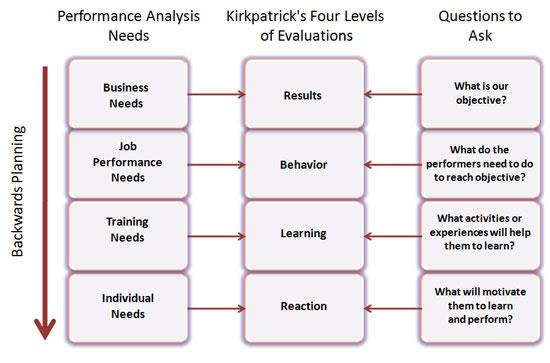
Since the flow of causality of the above pathway is from left to right, training must be planned in the opposite direction (backwards planning or design):
Desired business outcome → Required changes in performance to produce business outcome → Experiences and skills needed to produce the desired performance
Thus, designing a viable learning program should proceed in a manner similar to this:
- Analysis Phase: Determine the business outcome — How does it link to the business unit(s)?
- Design Phase: Determine required changes in the learner's performance.
- Development Phase: Create the experiences that will change the learner's performance.
- Implementation Phase: Provide support that encourges the learners to become expert performers.
Impact Mapping
Impact Mapping is a tool developed by Robert Brinkerhoff and Stephen Gill (1994) to ensure linkage between learning initiatives and business objectives. An Impact Map has three core elements: capability, performance, and results.
If we learn how to do something, we have the capability to perform in a new way. For value to occur, we have to change our behavior and use the new capability in performance. Further, our performance must be aimed at worthwhile results — Brinkerhoff and Apking.
Part of an impact map for Customer Service Reps would look similar tothis:

- The capability is the New Knowledge and Skills
- The performance is the Job Behaviors
- The results are the Job Success Indicators, which in turn creates the Business Objective
Backwards Planning
The Impact Map shown above can be used in conjunction with the Backwards Planning model that was introduced in the Introduction to Analysis section. In this step, Determining Business Needs or Outcome, the desired result or objective is spelled out in detail and agreed upon by both the Business Unit and the Learning/Training Department. The next step in the Analysis Phase will identify the performance (Behavior) that is needed to obtain this objective:
Customer Understanding and Agreement
To reach a common understanding of the required outcomes between the training team and business line-leaders, you should define the following activities and ensure your customers understand and agree to them:
- What business needs will be met?
- What will the learners/performers do differently and better?
- Who will be able to see and confirm these changes?
- How will we measure and document the results?
Learning initiatives should always be undertaken to improve the performance of the business, thus they should always be defined in business terms. An ROI (Return On Investment) is not normally required, and in some cases is not even cost-effective; however there should always be a clear causal link.
For example, frequent feedback to subordinates is normally considered a means for promoting better performance, which should equate to higher profits. Thus, “the students will learn feedback skills” is NOT a business outcome as it does not relate to a verifiable outcome.
A better business outcome would be “the learner's subordinates receive frequent and better feedback” as a result of the learning initiative. The first outcome only told us what will be learned, while the second outcome gives us a result than can be measured and verified.
The Business Outcome or Business Linkage should be one of the first things to determine during the analysis phase. However, to fully understand it, you might have to perform other steps in the analysis phase. In any case, it must be spelled out by the end of the analysis phase as this will determine if a learning or training platform is required.
Next Steps
Go to the next section: Performance Analysis
Return to the Table of Contents
Analysis Templates (contains several analysis templates)
Pages in the Analysis Phase:
-
Business Outcome
-
Return to the Table of Contents
References
Brinkerhoff, R., Gill, S. (1994). The Learning Alliance: Systems Thinking in Human Resource Development. San Francisco, CA: Jossey-Bass.
Garnevale, A., Gainer, L., Villet, J. (1990). Training in America: The Organization and Strategic Role of Training. San Francisco: Jossey-Bass.
Trolley, E. (2006). Lies About Learning. Israelite, L. (ed). Baltimore, Maryland: ASTD.
Wick, C., Pollock, R., Jefferson, A., Flanagan, R. (2006). Six Disciplines of Breakthrough Learning: How to Turn Training and Development Into Business Results. San Francisco: Pfeiffer.