
Note: This site is moving to KnowledgeJump.com. Please reset your bookmark.
Instructional Design

Scaffolding helps to build a framework for the learners
What is Instructional Design?
Instructional Design is defined as “a systematic process that is employed to develop education and training programs in a consistent and reliable fashion” (Reiser, Dempsey, 2007). In addition, it may be thought of as a framework for developing modules or lessons that (Merrill, Drake, Lacy, Pratt, 1996):
-
increase and enhance the possibility of learning
-
makes the acquisition of knowledge and skill more efficient, effective, and appealing,
-
encourages the engagement of learners so that they learn faster and gain deeper levels of understanding
In a nutshell, instructional design can be thought of as a process for creating effective and efficient learning processes. The list at the bottom of the page links to several types of instructional design processes. Some, such as Gagné and Keller, are concepts that work in most instructional design projects.
While other models are aimed at specific learning processes, such as van Merriënboer's 4C/ID model, which is used when the learners must master complex problem solving. Cognitive Task Analysis is even more specific — it is used to analyze tasks that are largely covert and nonprocedural in nature.
Learning can be quite complex, thus there is no one size fits all methodology. This is why instructional designers need to familiarize themselves with the various learning theories and concepts so that they can refer back to them when they experience new and/or complex design problems.
Differences Between Instructional Design and Instructional System Design
Instructional Design (ID) models differ from Instructional System Design (ISD) models in that ISD models have a broad scope and typically divide the instruction design process into the five phases of analysis, design, development, implementation, and evaluation that is often referred to as ADDIE (van Merriënboer, 1997). Reigeluth (1983) made the same point when he noted that ID models go into much more detail than ISD, albeit that detail has a narrower focus.
In addition, ISD models use both formative evaluations in all the phases and a summative evaluation at the end of the process. Examples of ISD models are ADDIE and the Dick and Carey model.
On the other hand, ID models are less broad in nature and mostly focus on analysis and design, thus they normally go into much more detail, especially in the design phase.
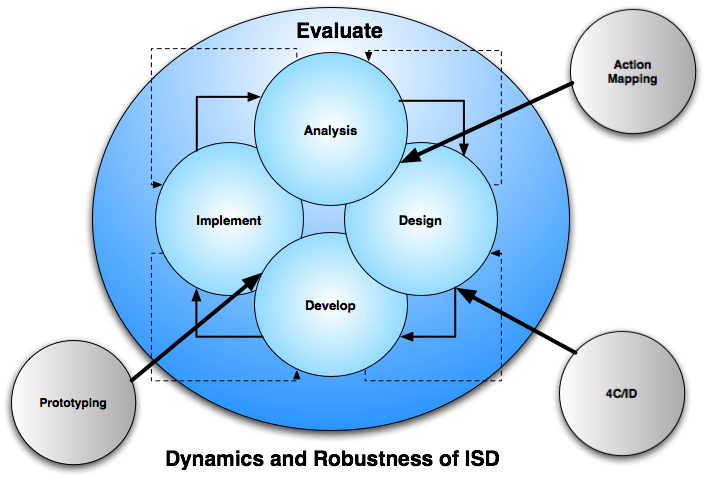
ID models are normally employed in conjunction with ISD models (van Merriënboer, 1997, pp 2-3). The ISD process keeps the entire training, development, or educational project on the correct path to reach the learning goals, while one or more ID models are used in conjunction that best supports the learning process being designed.
For example, you might use both ADDIE to ensure you reach your goal and 4C/ID to design the parts of the learning processes that require complex problem solving. This allows ISD to be similar to plug-and-play, in that you plug the needed ID theory into the ISD model as this example shows:
Strategies of Instructional Design
There are three types of learning strategies in Instruction Design — organizational, delivery, and management (Reigeluth, 1983):
1. Organizational
Organizational strategies are broken down on the micro or macro level so that the lesson may be properly arranged and sequenced. Some methods for performing this can be found at Sequencing and Structuring Learning Modules.
2. Delivery
Delivery strategies are concerned with the decisions that affect the way in which information is transferred to the learners. Delivery is the means of communicating and transferring a learning process to the learners. For example, you can deliver a lesson in the classroom or via elearning. This is quite similar to the concept of media. Some methods of delivery are:
3. Management
Management strategies involve the decisions and processes that allow the learners to interact with the learning activities in order that they may increase their knowledge and skills. Some of the strategies are:
Some other specific strategies, such as note taking and modeling, can be found in the following links (Marzano, 1998):
Should Instructional Design be called Learning Design?
Recently, there has been a strong movement to call Instructional Design “Learning Design,” with the premise that this will focus the process more on the learners rather than the content. However, others have criticized this because we cannot design learning as it is the outcome of good instruction, rather we can only design the instruction, which is a process.
Instructional Design Models and Theories
The major instructional design theories and/are models include:
- Gagné's Nine Steps of Instruction
- Merrill's First Principles of Instruction
- John Keller's ARCS model
- Merrill's Component Display Theory
- Reigeluth's Elaboration Theory
- Constructivism
- van Merriënboer's 4C/ID Model
- Rapid Instructional Design
Some other models for creating learning processes are:
- Design Methodologies: Instructional, Thinking, Agile, System, or X Problem?
- Instructional Design Framework
- Learning Design Model
- Agile Learning Development
- Learning and Instructional Templates
Next Step
Next page: Gagné's Nine Steps of Instruction (1985)
References
Gagné, R. (1985). The Conditions of Learning and the Theory of Instruction, (4th ed). New York: Holt, Rinehart, Winston.
Keller, J.M., Suzuki, K. (1988). Use of the ARCS motivation model in courseware design. Instructional designs for microcomputer courseware, Jonassen, D.H. (ed). Hillsdale, NJ: Lawrence Erlbaum.
Marzano, R.J. (1998). A Theory-Based Meta-Analysis of Research on Instruction. Mid-continent Aurora, CO: Regional Educational Laboratory. Retrieved from: http://www.peecworks.org/peec/peec_research/I01795EFA.2/Marzano%20Instruction%20Meta_An.pdf
Merrill, M.D. (1983). Component Display Theory. Instructional Design Theories and Models: An Overview of their Current States, Reigeluth, C.M. (ed). Hillsdale, NJ: Lawrence Erlbaum.
Merrill, M.D., Drake, L., Lacy, M.J., Pratt, J. (1996). Reclaiming Instructional Design. Educational Technology, 36(5), 5-7. Note: may be found at: http://mdavidmerrill.com/Papers/Reclaiming.PDF
Reigeluth, C.M., Stein, F.S. (1983). The Elaboration Theory of Instruction. Instructional Design Theories and Models: An Overview of their Current States, Reigeluth, C.M. (ed). Hillsdale, NJ: Lawrence Erlbaum.
Reigeluth, C.M. (1983). Instructional Design Theories and Models: An overview of their current status. Hillsdale, NJ: Lawrence Erlbaum.
Reiser, R.A., Dempsey, J.V. (2007). Trends and Issues in Instructional Design (2nd ed.). Upper Saddle River, NJ: Pearson Education, Inc.
van Merriënboer, J.J.G. (1997). Training Complex Cognitive Skills: A Four-Component Instructional Design Model for Technical Training. Englewood Cliffs, NJ: Educational Technology Publications.