Note: This site is moving to KnowledgeJump.com. Please reset your bookmark.
Agile Learning Design: An Ethos for Creating Learning, Training, and Performance Processes

Software design and related practices and methods have had a significant influence over the Instructional Design field. For example, ADDIE, Dick and Carey, and Rapid Prototyping are heavily influenced by software development methodologies (Rawsthorne, 2005).
Software design methodology is now going through another paradigm shift — Agile Design. And rather than being a methodology, it is more a philosophy or ethos that is best described by its manifesto (Agile Alliance, 2001):
We are uncovering better ways of developing
software by doing it and helping others do it.
Through this work, we have come to value:
Individuals and interactions over processes and tools
Working software over comprehensive documentation
Customer collaboration over contract negotiation
Responding to change over following a plan
That is, while there is value in the items on
the right, we value the items on the left more.
The Agile approach recognizes the need for collaboration, faster design solutions, feedback, and continuous improvement for producing business value in our ever faster and more networked society. For learning professionals to keep pace with the rest of the organization, Agile Design can be adapted to fit the needs of the learning and training community by providing an ethos for the design of learning:
We are uncovering better ways of designing
learning processes by doing it and helping others do it.
Through this work, we have come to value:
Individuals and interactions over processes and tools
Solutions that promote and speed the development of learning processes over comprehensive documentation
Customer collaboration over contract and formal negotiation
Responding to change over following a plan
That is, while there is value in the items on
the right, we value the items on the left more.
Because we still value the items on the right means that we do not have to abandon the technologies that benefit our profession, such as ADDIE, 4C/ID, ARCS, Captivate, or PowerPoint, but rather we pull the best concepts from them that will support the values and principles of Agile Design.
Values and Principles of Agile Design
Since Agile is a more of a philosophy, it has values and principles that guide its practices. The Sidky Agile Measurement Index (SAMI), developed by Sidky and Arthur (2008), is probably the most widely used method for guiding Agile principles. It is composed of five values: communication, collaboration, evolutionary, integrated, and encompassing. Three of Malcolm Gladwell’s ideas in The Tipping Point heavily inspired these five values:
- People = communication and collaboration
- Message = evolutionary, integrated, and adaptive
- Suitable environment = all encompassing
Listed below are the five values with their descriptions (please note that the descriptions have been adapted to fit learning design rather than software development):
- Encompassing: Establishing a vibrant and all-encompassing learning environment to sustain agility
- Adaptive: Responding to change through multiple levels of feedback
- Integrated: Developing high quality learning solutions in an efficient and integrated manner
- Evolutionary: Delivering learning processes and platforms early and continuously
- Collaborative: Enhancing communication and collaboration
The Agile Manifesto outlines twelve principles; however, Sidky and Arthur (2008) discovered they could group them into five tight principles (the descriptions have been adapted to describe learning design rather than software development):
- Embrace change to deliver customer value
- Plan and deliver learning processes and platforms frequently
- Human centric
- Technical excellence
- Collaboration with business people
These five values and principles can be placed in a matrix to guide the selection and population of practices that will best achieve the ethos of Agile Design. The matrix shown below lists the five values in the left column and the five principles in the top row. I then listed some Learning Design practices, concepts, and processes that may be used to guide the design of the learning process. Note that the principles may vary from organization to organization and may change from project to project within an organization, but any adopted practices should always be guided by the values and principles of Agile Design; that is, they should never go against them:
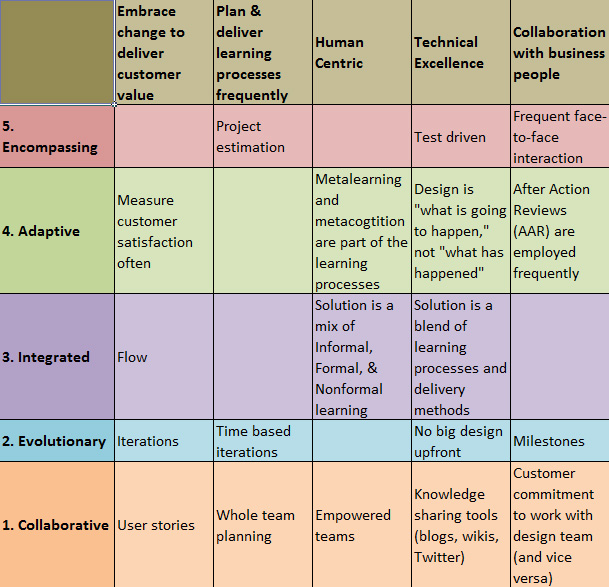
So that you don't have to reproduce the above matrix, I am including the Excel file for the Agile matrix of values, principles, and values. The xlsx file is for the latest version of Excel and is the one shown above. The xls file is for older versions of Excel and is the same except the colors are brighter and may need to be toned down:
Note: On some systems the xlsx version will try to download as a zip file. In that case, click the above xlsx file with the right mouse button to bring up the context menu and then click “Save Target As...” item. When the dialog window opens, change the extension from .zip to .xlsx to save the file correctly.
“Failure at an organizational level seems to come from the inability to customize processes and make them their own. Trying to apply someone else's template to your organization directly doesn't work well. It leaves out too many important details of the previous successes and ignores your company's specific situation.” — Kent Beck (2006 interview with InfoQ)
Adaptive vs. Predictive in Agile Design
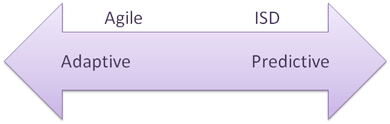
These value and principles make Agile more adaptive rather than predictive; and people-oriented rather than process-oriented (Fowler, 2003). However, it is misleading to view it on the opposite end of a spectrum from a plan-driven or disciplined method as it implies that agile methods are unplanned or undisciplined. A more accurate distinction is that methods exist on a continuum from adaptive to predictive and agile methods lie on the adaptive side of this continuum (Boehm, Turner, 2004).
To see how Agile Design compares to other design models, view the Design Methodologies: Instructional, Thinking, Agile, System, or X Problem?
Plan, Orientate, Design, Select, Iterate, Review (PODSIR)
To achieve an adaptive and people-oriented process, a strategy is implemented that allows collaboration among the designers, business unit (customer), learners, exemplary performers, SMEs, and other interested parties. To accomplish this, a conceptual framework is initiated that allows the strategy to be carried out — Plan, Orientate, Design, Select, Iterate, and Review (PODSIR):
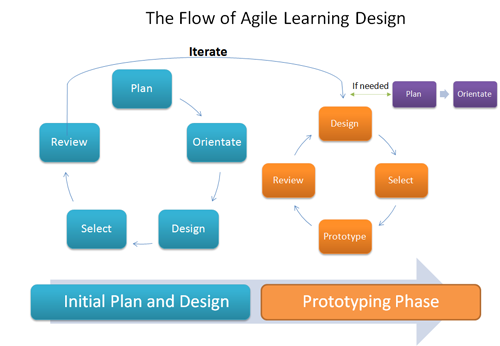
The blue cycle is the initial planning and design phase of the Agile Learning Design. Once the first prototype is built and reviewed, it is then iterated as needed (shown in the orange cycle). In the second phase, the two concepts of planning and orientation (shown in purple) are iterated on an as-needed basis. The concepts are explained briefly below and in further detail in the other chapters.
Planning
Plan by identifying the goal or objective, vision, and feasibility of the project that will ensure the active participation of all stakeholders. Determine if the managers are indeed going to collaborate or willing to learn to collaborate. If they simply want you to be an order-taker then, “Run my friend run; run as fast as you can!” Find a project with people who desire to collaborate.
Orientation
Orientate to recognize the level of the complexity of the environment so that the proper learning architecture can be used to solve the problem. Use Exemplary Performers and/or Subject Matter Experts to help identify the complexity of the environment.
Design
Design by using a collaborative approach so that only the minimum required knowledge and skills are taught that will resolve the problem. Build other benefits into the learning process during the final iterations.
Select
Select the correct learning objects, processes, and resources that will provide the required knowledge and skills that support both formal and informal learning. The use of small learning objects will increase the speed of iterations and allow you to more easily transform parts of the instruction into informal, nonformal, and formal learning.
Iterate
Iterate by prototyping the initial design and determine what other performance support technologies are required that will fully support the learners' quest for better performance.
Review
Review by implementing the newest iteration to determine if it works and meets your customer's needs. Use After Action Reviews to transform deficiencies into actionable items. Transform the formal learning objects to informal or nonformal learning if possible. Repeat the cycle (shown in orange in the last diagram) until it fully developed.
PODSIR is dynamic in that the above concepts or stages are not step-by-step, all encompassing solutions, but rather selected concepts from our profession that best support Agile. Even though they may be performed in order, particularly for the first iteration, the concepts should be thought of more as a network, rather than a template that must be adhered to. Thus, while the last concept is to review the learning process in order to achieve the best solution, the other concepts are iterated throughout the life-cycle of the project on an as needed basis.
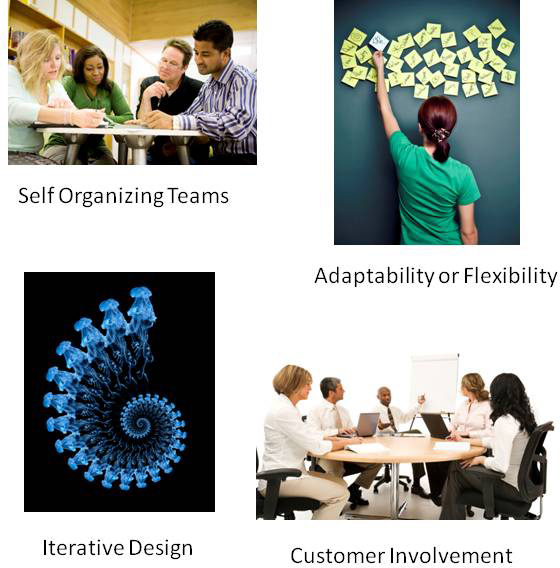
The Four Essences of Agile Design
 :
:
1. Self-organizing teams collaborate to ensure the values and principles of Agile Learning Design are upheld to bring value to the organization or business.
2. An appreciation for adaptability and flexibility that brings small changes over the long term, rather than the uncertainty of prediction that waterfall or linear design methods impose.
3. Iterative design methods that are based on real world experience and research.
4. Customer involvement and collaboration from start to end to ensure their needs are met to the fullest.
Thoughts?
This article was first posted on my blog, Agile Design: An Ethos for Creating Learning Platforms, but since blogs tend to push posts to the bottom as new posts are created, I thought I would post the series on my web site where they would stay more exposed and could be updated when needed. If you have any comments on this article please ffeel free to comment on the post.
Next Steps
-
Agile Design
References
Agile Alliance (2001). Manifesto for Agile Software Development. Retrieved from http://www.agilemanifesto.org/
Boehm, B., Turner, R. (2004). Balancing Agility and Discipline: A Guide for the Perplexed. pp.165-194. Boston, MA: Addison-Wesley.
Fowler, M. (2003). The New Methodology. Retrieved from http://www.martinfowler.com/articles/newMethodology.html
Rawsthorne, P. (2005). Agile Methods of Software Engineering Should Continue to have an Influence over Instructional Design Methodologies. Cape Breton University & Memorial University of Newfoundland. Retrieved from http://www.rawsthorne.org/bit/docs/RawsthorneAIDFinal.pdf
Sidky, A., Arthur, J. (2008). Value Driven Agile Adoption: Improving an Organization's Software Development Approach. New Trends in Software Methodologies, Tools and Techniques: Proceedings of the seventh SoMeT_08. Fujita, Zualkernan (eds). Vol 182, P149-164. The Netherlands: IOS Press. Retrieved from Google Books