
Note: This site is moving to KnowledgeJump.com. Please reset your bookmark.
List Learner Activities: Provide experiences that allow the learners to perform

Selecting the learning activities is the first step of the Development Phase:
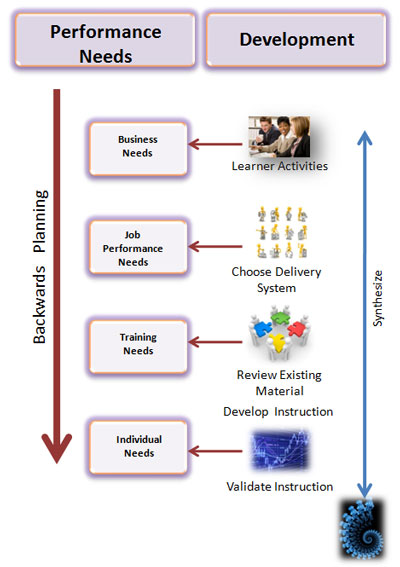
While the primary instructional setting and media were chosen in the first two phases (Analyze and Design), in this phase, the learning strategies and supporting activities that will best assist the learners in mastering the objectives are selected and built.
Developing Activities
When developing and selecting activities it often helps to use a series of If/Then statements (Wick, Pollock, Jefferson, Flanagan, 2006):
- Goal: If we want this outcome: _____, then the employees will need to perform in this manner: _____ .
- If we want them to perform like this, then they need to learn these skills: _____ .
- If we want them to learn these skills, then they need to know this information: _____ .
- If we want them to have these skills and knowledge, then they need to practice these activities: _____ .
The last statement, If we want them to have these skills and knowledge, then they need to practice these activities, is the foundation of learning as it gives the learners the needed time to gain experience through practice in order to master the skills they need to perform.
Some designers might prefer to design and develop the learning activities using a visual method:
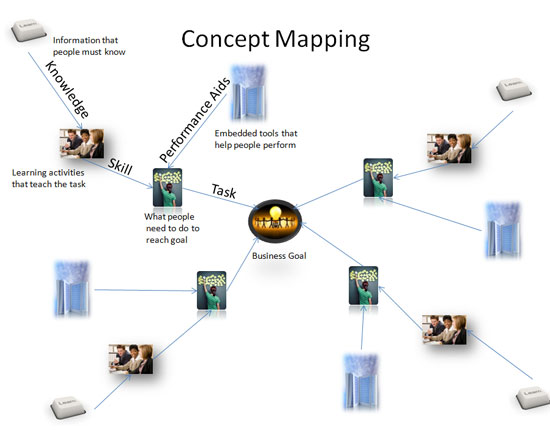
Cathy Moore has an excellent slide show on showing the learning requirements by using a concept mapping technique shown at Design Lively Elearning with Action Mapping.
Beyond the Classroom
In addition, think beyond the classroom when it comes to creating great activities:
- Onramping: What do they need to learn before the class?
- Create a Learning Platform that will support the learning process, rather than a one-shot activity.
- Create performance aids that can replace training or reduce the learners' training time to the bare minimum.
- On-the-Job Application: What resources do they need after the class to ensure they can perform (such as performance aides or access to people who can help and coach them)?
- Use social learning, on-the-job training, and/or informal learning methods to make the learning a process, rather than an one-time activity.
Activities = Practice = Experience
Practice provides opportunities to learn, such as giving them a safe place to make mistakes; however, not all practice is created equal — unstructured practice without objectives, appropriate stimulation, and useful feedback can teach wrong lessons. In addition, practice is most powerful when combined with timely, constructive, and diagnostic feedback, particularly when the feedback is actionable and task focused (Salas, Tannenbaum, Kraiger, Smith-Jentsch, 2012).
Selecting Activities
When selecting activities to help the future performers learn the new skills and knowledge, it helps to think in terms of Bloom's Cognitive Domain, but rather than use the old versions of his cognitive domain, use the updated version developed by Lorin Anderson, a former student of Bloom (Anderson, Krathwohl, Airasian, Cruikshank, Mayer, Pintrich, Raths, Wittrock, 2001):
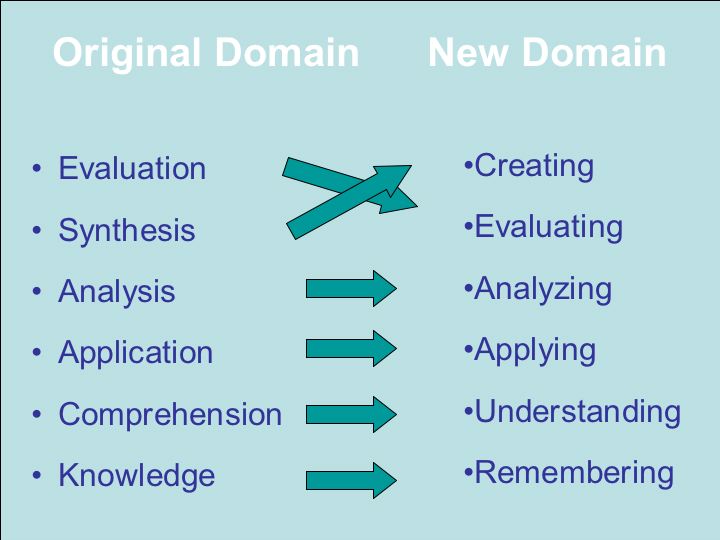
Note that this chart lists the categories in reverse order (complex skills to easier skills). This is the opposite from most other charts. This is because in a knowledge-based society, these types of skills are normally more important. For example, rather than remembering a lot of facts that will probably change, we can rely on our connections to others, internet search, and apps to provide the needed information.
The chart below list examples of activities that will help promote the skills and knowledge of the various cognitive domains (NOTE: depending on how you use the activity, it could be used in one or more of the cognitive categories):
Cognitive Category |
Activities |
| Creating (build a product, process, concept, etc. in order to obtain a result) | OJT (coaching), doing, learning through mistakes |
| Evaluating (judge if a course of action is worthy and then fixing if not worthy) | OJT (coaching), charts (matrix, flowcharts), branched scenarios, case studies, learning through mistakes, mentoring, use patterns (pdf) |
| Analyzing (troubleshoots and determine a course of action) | OJT (coaching), charts (matrix, flowcharts), branched scenarios, performance aids, discussions (face-to-face and/or social learning/media), case studies (examples), mentoring, PSI, use patterns (pdf) |
| Applying (complete all required steps in a process, procedure, etc.) | demonstration, OJT, scenarios, sequencing elements of a process, discussions (face-to-face and/or social learning/media), role playing, action learning, case studies (examples), PSI ,mLearning, podcast with videos), use patterns (pdf) |
| Understanding (gain knowledge by understanding a process, concept, etc. — make sense of information) | drag and drop, performance aids, questioning, animations to show process, diagrams with verbal instructions (multimedia), mLearning, podcast and/or videos), reading, discussions (face-to-face and/or social learning/media), case studies (examples), fishbowls |
| Remembering (recall facts) | performance aids, mLearning (these two examples provide a means of getting facts rather than memorizing facts), learning by repetition (rote), questioning, puzzles, flash cards, podcast, reading |
Defining Learning
To select the proper activities, it helps to know what learning is and what activities enhance a particular form of learning.
Learning has been defined as a relatively permanent change in behavioral potentiality that occurs as a result of reinforced practice (Kimble, 1961). The following elaborates on this basic definition:
- Learning is indexed by a change in behavior, which must be translated into observable behavior.
- After learning, learners are capable of performing something that they could not do before the learning experience.
- This change is relatively permanent; it is neither transitory nor fixed.
- The change in behavior need not occur immediately following the learning experience. Although there may be a potential to act differently, this potential may not be translated into a new behavior immediately.
- The change in behavior results from experience or practice.
- The experience or practice must be reinforced.
Learning is also defined as:
The process by which people acquire new skills or knowledge for the purpose of enhancing performance (Rosenberg, 2001).
Learning a subject seems to involve three almost simultaneous processes:
- There is acquisition of new information. Often the information runs counter to or is a replacement for what the learner had previously known.
- Learning may be called a “transformation” — the process of manipulating knowledge to make it fit new tasks. Transformation comprises the ways we deal with information in order to go beyond it.
- Some type of evaluation takes place by the learner in order to check whether the information and skills are adequate for the task.
Some describe learning as being “social.” The physicist Freeman Dyson wrote that when writing, he closes the door, but when doing science, he leaves it open, because “up to a point you welcome being interrupted because it is only by interacting with other people that you get anything interesting done.” He wrote two papers that were published in Physical Review that brought together Richard Feynman and Julian Schwinger's theories of quantum mechanics.
After Dyson's papers, Feynman and Schwinger's ideas became understandable to others and thus led to the two being awarded the Noble prize in physics. There is no doubt in most minds that the two would never have been awarded the prize if it was not for Dyson being able to explain their ideas to others.
Thus, you have Freeman Dyson, learning from Richard Feynman and Julian Schwinger. However, Feynman was such a genius that he learned from whenever he came across information, such as books and lectures. Einstein is another example — people learned a lot from being around him, yet he learned from what ever was available.
In addition, there is more than one type of learning. A committee of colleges and universities studied learning behaviors and broke learning into three main domains or Taxonomies (Krathwohl, at. el., 1964). Knowing the type of knowledge, skill, or attitude that is discussed in the taxonomy will assist you in determining the best instructional strategy.
Next Steps
Go to the next section: Choose Delivery System
Read Media, Strategies, & Methods for more help in choosing activities.
See learning activities for a description of various activities.
For some learning activity examples, see Leadership Learning Activities.
Return to the Table of Contents
Steps in the Development Phase
-
List Learner Activities
References
Anderson, L.W., Krathwohl, D.R., Airasian, P.W., Cruikshank, K.A., Mayer, R.E., Pintrich, P.R., Raths, J., Wittrock, M.C. (2001). A Taxonomy for Learning, Teaching, and Assessing: A revision of Bloom's Taxonomy of Educational Objectives. New York: Pearson, Allyn & Bacon.
Kimble, G.A. (1961). Hilgard and Marquis' Conditioning and Learning (2nd ed). Englewood Cliffs, New Jersey: Prentice-Hall.
Rosenberg, M. (2001). E-Learning: Strategies for Delivering Knowledge in the Digital Age. New York: McGraw-Hill.
Salas, E., Tannenbaum, S.I., Kraiger, K., Smith-Jentsch, K.A. (2012). The Science of Training and Development in Organizations: What Matters in Practice. Psychological Science in the Public Interest, 13(2), 74–101.
Wick, C., Pollock, R., Jefferson, A., Flanagan, R. (2006). Six Disciplines of Breakthrough Learning: How to Turn Training and Development Into Business Results. San Francisco: Pfeiffer.