
Note: This site is moving to KnowledgeJump.com. Please reset your bookmark.
Synthesizing and Chunking the Content in Instructional Design
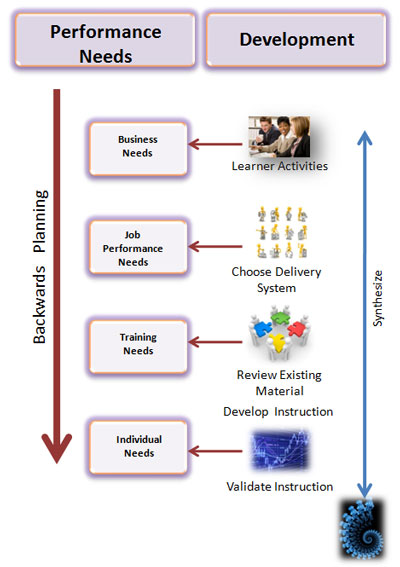
Synthesizing is presenting the instructional content to the learners in a manner that allows them to build upon the previous content (Reigeluth, Stein, 1983).This is done by organizing the material in a logical manner so that the learners can understand and memorize the material in the most effective manner. While this is the fifth step in the Development phase, it is actually performed throughout the phase as shown in the diagram.
Chunking is dividing the instructional material into small units to allow better learner retention (Reigeluth, Stein, 1983). This is sometimes known as microlearning or learning nuggets.
When the instructional content and the media that transports it is developed, ensure that it is synthesized into an integrated platform. It should flow as naturally as possible, with each lesson, module and/or activity building the foundation for the next one. In addition, provide variety that is conductive to learning.
Spacing
Mix the practice sessions in with instructional periods, rather than having all the instruction in the beginning, followed by nothing but practice. Research has shown that spaced practice (often called distributed practice) is more effective than an equivalent practice session that is given in one long stretch of time (Caple, 1996; Reynolds, Glaser, 1964).
In addition, vary the practice so that greater efficiency is gained as shown in this example of transfer of learning.
Reigeluth's Elaboration Theory

Charles Reigeluth developed a sequencing approach in which the instruction is made up of layers and each layer of instruction elaborates on the previously presented ideas (Reigeluth, Stein, 1983). By elaborating on the previous ideal, it reiterates, thereby improving retention. This layering has a zoom lens sequencing approach that runs from simple to complex and repeated general-to-specific:
- Present overview of simplest and most fundamental ideas
- Add complexity to one aspect
- Review the overview and show relationships to the details
- Provide additional elaboration of details
- Provide additional summary and synthesis
For more information, see Reigeluth's Elaboration Theory for Instructional Design.
Learner Control
Learner Control deals with the freedom of the learner to control the selection and sequencing of the instructional elements. Whenever possible, give the learners a choice or menu to choose from, rather than require them to learn in a preset, linear order.
Patrick Penland (1977), a library school professor at the University of Pittsburgh performed a survey as to why learners prefer to learn on their own, rather than in a class or course. The main reasons, in ranking order, are:
-
Desire to set my own learning pace.
-
Desire to use my own style of learning.
-
I wanted to keep the learning strategy flexible and easy to change.
-
Desire to put my own structure on the learning project.
-
I didn't know of any class that taught what I wanted to know.
-
I wanted to learn this right away and couldn't wait until a class might start.
-
Lack of time to engage in a group learning program.
-
I don't like a formal classroom situation with a teacher.
-
I don't have enough money for a course or class.
-
Transportation to a class is too hard or expensive.
What is interesting about the survey is that for the most part, it is not that learners lack resources or hate attending formal classes, for these items are at the bottom of the rankings, but rather they prefer being in charge of their own learning.
So unless the learning platform requires the material to be presented in a certain order, let the learners decide on the order of sequencing.
The Bracketing Process
The bracketing process is similar to iterations:
|
In the U.S. Army Artillery there is a firing method known as the bracketing process. Fire and adjust! Fire and adjust! This process is continued until there is fire for effect, and then adjusted again until the target is hit! Developing effective courseware is the same. Train and adjust! Train and adjust! Continue with the ISD process until the training is no longer needed or until the training courseware is the best learning process ever produced and then some! |
Next Steps
Go to the next section: Validate Instruction
Return to the Table of Contents
Pages in the Development Phase
-
Synthesize
References
Caple, C. (1996). The effects of spaced practice and spaced review on recall and retention using computer assisted instruction. Ann Arbor, MI: UMI. Retrieved from http://www.eric.ed.gov:80/ERICWebPortal/contentdelivery/servlet/ERICServlet?accno=ED427772
Penland, P.R. (1977). Self-planned learning in America. Pittsburgh: University of Pittsburgh.
Reigeluth, C.M., Stein, F.S. (1983). The Elaboration Theory of Instruction. Instructional Design Theories and Models: An Overview of their Current States, C.M. Reigeluth (ed). Hillsdale, NJ: Lawrence Erlbaum.
Reynolds, J.H., Glaser, R. (1964). Effects of repetition and spaced review upon retention of a complex learning task. Journal of Educational Psychology, 55(5): 297-308.