
Note: This site is moving to KnowledgeJump.com. Please reset your bookmark.
Choose the Delivery System
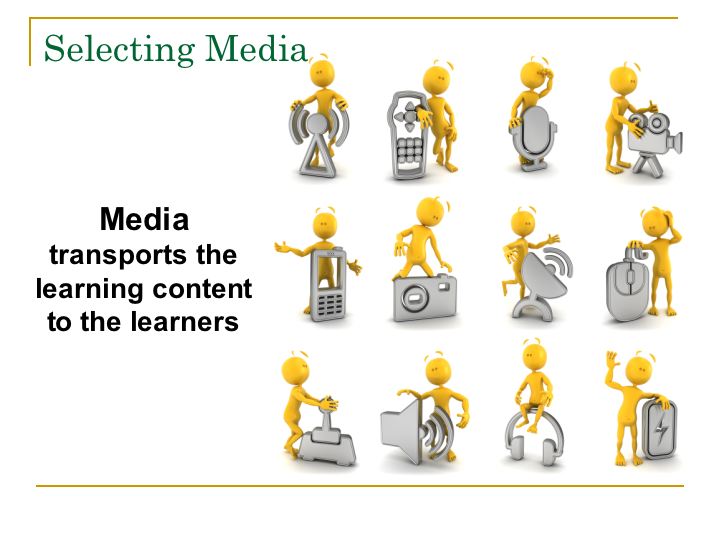
The media that transports the various instructional and support material are specified in this step. While the major medium for delivering the learning platform is normally determined in the Analysis Phase (Choose Instructional Setting), such as a classroom, elearning, performance support tool, or OJT; this step decides how the activities and content should be delivered.
For example, although the primary means of delivery might be elearning, you have to select various media to deliver parts of it, such as text, diagrams, audio, and/or video. In addition, it might be decided that the learners need to meet in a classroom setting for one of the activities in order to provide a face-to-face social setting.
This is called Blended Learning — using a mix of delivery methods (media) that have been selected and fashioned to accommodate the various learning needs for a diverse range of learners in a variety of tasks and activities. Note that the purpose in this step is not to show your mastery of the latest whiz-bang technology, but rather to select a medium that best supports the learning method so that it enhances the learning process.
When determining which media is best suited to train the learning objectives and activities, consider the following:
-
The instructional setting: What type of setting is required? Is it up to date or does it have to be modified? If the instructors and learners have to travel to the site, what materials must they bring? Is the cost of travel worth it?
-
Media characteristics: What is the best media for this type of instruction? How must the media be obtained? Must we produce it? If so, do we have the technical expertise?
-
Time: What are the critical time factors involved? When and how many learners must be trained by a given time? Is there more than one group to be trained and how closely will each group follow?
Each type of instructional medium has certain points to consider:
-
Performance Aids (PA): This is an excellent option if people just need simple reminders or a list of steps for performing a task. Using a PA also allows the learners to fully focus on complex activities, rather than wasting their time using rote learning methods to remember facts that can easily be found.
-
EPSS (Electronic Performance Support System): If a Job Performance Aid is on a computer, then it is normally called an EPSS. Will an embedded app on a computer or mobile device provide the needed support, rather than a full blown training system?
-
Technical Manuals: Is the manual already available? If so, must additional material be developed to enhance the manual for instructional purposes?
-
Flowcharts and schematics: Should these be decals or apps? Where must they be placed so that people will use them?
-
Self-Teaching Package: Are books, internet/intranet, and manuals available? Are they geared to the students' educational level? Are the workers motivated to learn on their own?
-
Programmed Text: At what level must it be? Is additional instruction needed?
-
eLearning: This type of instruction normally takes more time and resources to develop, but can often be cheaper and better in the long term. What must be done to complete it in time and within budget? After it is developed, for how long of a time period will it be valid? Do we have the authoring tools available? Do we have learning specialists who can develop the instruction with the authoring tools or must they be instructed in the new media?
-
Personalized System of Instruction: Are coaches readily available to aid the learners. What goals need to be established and how will the learners obtain them?
-
On-The-Job Training: Are the supervisors/informal trainers (peers) ready to take on the task of providing training and coaching? Must they be instructed to use On-The-Job learning platforms? Do they have the time? Are trainers needed for this type of training? If so, what will be their role?
-
Classroom Setting: Classroom instruction is normally one of the more expensive options available, but it does add the social contract that learners thrive on. Do we have instructors who can perform this type of training? If it is contracted out, will it be given at our location or a separate location? What sort of time frame is involved (classroom training can normally be developed faster than other media as the instructors bring their own wealth of experience to the learning environment)?
-
Lockstep or self pace: Self pace is generally consider better in most cases because it allows each learner to proceed at her or his own pace, but it is more difficult to manage than lockstep and usually requires more instructors because of the wide range of variables that take place within the learning environment. Note: lockstep is when the learners learn the same thing at the same time (they are locked in step with each other).
-
Social Media: Will having access to a wide variety of peers and experts provide the needed learning opportunities?

The guidelines that were noted in the Selecting the Instructional Setting step may also be used for selecting the correct delivery method.
The media selection flowchart is also a helpful guide for choosing delivery strategies based upon needs:
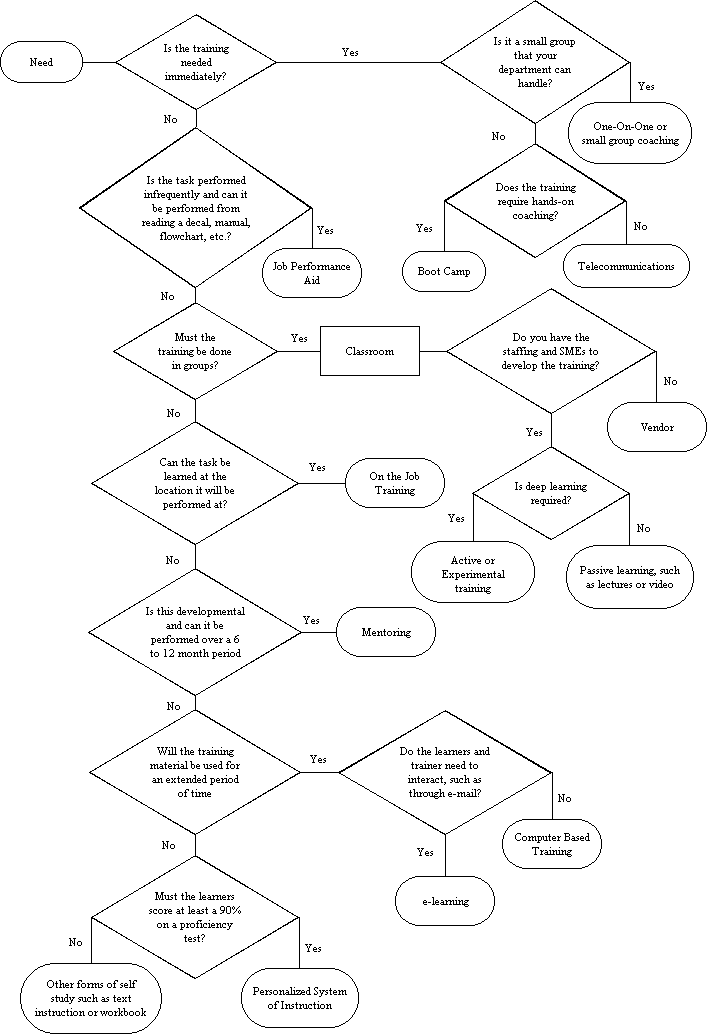
Note: When the widow opens, click it to enlarge and scroll, or right-click to save the image to your device
Next Steps
Go to the next section: Review Existing Material
For more ideas on selecting the correct media, see Media, Strategies, & Methods.
Return to the Table of Contents
Pages in the Development Phase: