

Note: This site is moving to KnowledgeJump.com. Please reset your bookmark.
Data
Data is a set of discrete, objective facts about events. In an organizational context, data is more usefully described as structured records of transactions. - Davenport & Prusak (1998)
Data is created with facts. Thus, a datum (see note below) can be thought of as an artifact of a fact.
Data is the building blocs of meaning. It has no context except for its relationship to other bits of data. Without further context, data is meaningless as the user cannot determine where it came from, why it is being communicated, etc. Examples of data are lists of temperature, scores, and bits of news. (Wurman, 2001)
Note that data can pose as information. For example, trivia and bits of news is just data as it has nothing to teach us. In addition, what constitutes information to one person, may in fact be data to others as they may not have the needed context to make full use of it.
Information reduces uncertainty. - Claude Shannon and Warren Weaver in The Mathematical Theory of Communication.
Data also serves as a "reality check" in that it provides feedback so that we can validate or challenge an assumption.
Next Step
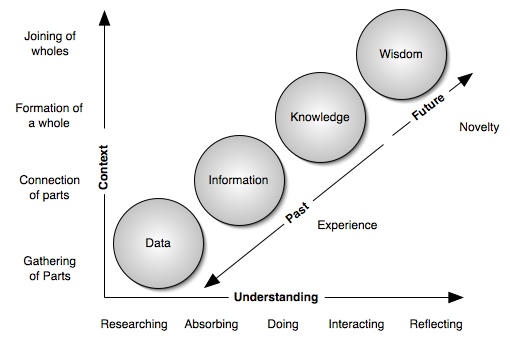
Click on the various parts of the chart to learn more about that topic
Reference
Davenport T., Prusak L. (1998). Working Knowledge. Harvard Business School Press: Boston, MA.
Wurman, S. (2001). Information Anxiety 2 Indianapolis: Que.