
Note: This site is moving to KnowledgeJump.com. Please reset your bookmark.
George Odiorne - A System Approach to Training - 1968
George Odiorne's article, A Systems Approach to Training (1965) is published. Although still not ADDIE or ISD that we know today, it begins outlines some important concepts. In the article he discusses eight types of training systems that are often found in organizations:
-
Static System of Training: This is a static structure best pictured as an organization chart. Objectives and definitions are the input, classes are the processes, and trained people are the output.
-
The Clock Like System of Training: This is a structure based on time which is wound up at the beginning of a semester or season. Exact hours of training are laid out. The clock runs it course until the program is completed.
-
The Cybernetic: This presumes that the needs will be identified, the training process will meet the needs, and evaluation will measure the effect. There is a plan for restoring organization performance to ideal levels by changing behaviors.
-
The Cell System of Training: The training department is sustained on a self maintaining basis. It charges other departments for all cost of training, confident that it can sustain its own existence by providing training to line departments.
-
The Plant System of Training: This is modeled after a central stem with branches and twigs. Branches such as sales training or leadership training can be snipped or grafted on.
-
Training as a Organism: Analogous to an animal or a human. It has receptors, such as advisory groups and research which provide information to its brain. It often works at symbolic levels.
-
Training Department as Social Organization: It is concerned with complex relations and numerous contact points.
-
Training as a Social Movement: Closely associated with a social change movement, such as achieving an industrial democracy.
Almost no real-life training and development model operates wholly to any one of the above training systems, but is normally a combination or two or more. During this time frame (sixties and seventies), the training literature was becoming more and more inline with systems. And in particular, cybernetic systems. One of the major reason was the impact that B.F. Skinner and other behaviorists were having on the training industry.
Although cybernetic can mean a world of things depending on what perspective you are looking at it from, training professionals at this time looked upon it as a communication theory that treats organisms and organizations as being very much alike in that they both display behavior. The term “cybernetic” (Greek kybernetes, pilot, steersman — steering a ship on course to a desired destination) was coined by the mathematician Norbert Wiener in 1948 to describe the field of control and communication theory, whether it be by a human or in a machine. It treats not “things” but rather “ways of behaving.”
In 1993, physiologist Arturo Rosenblueth collaborated with MIT mathematician Norbert Wiener and engineer Julian Bielow to create an influential paper, Behavior, Purpose, and Teleology (1943), in which they establish a clear link between animate behavior and that of feedback-control systems. In addition, they maintained that purposeful behavior (either human or machine), did not require the teleological assumption of a future cause having a present effect, but rather purposeful behavior was a circular causation. Going one step more, Wiener published a ground breaking book, Cybernetics (1948), that continued the application of feedback to living organisms.
Odiorne created a training cybernetic model that was built on the feedback and control (evaluation) system:
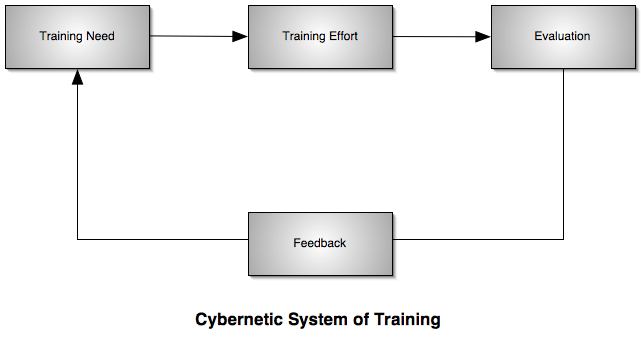
As the model shows, the cybernetic approach is a causal loop where analysis (feedback) occurs repeatedly throughout the entire life of the system. Since it is a system, it has an input, process, and output:
. . . three ingredients comprise most of the systems we deal with: INPUTS, PROCESSES, AND OUTPUTS. At a very rudimentary level of system, it could be said that objectives are inputs, courses are processes, and the output is trained people - George Odiorne, 1965.
Cybernetic systems encourage response to training through changed behavior that carries over into the actual work environment.
Next Steps
Next chapter: Bela Banathy - Instructional Systems
Return to the History of Instructional System Design
Reference
Odiorne, G.S. (1965). A Systems Approach to Training. Training Director's Journal, 1965,19,10,11-19. Note: The Training Director's Journal was the magazine of American Society of Training Directors; it now called ASTD (American Society of Training and Development).
Rosenblueth, A., Wiener, N., Bigelow, J. (1943). Behavior, Purpose and Teleology. Philosophy of Science, 10(1943), S. 18–24.