
Note: This site is moving to KnowledgeJump.com. Please reset your bookmark.
Kolb's Learning Styles and Experiential Learning Model
Note: While you can start at any of the major themes listed to the left of this screen, you should read the Introduction to get a background of learning styles.
While VAK may have popularized learning styles, David Kolb, Professor of Organizational Behavior at Case Western Reserve University, is credited with launching the learning styles movement in the early seventies and is perhaps one of the most influential learning models developed.
Learning is the process whereby knowledge is created through the transformation of experience. Knowledge results from the combination of grasping experience and transforming it. - Kolb (1984, 41)
Kolb proposes that experiential learning has six main characteristics:
- Learning is best conceived as a process, not in terms of outcomes.
- Learning is a continuous process grounded in experience.
- Learning requires the resolution of conflicts between dialectically opposed modes of adaptation to the world (learning is by its very nature full of tension).
- Learning is a holistic process of adaptation to the world.
- Learning involves transactions between the person and the environment.
- Learning is the process of creating knowledge that is the result of the transaction between social knowledge and personal knowledge.
Kolb's learning theory sets out four distinct learning styles, which are based on a four-stage learning cycle. In this respect, Kolb's model differs from others since it offers both a way to understand individual learning styles, which he named the "Learning Styles Inventory" (LSI), and also an explanation of a cycle of experiential learning that applies to all learners.
Basis of Kolb's Experiential Learning Model
Note: “Experiential” means relating to or resulting from experience while “experimental” means relating to or based on experiment. Kolb uses the term “experiential” as his theory is based more on reflection of experiences. While others use “experimental” when referencing experimental-inquiry techniques that requires learners to test hypothesis (experiment) about content knowledge.
Kolb's learning model is based on two continuums that form a quadrant:
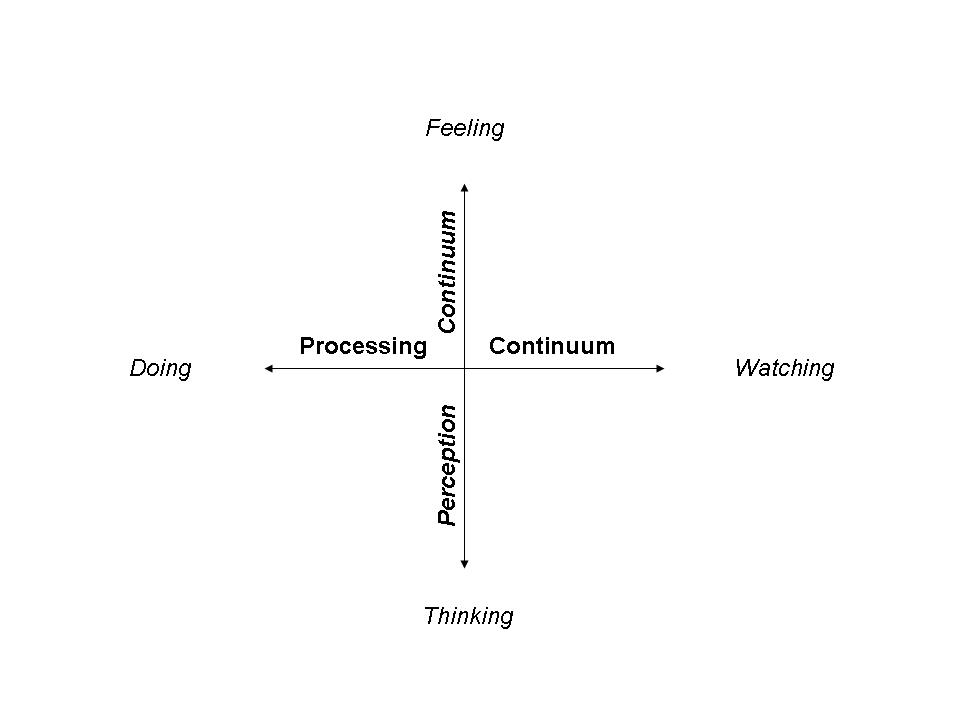
For a larger picture, click on the image
- Processing Continuum: Our approach to a task, such as preferring to learn by doing or watching.
- Perception Continuum: Our emotional response, such as preferring to learn by thinking or feeling.
The Learning Cycle
This matrix provides a learning cycle that involves four processes that must be present for learning to occur. Note that this part of Kolb's model is more useful in that rather than trying to pinpoint a learning style, he provides a model learning program.
Kolb called this Experiential Learning since experience is the source of learning and development (1984). Each ends of the continuums (modes) provide a step in the learning process:
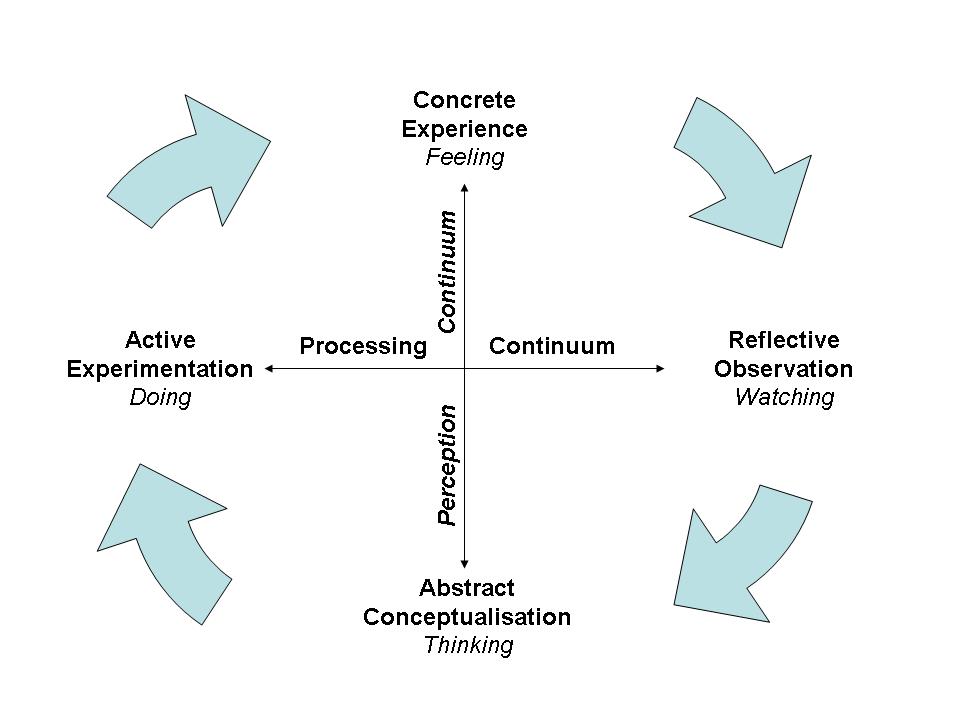
For a larger picture, click on the image
- Concrete experience (feeling): Learning from specific experiences and relating to people. Sensitive to other's feelings.
- Reflective observation (watching): Observing before making a judgment by viewing the environment from different perspectives. Looks for the meaning of things.
- Abstract conceptualization (thinking): Logical analysis of ideas and acting on intellectual understanding of a situation.
- Active experimentation (doing): Ability to get things done by influencing people and events through action. Includes risk-taking.
Depending upon the situation or environment, the learners may enter the learning cycle at any point and will best learn the new task if they practice all four modes.
Listed below are some examples:
- Learning to ride a bicycle:
- Reflective observation - Thinking about riding and watching another person ride a bike.
- Abstract conceptualization - Understanding the theory and having a clear grasp of the biking concept.
- Concrete experience - Receiving practical tips and techniques from a biking expert.
- Active experimentation - Leaping on the bike and have a go at it.
- Learning a software program:
- Active experimentation - Jumping in and doing it.
- Reflective observation - Thinking about what you just performed.
- Abstract conceptualization - Reading the manual to get a clearer grasp on what was performed.
- Concrete experience - Using the help feature to get some expert tips.
- Learning to coach:
- Concrete experience - Having a coach guide you in coaching someone else.
- Active experimentation - Using your people skills with what you have learned to achieve your own coaching style.
- Reflective observation - Observing how other people coach.
- Abstract conceptualization - Reading articles to find out the pros and cons of different methods.
- Learning algebra:
- Abstract conceptualization - Listening to explanations on what it is.
- Concrete experience - Going step-by-step through an equation.
- Active experimentation - Practicing.
- Reflective observation - Recording your thoughts about algebraic equations in a learning log.
Kolb views the learning process as a context of people moving between the modes of concrete experience (CE) and abstract conceptualization (AC), and reflective observation (RO) and active experimentation (AE). Thus, the effectiveness of learning relies on the ability to balance these modes, which Kolb sees as opposite activities that best promote learning.
In addition, Kolb (1999) claims that concrete experience and abstract conceptualization reflect right-brain and left-brain thinking respectively.
Kolb's Learning Styles
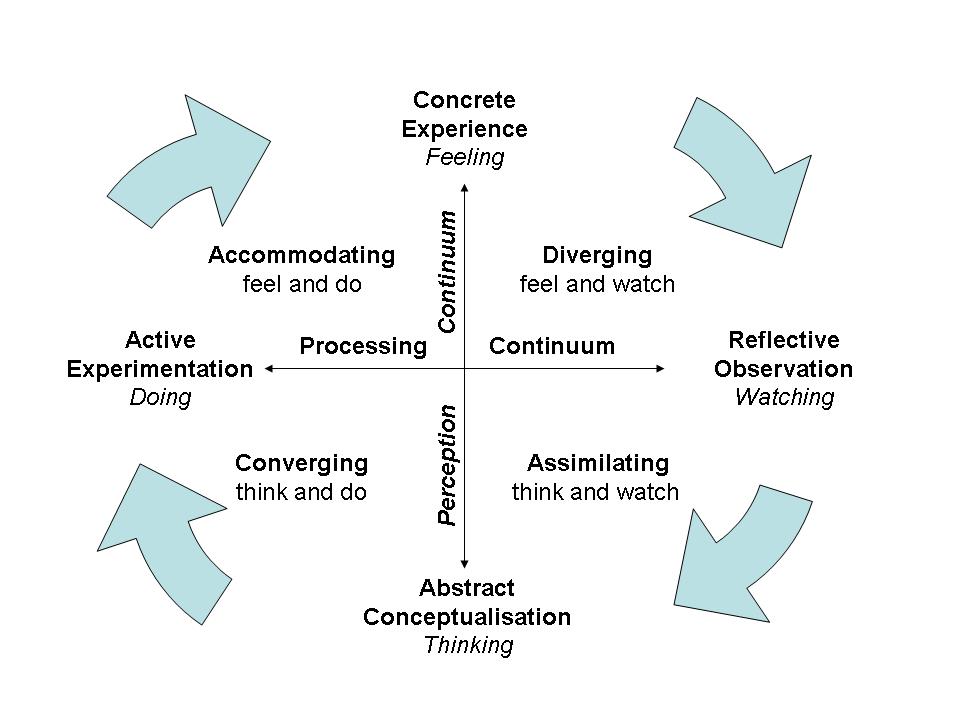
Kolb theorized that the four combinations of perceiving and processing determine one of four learning styles of how people prefer to learn. Kolb believes that learning styles are not fixed personality traits, but relatively stable patterns of behavior that is based on their background and experiences. Thus, they can be thought of more as learning preferences, rather than styles.
For a larger picture, click on the image
- Diverging (concrete, reflective) - Emphasizes the innovative and imaginative approach to doing things. Views concrete situations from many perspectives and adapts by observation rather than by action. Interested in people and tends to be feeling-oriented. Likes such activities as cooperative groups and brainstorming.
- Assimilating (abstract, reflective) - Pulls a number of different observations and thoughts into an integrated whole. Likes to reason inductively and create models and theories. Likes to design projects and experiments.
- Converging (abstract, active)- Emphasizes the practical application of ideas and solving problems. Likes decision-making, problem-solving, and the practical application of ideas. Prefers technical problems over interpersonal issues.
- Accommodating (concrete, active) - Uses trial and error rather than thought and reflection. Good at adapting to changing circumstances; solves problems in an intuitive, trial-and-error manner, such as discovery learning. Also tends to be at ease with people.
Each learning style is located in a different quadrant of the cycle of learning:
Kolb is the inspiration for a large numbers of theorists. For example, Honey and Mumford's model is directly derived from Kolb's theory. To help you under learning styles, see the learning style survey
References
Coffield, F., Moseley, D., Hall, E., & Ecclestone, K. (2004). Learning styles and pedagogy in post-16 learning: A systematic and critical review. www.LSRC.ac.uk: Learning and Skills Research Centre. Retrieved January, 15, 2008: http://www.lsda.org.uk/files/PDF/1543.pdf
Kolb D. (1984). Experiential learning: experience as the source of learning and development. Englewood Cliffs, New Jersey: Prentice Hall.
Kolb D. (1999). The Kolb Learning Style Inventory, Version 3. Boston: Hay Group.