
Note: This site is moving to KnowledgeJump.com. Please reset your bookmark.
Learning Style Survey
This survey is designed to help you gain an understanding of learning styles so that you can incorporate the various learning styles in your daily learning activities. It is NOT meant to show you your best way of learning as the research does not promote that. Rather, it is a tool for learning-to-learn (metalearning) in order to increase self-awareness about your strengths and weaknesses as a learner so that you will try to use the correct method for learning a task or subject, rather than sticking with a preferred method.
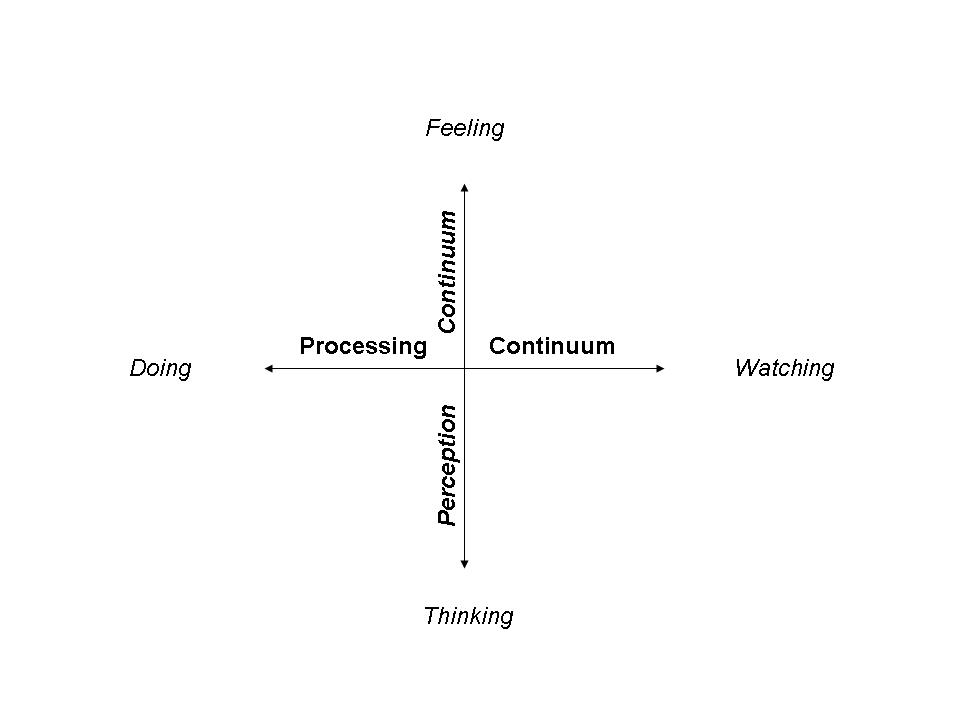
Note that like any survey of this nature, it is not 100 percent accurate, but it should help you gain some understanding of your preferred learning styles based on two continuums:
- Processing Continuum: Our approach to a task — learn by doing or watching.
- Perception Continuum: Our emotional response — learn by thinking or feeling.
For a learning style survey based on modalities (Visual, Auditory, and Kinesthetic), see VAK.
Instructions
Read each statement carefully. Answer honestly as there are no correct or incorrect answers. It is best if you do not think about each question too long, as this could lead you to the wrong conclusion.
SECTION 1 (Doing & Watching)
Circle either "Doing" or "Watching" next to the statements below, depending upon the part of the statement you most closely relate to.
- Doing - I often produce off-the-cuff ideas that at first might seem silly or half-baked. Watching - I am thorough and methodical.
- Doing - I am normally the one who initiates conversations. Watching - I enjoy watching people.
- Doing - I am flexible and open minded. Watching - I am careful and cautious.
- Doing - I like to try new and different things without too much preparation. Watching - I investigate a new topic or process in depth before trying it.
- Doing - I am happy to have a go at new things. Watching - I draw up lists up possible courses of actions when starting a new project.
- Doing - I like to get involved and to participate. Watching - I like to read and observe.
- Doing - I am loud and outgoing. Watching - I am quiet and somewhat shy.
- Doing - I make quick and bold decisions. Watching - I make cautious and logical decisions.
- Doing - I speak fast, while thinking. Watching - I speak slowly, after thinking.
SECTION 2 (Thinking & Feeling)
Circle either "Thinking" or "Feeling" next to the statement below, depending upon the part of the statement you most closely relate to.
- Thinking - I ask probing questions when learning a new subject. Feeling - I am good at picking up hints and techniques from other people.
- Thinking - I am rational and logical. Feeling - I am practical and down to earth.
- Thinking - I plan events down to the last detail. Feeling - I like realistic, but flexible plans.
- Thinking - I like to know the right answers before trying something new. Feeling - I try things out by practicing to see if they work.
- Thinking - I analyze reports to find the basic assumptions and inconsistencies. Feeling - I rely upon others to give me the basic gist of reports.
- Thinking - I prefer working alone. Feeling - I enjoy working with others.
- Thinking - Others would describe me as serious, reserved, and formal. Feeling - Others would describe me as verbal, expressive, and informal.
- Thinking - I use facts to make decisions. Feeling - I use feelings to make decisions.
- Thinking - I am difficult to get to know. Feeling - I am easy to get to know.
SCORING PROCEDURES
Total up the two choices from Section One (Doing & Watching). The one that has the larger number is your task preference:
Total number of Doing _____
Total number of Watching _____
Total up the two choices from Section two (Thinking & Feeling). The one that has the larger number is your thought or emotional preference:
Total number of Thinking _____
Total number of Feeling _____
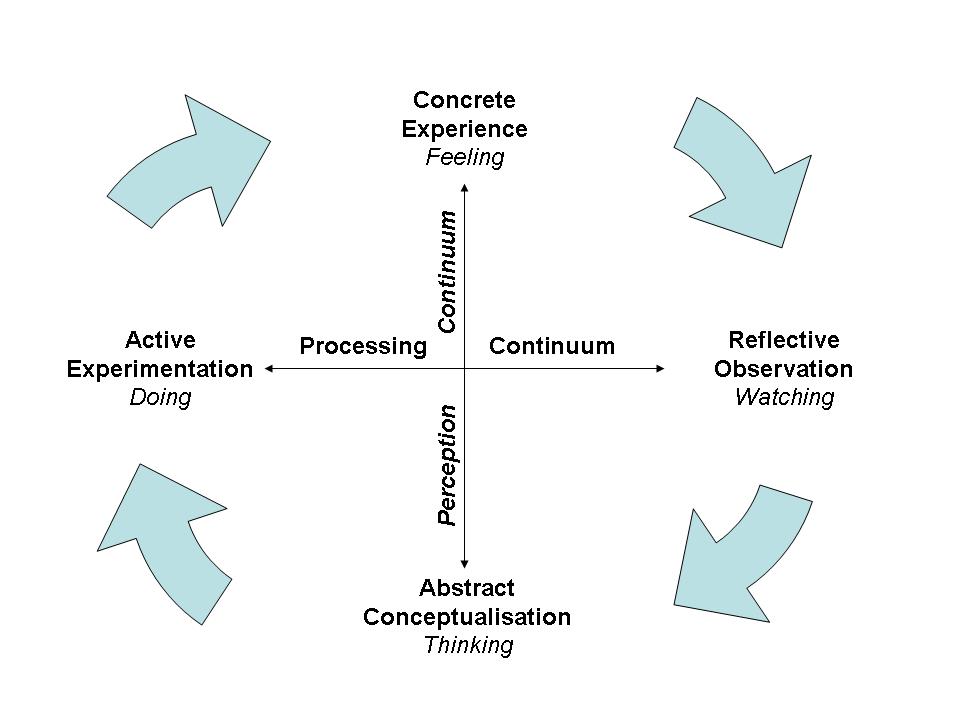
Each preference (high score) from the two above sections are used to determine your preferred learning style:
If you prefer Watching and Feeling then this puts you in the reflecting category:
- Prefers to learn from activities that allows watching, thinking, and to review what has happened, such as brainstorming and cooperative groups.
- Lectures may be helpful but only if they provide expert explanations and analysis.
- Likes innovative and imaginative approaches to doing things.
- Prefers to view situations from many perspectives.
- Interested in people and tends to be feeling-oriented.
If you prefer Watching and Thinking then you are in the philosophy category:
- Prefers to pull a number of different observations and thoughts into an integrated whole in a step-by-step manner (go from details to big-picture).
- Prefers to reason logically and design models, theories, and projects.
- Likes lectures, analogies, systems, and case studies.
- Talking with experts is normally not helpful.
If you prefer Doing and Thinking then you are in the analyzing category:
- Prefers the practical application of ideas, solving problems, feedback, and decision-making (obvious links between the task-on-hand and a problem).
- Prefers technical problems over interpersonal issues.
- Prefers to apply new learnings to actual practice to see if they work.
- Likes laboratories, field work, observations, and coaching.
If you prefer Doing and Feeling then you are in the organizing category:
- Good at adapting to changing circumstances and solves problems in an intuitive, trial-and-error manner, such as discovery learning.
- Tends to be at ease with people.
- Prefers the challenges of new experiences, involvement with others, assimilation, and role-playing.
- Likes anything new, problem solving, and small group discussions.
You will learn best by using ALL four styles, rather than your preferred learning style. That is, you should incorporate the styles so that you use the Learning Cycle.
Reliability and Validity
This survey was designed as a learning tool for use in training programs such as leadership development and learning-to-learn (metalearning), rather than a research tool, thus it has not been formally checked for reliability or validity. However, in order to be of any use to the learners, it has to be fairly accurate.