
Note: This site is moving to KnowledgeJump.com. Please reset your bookmark.
Performance Appraisal Learning and Training Activity
This activity is based on a Fishbowl: a small inner-circle composed of about 4 or 5 learners who discuss or perform a task while an outer-circle of about 4 or 5 learners observe silently and take notes for later discussions.
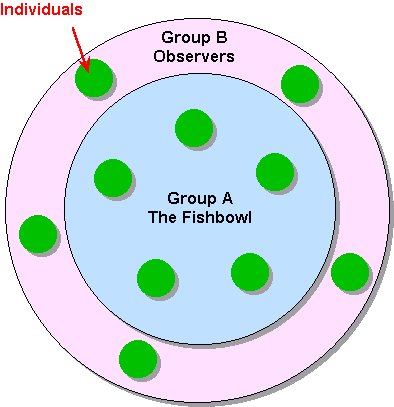
Objective: This activity has a twofold purpose: 1) to have the learners perform as objective observers, and 2) provide a discussion format for performance appraisals. Note that it could also make a good transitional device between the two subjects.
Depending on the size of the class, break the learners into fishbowls. Each fishbowl needs two groups, with 4 or 5 people to a group. Group A will be the first inner-circle, while group B is the outer circle (observers). Have the inner-circle read and discuss the following statement:
It is time to perform a performance appraisal for one of your employees. Your method of handling employee evaluations is: A. Performance appraisals are usually a waste of time. Even when the employee is open to what I have to say, they never really seem to change. They soon fall back into their same old habits. Therefore, I keep the sessions short and fairly general. It is also a good idea to keep as few records as possible... they might get you into trouble at a later date. B. Performance appraisals are excellent for evaluating the employee's past performance and setting new goals. I always consider the employee's strengths and weaknesses. I ensure that the employee is actively involved in the evaluation so that he or she takes ownership of the final appraisal. I expect the employee to use the appraisal as a tool for growth. |
After about 5 or 10 minutes, rotate the inner and outer circles. Have the new inner-circle read and discuss the following statements:
It is time to perform a performance appraisal for one of your employees. Your method of handling employee evaluations is: C. Criticism only hurts people's feelings, and few people can be objective when discussing their weaknesses. Therefore, unless there is a serious problem, I only concentrate on the employee's strengths. For example, after a game day, Vince Lombardi never replayed the bad plays, only the good plays. He wanted his players to concentrate on the winning plays! D. Appraisals are quite valuable when used to instruct the employee on how to improve. Although some supervisors tend to beat around the bush, the direct approach works best for me. If an employee has done something wrong, I tell him or her. Vince Lombardi once said, "If you don't keep score, you're only practicing." I have to let my employees know that they are falling short of expectations so that they can set new goals! |
After the small group activities, form back into a class and discuss:
- As an observer, was the discussion favorable or non-favorable to performance appraisals? What made you come to this conclusion?
- Besides speaking, what other methods of communication did you observe to base your decision on? (such as the tone of voice or body and hand gestures) How important are these other methods of communication as compared to what is being spoken?
- Did you find yourself wanting to infer something by what was being said or not being said? What harm could this do?
- How is being an observer in this exercise the same as being a rater for a performance appraisal?
- When you were in the inner-circle and being observed, how did it affect your actions?
- What one thing did you learn from this exercise that you could use the next time you have to give a performance appraisal?
- Thinking back on your everyday activities at work, how hard is it to strictly base your decisions on observable behavior?
Next Steps
This activity is used in conjunction with the chapter on Leadership and Motivation
Return to the Leadership Training and Development Outline