
Note: This site is moving to KnowledgeJump.com. Please reset your bookmark.
Motivation and Drive
Men wanted for hazardous journey. Small wages, bitter cold, long months of complete darkness, constant danger, safe return doubtful. Honor and recognition in case of success. - Explorer Ernest Shackleton in a 1890 ad for the first Antarctic expedition
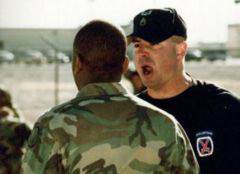
photo by Sgt. David E Gillespie, Courtesy of U.S. Army
A person's motivation is a combination of desire and energy directed at achieving a goal. It is the cause of action. Influencing someone's motivation means getting them to want to do what you know must be done. (U.S. Army Handbook, 1973)
A person's motivation depends upon two things:
- The strength of certain needs. For example, you are hungry, but you must have a task completed by a nearing deadline. If you are starving you will eat. If you are slightly hungry you will finish the task at hand.
- The perception that taking a certain action will help satisfy those needs. For example, you have two burning needs — the desire to complete the task and the desire to go to lunch. Your perception of how you view those two needs will determine which one takes priority. If you believe that you could be fired for not completing the task, you will probably put off lunch and complete the task. If you believe that you will not get into trouble or finish the task in time, then you will likely go to lunch.

Forces, such as beliefs, values, interests, fear, and worthy causes can motivate people. Some of these forces are internal, such as needs, interests, and beliefs. Others are external, such as danger, the environment, or pressure from a loved one. There is no simple formula for motivation — you must keep a open viewpoint on human nature.
There is a complex array of forces steering the direction of each person and these forces cannot always be seen or studied. In addition, if the same forces are steering two different people, each one may act differently. Knowing that each person may react to different needs will guide your decisions and actions in certain situations.
Guidelines for Motivation
As a leader you have the power to influence motivation. The following guidelines form a basic view of motivation (U.S. Army Handbook, 1973). They will help guide your decision making process:
Allow the needs of your team to coincide with the needs of your organization
Nearly everyone is influenced by the needs for job security, promotion, raises, and approval of their peers and leaders. Internal forces, such as values, morals, and ethics, also influence them. Likewise, the organization needs good people in a wide variety of jobs.
Ensure that your team is trained, encouraged, and has opportunities to advance. Also, ensure that the way you conduct business has the same values, moral, and ethic principles that you seek in others. If you conduct business in a dishonest manner, your team will be dishonest to you; for that will be the kind of people that you will attract.
Reward good behavior
Although a certificate, letter, or a thank you may seem small and insignificant, they can be powerful motivators. The reward should be specific and prompt. Do not say something general, such as “for doing a good job,” rather you should cite the specific action that made you believe it was indeed a good job.
Set the example
You must be the role model that you want others to grow into. As Mahatma Gandhi said, “We must become the change we want to see.”
Develop morale and esprit de corps
Morale is the mental, emotional, and spiritual state of a person. Almost everything you do will have an impact on your organization. You should always be aware how your actions and decisions might affect it.
Esprit de corps means team spirit — it is defined as the spirit of the organization or collective body (in French it literally means “spirit of the body”). It is the consciousness of the organization that allows the people within it to identify with and feel a part of. Is your workplace a place where people cannot wait to get away from; or is it a place that people enjoy spending a part of their lives?
 Allow your team to be part of the planning and problem solving process
This helps with their development and also allows you to coach them to greater things. Secondly, it motivates them — people who are part of the decision making process become the owners of it, thus it gives them a personal interest in seeing the plan succeed. Thirdly, communication is clearer as everyone has a better understanding of what role they must play as part of the team. Next, it creates an open trusting communication bond. They are no longer just the doers for the organization — they are now part of it! Finally, recognition and appreciation from a respected leader are powerful motivators.
Look out for your team
Although you do not have control over their personal lives, you must show concern for them. Things that seem of no importance to you might be extremely critical to them. You must be able to empathize with them. This is from the German word, einfuhling, which means “to feel with”, or the ability to perceive another person's view of the world as though that view were your own.
The Sioux Indian Tribal Prayer reads, “Great Spirit, help us never to judge another until we have walked for two weeks in his moccasins.” Also note that empathy differs from sympathy in that sympathy connotes spontaneous emotion rather than a conscious, reasoned response. Sympathizing with others may be less useful to another person if we are limited by the strong feelings of the moment.
Drive
This lively RSA Animate, based on Daniel Pink's book, Drive: The Surprising Truth About What Motivates Us, illustrates some of the hidden truths behind what really motivates us:
Informed Acquiescence Vs. Value-Based Self-Governance
The most common form of culture in modern organizations is often referred to as informed acquiescence. It is rule-based in that the workers learn the rules and agree to abide by them. Rules normally work their way from the top-down in a fairly controllable and predictable manner. Thus, a large organization can become management-orientated that often leads to bureaucracy. And it is this bureaucracy that tends to slow things down.
However, many of the leading organizations are becoming more value-based self-governance in that rather than the workforce being governed by “should,” they act upon “can” (Seidman, 2007). They have a small core set of rules that are valued by the workforce. Rather then being motivated to do better, they are inspired. Motivation is controlled somewhat by outside factors, while inspire (similar to “esprit”) is more inside the individual's soul or spirit and is usually considered the greatest motivator. Being freed from the crippling pace of bureaucracy, value-based companies operate and move faster.
Probably no organization is based solely on one or the other, but rather someplace on a continuum, with the better and faster ones being more value-based. Nordstrom is one good example of an organization that leans heavily towards value-based self-governance. For example, Nordstrom's rule is to “Use good judgment in all situations.” Employees are encouraged to ask questions from anyone because they believe that all information should be accessible to everyone, regardless of seniority or status.
Next Steps
Next chapter - Counseling and Performance Appraisals
Arousal is a major aspect of many learning theories and is closely related to other concepts, such as anxiety, attention, agitation, stress, and motivation.
Leadership Learning Activities:
References
Buchen, I. (2004). Upgrading Performance and Targeting Learning. Chief Learning Officer July 2004.
Craig, R.L. (1996). The ASTD Training and Development Handbook. New York: McGraw-Hill.
Seidman, D. (2007). How: Why HOW We Do Anything Means Everything . . . in Business (and in Life). Hoboken, New Jersey: John Wiley & Sons.
U.S. Army Handbook (1973). Military Leadership.