
Note: This site is moving to KnowledgeJump.com. Please reset your bookmark.
Performance and Learning Objectives in Instructional Design
 In the analysis phase, the backwards planning model was used to discover what needs to be trained to reach the performance requirements of the business. The information that was collected is now used to design the learning platform. And as noted in the Introduction to Design, the starting point is normally the performance or learning objectives:
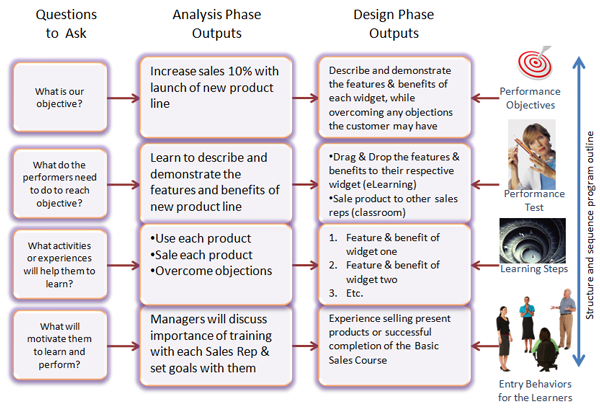
Learning and performance objectives are created so that we know exactly what the learners must be able to do once they have completed the training process. Of all the activities within the ISD process, this is normally considered one of the more critical steps in that well-constructed performance objectives that align with the business unit's requirements allow the three key groups to know what to focus on:
- The instructors know what needs to be taught
- The learners know what they are supposed to learn
- The managers know what they are investing their training dollars in.
Learning objectives form the basis for what is to be learned, how well it is to be performed, and under what conditions it is to be performed.
While there are specific objectives that means different things, such as educational, instructional, learning, behavioral, and performance objectives (Saettler, 1990); most instructional designers generally use two terms — terminal or performance objectives and enabling or learning objectives (Mager, 1975):
- A Terminal or Performance Objective is developed for each of the tasks selected in the learning program. A terminal objective is at the highest level of learning (KSA) appropriate to the human performance requirements a student will accomplish.
- Each terminal performance objective is then analyzed to determine if it needs one or more Enabling or Learning Objectives. These supporting objectives allow the Terminal Objective to be broken down into smaller, more manageable objectives. Each enabling learning objective measures an element of the terminal performance objective.
For example, a terminal (performance) objective might teach a salesperson how to sell a product, while enabling (learning) objectives might include:
- Describing the benefits and features
- Overcome objections that a customer has about the product
- Closing the sale
The Three Parts of an Objective
Every performance or learning objective contains at least three parts:
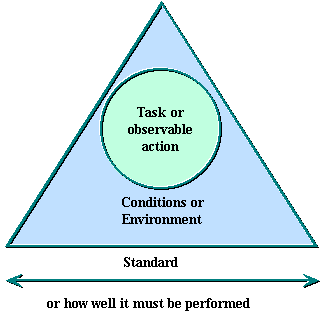
Observable Action (task)
This describes the observable performance or behavior. An action means a verb must be in the statement, for example “type a letter” or “lift a load.” Each objective covers one behavior, hence, normally only one verb should be present. If there are more than one behavior or the behavior is complicated, then the objective should be broken down into one or more enabling learning objectives that supports the main terminal learning objective.
At Least One Measurable Criterion (standard)
A criterion states the level of acceptable performance of the task in terms of quantity, quality, time limitations, etc. This will answer any question such as “How many?” “How fast?” or “How well?” For example, “At least 5 will be produced”, “Within 10 minutes”, and “Without error.” There can be more than one measurable criterion.
Do not fall into the trap of putting in a time constraint because you think there should be a time limit or you cannot easily find another measurable criterion — use a time limit only if required under normal working standards.
Conditions of performance
A condition describes the actual conditions, which the task will occur or be observed. In addition, it identifies the tools, procedures, materials, aids, or facilities to be used in performing the task. This is best expressed with a prepositional phase such as “without reference to a manual” or “by checking a chart.”
Examples of Performance Objectives
Example 1:
Write a customer reply letter with no spelling mistakes by using a word processor.
- Observable Action: Write a customer reply letter
- Measurable Criteria: with no spelling mistakes
- Conditions of Performance: using a word processor
NOTE: If more that one type of word processor or computer is used in the organization, then it should be more specific. For example: Given a personal computer, Word for Windows, and printer, create a printed customer reply letter with no spelling mistakes. The conditions of performance are “Given a personal computer, Word for Windows, and printer.” Generally speaking, the larger the organization or the more technical the task, the more specific the conditions of performance must be spelled out.
Example 2:
Copy a table from a spreadsheet into a word processor document within 3 minutes and without reference to the manual.
- Observable Action: Copy a table from a spreadsheet into a word processor document
- Measurable Criteria: within 3 minutes
- Conditions of Performance: without referencing the manual
Note: The Conditions of performance may also include a variable as shown in the next example.
Example 3:
Smile at all customers, even when exhausted, unless the customer is irate.
- Observable action: Smile
- Measurable Criteria: at all customers
- Conditions: even when exhausted
- Variable: unless the customer is irate
Note: Sometimes it's helpful to start with the phase, “After training, the worker will be able to . . .”
Example 4:
After training, the worker will be able to load a dump truck with three loads with a scooploader, in the hours of darkness, unless the work area is muddy.
- Observable Action: load a dump truck
- Measurable Criteria: with three loads
- Conditions: with a scooploader in the hours of darkness
- Variable: unless the work area is muddy
The Performance objective spells out the exact training requirement. Without them, time and money could be wasted by training workers to type at 65 WPM when all that is required is to be able to type at 35 WPM, or training employees to sell an item to an easygoing customer when what they really need to know is how to sell an item to a skeptical customer, or training them to enter data into a spreadsheet application when the actual job requires them to enter data into a customized database package.
A clearly formulated objective has two dimensions, a behavioral aspect and a content aspect. The behavioral aspect is the action the learner must perform, while the content is the product or service that is produced by the learner's actions. For example, “the student will learn forklift operations by studying the operator's manual” refers not to an outcome of training but to an activity of learning. If you observed the student reading, you could make no judgment if he or she was actually learning (behavioral aspect) and there is no service produced by the learner's action (content aspect).
A better example would be “Given a forklift, load a pallet onto a trailer without any safety errors.” In this example, the behavioral aspect is loading a trailer, while the content aspect is a pallet placed on the trailer.
Notice that learning objectives look a lot like tasks. A task analysis itemizes each discrete skill found in a job, but it provides only end-goal statements. While learning objectives spell out the prerequisite skills and makes them the course objectives.
Using the Correct Verb
The type of verb that is used in the task statement, determines the level or of learning (or degree of difficulty) that must achieved. For example, being able to criticize a process shows a more complex behavior than simply being able to identify a process. Bloom's Taxonomy (Krathwohl et al., 1964) and the People, Data, and Things Checklist can assist you in choosing the correct verb for the task you want to train.
Next Steps
For more information and examples, see More On Performance and Learning Objectives.
For a job performance aid, see a A Quick Guide to Creating Learning Objectives.
Go to the next section: Develop Tests
Return to the Table of Contents
Pages in the Design Phase
-
Develop Objectives
References
Brown, F.G. (1971). Measurement and Evaluation. Itasca, IL: F.E. Peacock.
Krathwohl, D.R., Bloom, B.S., Mesia, B.B. (1964). Taxonomy of Educational Objectives: Handbook 1: Cognitive Domain. New York: David McKay.
Mager, R.F. (1975). Preparing Instructional Objectives. (2nd ed.). Belmont, CA: Fearon.
Saettler, P. (1990). The Evolution of American Educational Technology. Englewood, Colorado: Libraries Unlimited, Inc.
Wolansky, W.D. (1985). Evaluating Student Performance in Vocational Education. Ames, Iowa: Iowa State University Press.