
Note: This site is moving to KnowledgeJump.com. Please reset your bookmark.
Leadership and Human Behavior (part2)
The previous chapter discussed three theories of human behavior and motivation: Maslow's Hierarchy of Needs, Herzberg's Hygiene and Motivational Factors, and McGregor's Theory X and Theory Y. The next two theories, Alderfer's Existence/Relatedness/Growth theory and Vroom's Expectancy theory are similar in nature, but are slightly more complex in nature.
Alderfer's Existence/Relatedness/Growth (ERG)
Clayton Alderfer's (1969) Existence/Relatedness/Growth (ERG) Theory of Needs postulates that there are three major groups of needs:
- Existence - This group of needs is concerned with providing the basic requirements for material existence, such as physiological and safety needs. This need is satisfied by money earned from a job so that one may buy food, shelter, clothing, etc.
- Relationships - This group of needs centers upon the desire to establish and maintain interpersonal relationships. Since people normally spend approximately half of their waking hours on the job, this need is normally satisfied to some degree by peers, coworkers, and leaders.
- Growth - These needs are partly met by learning opportunities, such as personal development, training, and new experiences. A person's job, career, or profession provides significant satisfaction of growth needs.
Notice that Alderfer's ERG theory is built upon Maslow's theory, however it does differ. First, he collapses it from five needs to three. And unlike Maslow, he does not see these needs as being a hierarchy, but rather a continuum:
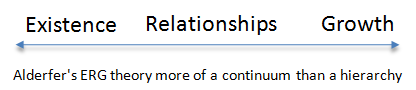
Alderfer's ERG theory states that more than one need may be influential at the same time. If the gratification of a higher-level need is frustrated, the desire to satisfy a lower-level need will increase. He identifies this phenomenon as the frustration and shy aggression dimension. Its relevance on the job is that even when the upper-level needs are frustrated, the job must provide the basic physiological needs that one would then be focused upon. If a person reaches this point and something happens to threaten the job, then the person's basic needs are significantly threatened. If there are no factors present to relieve the pressure, the person may become desperate and panicky.
While there has not been a lot of research on Alderfer's theory, most contemporary theories and related studies tend to give it stronger support than Maslow's theory.
Vroom's Expectancy Theory
Vroom's Expectancy Theory (1964) states that an individual will act in a certain way based on the expectation (belief) that the act will be followed by a given outcome and on the attractiveness of that outcome to the individual. Several people, to include Porter and Lawler (1968), have modified this motivational model. Vroom's Expectancy Theory is often written as a formula:
Valence x Expectancy x Instrumentality = Motivation
- Valence (Reward) = the amount of desire for a goal (What is the reward?)
- Expectancy (Performance) = the strength of belief that a work related effort will result in the completion of the task (How hard will I have to work to reach the goal?)
- Instrumentality (Belief) = the belief that the reward will be received once the task is completed (Will others notice the effort I put forth?)
This formula is illustrated in the following model:
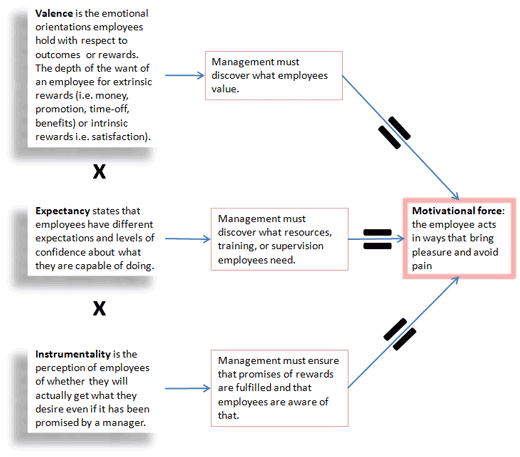
The product of valence, expectancy, and instrumentality is motivation. It can be thought of as the strength of the drive towards a goal. For example, if an employee wants to move up through the ranks, then promotion has a high valence for that employee. If the employee believes that high performance will result in good reviews, then the employee has a high expectancy. However, if the employee believes the company will not promote from within, then the employee has low instrumentality, and the employee will not be motivated to perform better.
The thought manifests as the word;
The word manifests as the deed;
The deed develops into habit;
And habit hardens into character;
So watch the thought and its ways with care,
And let is spring from love
Born out of concern for all beings…
As the shadow follows the body,
As we think, so we become.
- From the Dhammapada - Sayings of the Buddha
Next Steps
Go to the next chapter: Motivation
Go to the main Leadership Page
Return to Part I of Leadership and Human Behavior (Maslow, Herzberg, and McGregor)
References
Alderfer, C. (1969). An Empirical Test of a New Theory of Human Needs. Organizational Behavior and Human Performance, vol. 4, pp. 142-175.
Porter, L., Lawler, E. (1968). Managerial Attitudes and Performance. Homewood, Ill.: Dorsey Press.
Vroom, V. (1964). Work and Motivation. New York: Jon Wiley & Sons.