
Note: This site is moving to KnowledgeJump.com. Please reset your bookmark.
Learning Activities for Instructional System Design
Seven learning activities for learning Instructional System Design are presented:
- The Art of Observing
- Interviewing and Listening
- Surveys
- Jobs and Tasks
- Performance Problems
- Case Study 1
- Case Study 2
The Art of Observing - Fact vs. Inference
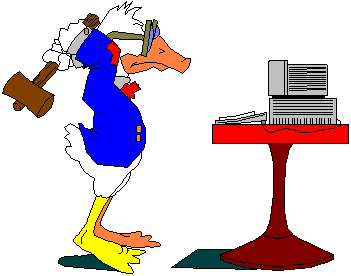
This activity is to help illustrate the difference between statements of fact (descriptions of observations) and statements of inference (opinions).
Write about 10 statements of facts about the picture above, for example, "There is a computer on the table."
- __________________________
- __________________________
- __________________________
- __________________________
- __________________________
- __________________________
- __________________________
- __________________________
- __________________________
- __________________________
Questions:
1. What are the major differences between statements of fact and statements of inference?
2. Why is it especially important during conversations, both in gathering and evaluating the data, to distinguish between fact and inference?
3. When can statements of inference be used in the analysis phase?
4. Should both statements of facts and inference be treated with the same degree of certainty? Why?
Interviewing and Listening
Interviewing is an important part of discovering what tasks need to be trained. The two most important activities an analyst performs are asking questions — most of us know how to that, and listening — most of us could improve on this. A good listener:
- Is aware of all the cues the speaker emits (voice, demeanor, vocabulary, and gestures).
- Listens with a purpose (listening requires more work than speaking).
- Is aware of the feelings that arise within - our own emotional resonance is another ear.
- Listens with mind, heart, and soul.
- Listens to the messages that are buried in the words or encoded in the cues that surround the words.
Reflect on the following three questions:
1. Of the five statements above, which ones do you perform effectively?
2. Which ones could you improve the most?
3. Ask a couple of close friend if they agree with your assessment, then try inserting those improvements into your daily conversations.
Listed below are eleven activities that good listeners perform. Watch one of your favorite day or night time talk show hosts as they interview someone (Jimmy Fallon, Oprah Winfrey, etc.). Write a few comments below each activity as to what they are trying to achieve and how they go about performing when they use one of these good listening techniques.
- Invites additional comments, "Go on", "What else?" Comment ___________________________
- Asks questions for more in-depth details or clarification. Comment ___________________________
- Uses variety - "Yes", "I see", "Go on", "Right", NOT "Yes", "Yes", Yes". Comment ___________________________
- Avoids complete silence. Comment ___________________________
- Leans forwards (demonstrates interest). Comment ___________________________
- Uses direct body orientation. Comment ___________________________
- Uses relaxed but alert position. Comment ___________________________
- Establishes open body position (do not cross arms). Comment ___________________________
- Uses facial expressions and head moments. Comment ___________________________
- Uses direct eye contact. Comment ___________________________
- Sits or stand close to speaker. Comment ___________________________
Answer Guide for Interviewing and Listening
Surveys
Choose a job of special interest; it should be one that you would enjoy performing an analysis on. Compare how you would carry out the analysis by performing a survey and by using another method, i.e. Observation Task Analysis (observe task), Simulated Task Analysis, Content Analysis (analyze books and manuals), or Interview Analysis (Consult with Subject Matter Expert):
1. What would the survey provide that the other method would not?
2. What method(s) would you use if you had an unlimited budget?
3. What method(s) would you use if you had a very limited budget?
Jobs and Tasks
There are five components of a job:
- Job - The main description of what a person does.
- Duties - contains two or more tasks.
- Tasks - contains two or more elements. A Task has an identifiable beginning and end.
- Elements - contains two or more KSA.
- Knowledge, Skills, and Attitudes (KSA).
Example One
| Component | 1st Example | 2nd Example |
| Job | Trainer | Trainer |
| Duties | Instruct classes | Identify training needs |
| Tasks | Lead a classroom discussion | Analyzes task being performed |
| Elements | Ask leading question | Lists performance steps |
| SKA | Actively Listens | Ability to identify a task |
Example Two
| Component | Example |
| Job | Mechanic |
| Duty | Tune engines |
| Task | Rebuild carburetor (must have verb and object) |
| element | Replaces a worn part on a carburetor |
| SKA | Identify parts of a carburetor |
Break down your job and another job that you are familiar with into the 5 main components. Place special emphasis on the task as it is normally the center of learning objective (that will be discussed in the next chapter - Design):
My Job- Job:_______________________________________________________
- Duties:____________________________________________________
- Tasks:_____________________________________________________
- Elements:__________________________________________________
- SKA:_______________________________________________________
Another Job
- Job:_______________________________________________________
- Duties:____________________________________________________
- Tasks:_____________________________________________________
- Elements:__________________________________________________
- SKA:_______________________________________________________
Answer Guide for Jobs and Tasks
Performance Problems
Good trainers are also performance specialists, that is, they assist in the identification of training and non-training problems. The Performance Analysis Quadrant (PAQ) is a tool to help in the identification. By asking two questions, "Does the employee have adequate job knowledge?" and "does the employee have the proper attitude (desire) to perform the job?" and assigning a numerical rating between 1 and 10 for each answer, will place the employee in 1 of 4 the performance quadrants:
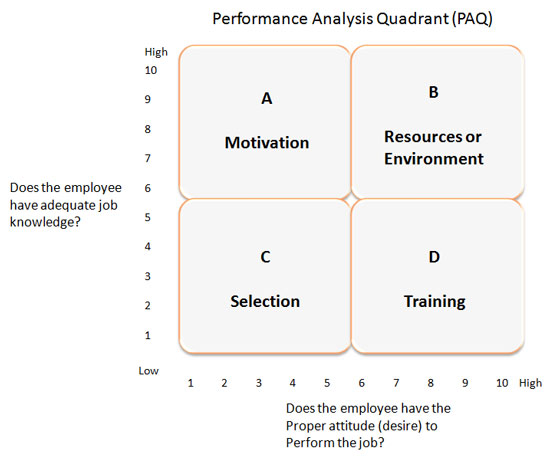
1. Quadrant A (Motivation): If the employee has sufficient job knowledge but has an improper attitude, this may be classed as motivational problem. The consequences (rewards) of the person's behavior will have to be adjusted. This is not always bad — the employee just might not realize the consequence of his or her actions.
2. Quadrant B (Resource/Environment): If the employee has both job knowledge and a favorable attitude, but performance is unsatisfactory, then the problem may be out of control of the employee. i.e. lack of resources or time, the work station is not ergonomically designed, etc.
3. Quadrant C (Selection): If the employee lacks both job knowledge and a favorable attitude, that person may be improperly placed in the position. This may imply a problem with employee selection or promotion, and suggest that transfer or discharge be considered.
4. Quadrant D (Training): If the employee desires to perform, but lacks the requisite job knowledge or skills, then additional training may be the answer.
Questions
1. Draw a mental image of an employee you know who is not performing adequately. Select an intersection point in the PAQ matrix that best portrays the employee's behavior by answering the vertical axis' "Does the employee have adequate job knowledge?" and the horizontal axis' "Does the employee have the proper attitude (desire) to perform the job?"
What quadrant did the employee fall into?
2. Do performance problems always point to training?
2. Considering the employee performance problems in your organization, is there a pattern to the form they take (e.g. are most in Quadrant)? If there is a pattern, what does this tell you?
3. What implications does this model have for the role of a trainer as a problem-solver?
4. Should training be given if the problem clearly points to a quadrant besides training?
Answer Guide for Performance Problems
Case Study One: Wholesome Food
A case study on an organization that promises safety improvements.
Case Two: The Fall of Quest
A case study based on the troubles of a computer manufacturer in 1999.
Answer Guide for Activity 1 - Observing
Answer Guide for writing 10 statements of facts about the picture of the duck:
Statements of facts would include such items as:
- There are two buttons on the duck's jacket
- The duck has a hammer.
- There is a computer on the table.
- The jacket is blue.
- The duck is wearing glasses.
- The duck is holding a hammer.
While statements of inference would include such items as:
- The duck is mad at the computer. (he might only be acting)
- The duck is going to smash the computer with the hammer. (he might only be posing)
- The duck thinks the computer is bad. (we have no idea what he thinks)
1. What are the major differences between statements of fact, and statements of inference? Statements of facts are limited to description, made only after observation, and limited in the number that can be made (there are only so many facts that can be stated). Statements of inferences go beyond what was directly observed, can be made at any time without observation, and are unlimited in number (it is almost unlimited in the number of assumptions that can be made) .
2. Why is it especially important during conversations, both in gathering data and evaluating, to distinguish between fact and inference? Danger of misunderstandings, ineffective communication, failure to document the task performance correctly, etc.
3. When can statements of inference be used in the analysis phase? Psychomotor tasks (skills) are normally observable so you can observe the task being performed to get the facts. Cognitive tasks (knowledge) are not normally observable, but you can make inferences and then back your inferences by observing the performance and ensuring that the end product is up to standards. You can also interview the task performer or other Subject Mater Experts (SME). Affective tasks (attitudes) are also not normally observable; and to make it even harder, the affective domain is a latent construct, that is, it is composed of concepts, models, and schematic ideas (biases) that are present in the unconscious mind, and these biases cannot always be consciously expressed by the person holding them. Many biases (subjective points of view) are good, for they allow us to make sense of new information and experiences based upon what we already know. It is when we allow these biases to shade our perceptions of what we or others are capable of doing that they become harmful — and this is where training and development comes in — to turn these bad biases into good biases.
4. Should both statements of facts and inference be treated with the same degree of certainty? Why? No, statements of inference are always suspect until they can be proven with facts.
Answer Guide for Activity 2 - Interviewing and Listening
Note that both of these exercises are reflection type activities where there are no right or wrong answers. Reflecting uses mental concentration and careful consideration to come to a strong thought or opinion. We use three main means of acquiring knowledge:
- Observation - collecting facts by observing
- Reflection - combines all the facts we observed to obtain a theory or premise
- Experimentation - verifies the result of that combination
Answer Guide for Activity 3 - Surveys
1. What would the survey provide that the other method would not? Surveys allow you to reach a large number of people at a reasonable cost. That is, you could survey your entire organization to ensure you captured everyone. This method works well if your organization is not too large, as you have to compile all the data once the surveys are completed.
They also allow you to produce a representative distribution of the target population. That is, if the survey is conducted correctly, you only have to survey a percentage of your organization. This allows large organizations to determine its requirements without surveying and compiling the results of everyone within the organization.
2. What method(s) would you use if you had an unlimited budget? Normally, you want to use at least two methods, with actually observing the task as a preferred method.
Various Approaches to Needs Analysis will help to explain the benefits of different approaches.
3. What method(s) would you use if you had a very limited budget? Normally, you would want to observe the task or have a Subject Matter Expert (SME) document the procedures. If you had a lot of task to check, then a survey would be the cheapest.
Answer Guide for Activity 4 - Jobs and Tasks
Job: This component should include a trade, occupation, profession, or position such as plumber, waiter, doctor, accountant, writer, etc. Note that some jobs might be the same, although they might have different titles at different companies. For example, a warehouse person, inventory control specialist, and shipper receiver could all have the same duties at different companies.
Duties: These are acts or course of actions that are required of one by position. They are generally not as well defined as tasks. For example, a medical lab technician will perform duties of blood tests, while the tasks will be the specific tests they perform, such as cholesterol or diabetic. Waitresses will perform duties of serving customers, while the tasks include taking orders, serving meals, recommending wines, etc.
Tasks: This has an identifiable beginning and end; that is, something should result from or be produced by the work. It is also is a well-defined responsibility. For example:
- The trainer who "Leads a classroom discussion" should produce some trained students.
- The mechanic who "Rebuilds a carburetor" should produce a carburetor in good working condition.
- The medical lab technician who "draws blood for a cholesterol test" should produce some valid cholesterol levels that can be read and used by a doctor.
- The waitress or waiter who "takes an order" should produce a ticket that can be read and used by the cook to prepare a meal.
- An insurance writer who "writes or creates a policy" should produce a document that clearly spells out what the insurance company will cover and what both the company and client are responsible for.
Elements: These are the basic parts of a task and consists of the essential parts of performing a task. Some trainers consider the task performance steps as the elements. Performance steps are the step-by-step instructions for performing a task, for example an order packer would:
- Select correct size box for the order
- Pick items on customer-order by location
- Place packing material around all loose items
- Seal box
- Remove shipping labels from order and place on the top of the box
- Weigh box
- Place correct postage on box
- Confirm order (bills customer and deducts items from inventory)
Some trainers consider the elements to be parts or components of the task. For example, using the same task:, the elements might be:
- Gathering of items
- Boxing
- Shipping paperwork
SKA: These are the Skills, Knowledge, and Attitudes that allow a person to perform a task. For example, a forklift operator needs eye and hand coordination to control the movements of the forks so that no product is damaged, driving skills, knowledge of lifting capabilities, a desire to operate safely, ability to read charts and manuals, etc. For example, a trainer might need the ability to speak in front of groups, a desire to coach others on to excellence, interpersonal skills, etc.
Answer Guide for Activity 5 - Performance Problems
1. Draw a mental image of an employee you know who is not performing adequately. Select an intersection point in the PAQ matrix that best portrays the employee's behavior by answering the vertical axis' "Does the employee have adequate job knowledge?" and the horizontal axis' "Does the employee have the proper attitude (desire) to perform the job?"
What quadrant did the employee fall into?
The employee should have fell into one of the four quadrants: Motivation, Resource/Environment, Selection, or Training.
Do performance problems always point to training?
See the four quadrants, only one of them clearly points to training.
2. Considering the employee performance problems in your organization, is there a pattern to the form they take (e.g. are most in Quadrant)? If there is a pattern, what does this tell you?
That instead of there being individual problems that are in every organization, there might be a flaw in a process that is allowing a certain group of problems to creep in.
3. What implications does this model have for the role of a trainer as a problem-solver?
Some managers believe that the best solution towards a performance problem is training. The trainer should help the manager (or messenger) identify the type of problem they have and then steer them towards the proper solution, which might be AWAY from training.
4. Should training be given if the problem clearly points to a quadrant besides training?
Only if your analysis determines that training will help. And normally this training will be given to someone besides the performance problem person. For example, if it is a selection problem, then the person(s) involved in hiring the individual might need training in interviewing and new-hire selection.
Also, some managers might be adamant about performing training, even if your analysis determines that training is not the answer. You and your managers will then have to select a solution that best maintains the relationships you have built.
Answer Guide for Activity 6 - Case Study 1
- What role can Wholesome Path's human resource department play in making the workplace safer? Ensuring that safety committees are in place, provide training for forklift operators, provide safety training, etc.
- What might the company have done to prevent them from getting into trouble with OSHA? Consult with a lawyer or human resource specialist in the manufacturing field to ensure they were complying with all government regulations. Also, perform task analysis on all the major processes as this would help to uncover any unsafe procedures. This could be done in conjunction with process improvement to reduce costs.
- What type of analysis might you perform to ensure that the safety training programs are adequate? Any method that consults with the SME (Subject Matter Experts) and technical references. The experts and manuals should be able to reveal any safety procedures that might be missing.
- What would you recommend if your analysis showed that training was not the answer? In most instances, you would want to implement the performance improvement program that best fixes the problem. However, since Wholesome Path's safety track record has drawn the interest of OSHA, then in this instance it might be advisable to implement the training programs, even if it is redundant.
- What type of training could you provide for the supervisors and management, besides safety, that would help them comply with OSHA requirements? A couple of programs would be advisable: 1) Communication training that helps them relate to the employees as they often know the safest and best method for performing tasks and procedures. Also, if they had a good communication program in place in the first place, this trouble with OSHA might have never happened. 2) Supervisory training, as you want to ensure that all the safety rules and regulations are followed. It is not enough to simply post and train the rules . . . they must also also be enforced.
Answer Guide for Activity 7 - Case Study 2 - The Fall of Quest
Discussion - Competencies
- What are competencies and how are they related to performance? Having the required competencies means that a person is qualified to perform a task or job. This in turn means that it will be performed to the best interest of the organization. That is, the person will help the organization to excel by his or her performance. It does not necessarily mean it will be performed to set standards as the standards might have been arbitrarily built by someone with less knowledge of what the job requires.
- How do Skills, Knowledge, and Attitudes (SKA) fit into competencies? In order to have a competency, you must first have the skill and/or knowledge that allows you to perform. Having the proper attitude or desire will then allow you to excel at that task performance.
- What is leadership and how do competencies fit in with it? Although there are many definitions of leadership, almost all of them have two things in common: 1) having a vision to aspire to 2) having a certain charismatic (or traits) that inspires others to follow that leader. The leader must also have a set of competencies, which are different for each organization and position, that helps to build trust among the leaders followers and other leaders.
- What are the differences between job based performance models and competency based performance models? In job based performance models, the standards are built and then the jobholder must meet these standards. In a competency driven organization, the standards are based on jobholders who have been identified as good performers.
- How can implementing a competency based performance model help Quest? By first identify the great leaders, and then building a model based on them for the other leaders to follow. In areas where they fall short, development and training programs should be built to help them achieve the model's required competencies.
- If a competency based performance model was implemented years earlier at Quest, do you think it would have prevented its present troubles? Why? My best guess is that no, it would not of helped. Normally, leaders who are this high up on the hierarchy would not be held as accountable for a competency based performance system as they would have already been deemed to have the necessary competencies. But, by implementing one now will help to build the future leaders and inspire trust back into the system.
- What are the three key leadership competencies that you believe are most important for Quest's leaders to have in order to ensure its survival? This is open for debate, but I would pick:
- Building visions and trust — inspiring others to follow them.
- Fostering conflict resolutions — building win/win resolutions.
- Decision making — being able to make the HARD choices.
Discussion - Building the Competency Model
- What methods could you use to determine the required competencies? What method do you think would work best for quest? See "Building the Leadership Competency Model."
- How could you validate your competency model? See "Building the Leadership Competency Model."
- How can you help to ensure the competency model will be accepted by all the members of Quest? By getting them involved — people accept what they build and challenge what is forced upon them.
- Who do think will be most resistant to the implementation of a competency model at Quest - the executives, upper management, middle management, supervisors, or the workers? Why? Who might be the least resistant? This is open for debate but I would say that the executives and upper management would be least resistant as they know they need to repair the damage. The lower levels would be the most resistant as their trust has been violated by their leaders.
Discussion - Building the Leadership Appraisal Model
- How and why should you trial the leadership appraisal model? Any of the discussed methods can be used to validate it. It needs to be validated to ensue the model is correct.
- What pitfalls do you think the leaders at Quest might be most susceptible to when performing an evaluation? Open for debate, however they will want to rush it as they believe they need to accomplish something and they will want to model it after themselves (many leaders are very egotistical — its how they got there in the first place).
- How can you help them to perform the performance appraisal correctly once it is implemented? By ensuring they are trained to so and then coaching them throughout the process.
Discussion - Other Topics
- What are some short-term human resource strategies that can be implemented to help Quest become more competitive? Having discussions between the workers and top leadership (getting a dialog going), implementing development and educational programs to increase the quality of leadership within all ranks, teach management—by—walking—around to top management in order to help develop trust, etc.
- What role should the human resource department perform in an organization? Why did the last regime go out of bounds? Most human resource departments walk a fine line — they are charged with growing and guarding the organization's workers of all ranks which means they need to look out for the organization's best interest. Yet, by growing and guarding the individuals, they take on the responsibility of also looking out for these individuals' best interest... so who come first — the organization or the individuals? The last regime went out of bounds because they looked after their interest first instead of their people and the organizations'.
- How can you help the departments' managers to determine when they are meddling in other departments affairs, and when the are actually helping other departments? One way is by helping to create a healthy dialog and fostering win/win relationships.
- How do you approach an executive who you believe is not performing in the best interest of the organization? One way is by being honest and forthcoming. Another method is to approach another leader who is on close terms with the executive.
Next Steps
Go to the next Chapter: Design
Return to the Table of Contents for Instruction System Design
Return to the Leadership guide for competencies: Case Study: The Fall of Quest