
Note: This site is moving to KnowledgeJump.com. Please reset your bookmark.
Arousal, Learning, and Performance
Arousal is a major aspect of many learning theories as it is closely related to other concepts, such as attention, motivation, agitation, anxiety, and stress.

Our level of arousal varies with our physical condition and surrounding environment
The arousal level may be thought of as how much emotional capacity you have available to work with. One finding with respect to arousal is the Yerkes-Dodson law, which predicts an inverted U-shaped function between arousal and performance (Yerkes, Dodson, 1908):
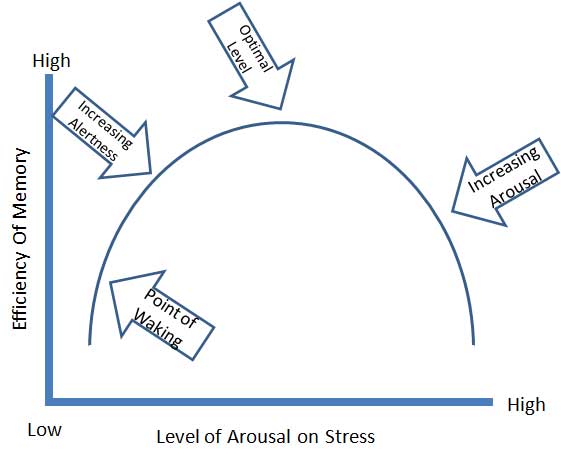
A certain amount of arousal can be a motivator toward change (with change in this discussion being learning). However, too much or too little will work against the learner. You want some mid-level point of arousal that arouses them with the attention and motivation to learn, as shown with the optimal arrow in the above chart, but does not raise the emotional level to a point of anxiety or stress. Too little arousal has an inert affect on the learners, while too much has a hyperactive affect.
There has been quite a bit of research indicating the correlation suggested by Yerkes and Dodson exists (Broadhurst, 1957; Duffy, 1957; Anderson, 2000), but a cause of the correlation has not yet been fully established (Anderson, Revelle, Lynch, 1989). Although the Yerkes-Dodson law is quite old, it has held up in time through numerous studies.
There are optimal levels of arousal for different kinds of concepts or task to be learned:
- lower for more difficult or intellectually (cognitive) tasks
- higher for tasks requiring endurance and persistence
For example, an algebra or software programming class requires a high level of engagement on the cognitive level, thus, arousal must be kept low as you need the learners' full attention on the subject matter as too much arousal overloads them.
Whereas the arousal level in a team training episode is normally higher as it requires more of the learners' self-system (emotional level). It also normally requires a lower level of cognitive engagement.
You might think of arousal and cognitive levels as two fluids in a glass. If you put too much in of any ingredient, the glass overflows, or put too little in, then you are not using the glass to its fullest capabilities. And if the ratio of the two ingredients is not correct, it does not provide the proper nutrition.
What does this mean to trainers?
Environmental arousal factors, such as the noise, temperature, and comfort levels, must be controlled. This allows you to put more arousal factors that are beneficial to learning, without going into arousal overload. For example, a colleague of mine once had to give some training at a meat packing company. The only place they had for him to train was in a cold storage warehouse. He managed to get through the training by leaving out most of the arousal factors that he normally uses. The cold room had already overloaded the learners' peak arousal level (stress) and he did not want to arouse them anymore.
When training tasks that are high on the cognitive scale or are highly complex, use less motivators and keep the stress level low. The brain tends to shut certain aspects out when it has too many inputs coming in at once, and the one input that you do not want it to shut out is what the learners need to learn. Some instructors call this brain-overload or brain-cramps. This does not mean you cannot make the material interesting, just keep their arousal on an even keel.
Outdoor or physical team training activities normally require more arousal techniques. This is where the instructor has to become more of a college football coach and less of a trainer. The effort to reach the peak arousal point where the most change (learning) takes place is higher on this scale than cognitive learning. To reach that peak arousal point you need to provide more attention and motivation. This is why such team training programs as the U.S. Armed Forces Basic Training creates great teams — they reach the arousal point that is on the high-end for this type of learning.
Tests can be great motivators for getting students to learn...it shows they mastered the task, they do not like to fail, they want that certificate, its a challenge, etc. However, test-taking anxiety can push some learners' arousal level over the optimal point. You can reduce stress levels by supplying non-graded quizzes and performance activities that provide reassurance and feedback to the learners.
When the optimum arousal point goes too low, then use activities that get the learners interacting with each other or moving. Provide inspirational speeches, challenging games, and puzzles. Give a pop quiz.
If the optimum arousal point goes too high, then take the focus off cognitive goal, such as eliminating “what if” statements. You can also take a break, watch a video, stretch. Play a fun, but interesting game.
Provide the who, what, when, where, why, and how questions about the learning to take place as it helps to eliminate fears... this will help you control the learning environment stress factors.
Anxiety and Arousal
Some trainers might believe that all anxiety must be removed from the training environment. But, again, there is an optimal level. The Optimal Arousal Level can be thought of as the Optimal Motivational Level. And one of the things that motivate people is anxiety. But, many people seem to have a negative connotation to the word "anxiety" as they associate it with neurotic inferences. It might help to picture anxiety in three terms as Freud did:
- Reality anxiety - the fear of a real danger in the external world that alerts the ego to danger. NOTE: This is the type of anxiety needed in some types of training, while the next two need to be eliminated.
- Neurotic anxiety - the fear that one's inner impulses cannot be controlled (id).
- Moral anxiety - the fear of the retributions of one's own conscience (superego).
Mild anxiety motivates us in the real world. Without it, bills would not be paid on time, term papers would not get written, people would not get medical check-ups, drivers would race, people would steal, etc. In the real world, anxiety is a major motivational force that drives and changes our behavior.

Of course, too much anxiety impedes the learning process
When you take anxiety out of the training environment, you leave the learner without a major motivator. There is an old learning theory (now discredited) in which the learner is an empty vessel in which the instructor pours knowledge. And unintentionally, this is how many training environments now operate. All the learners have to do is show up for the training session and they pass as the training environment has been completely sanitized of all emotions. The trainers believe that their entertaining and interesting instruction is going to be poured into the learners.
Excellent training places the responsibility of learning on both the trainer and the learner - the trainer provides the learning tools, while the learner's responsibility is to use these tools. And by creating an anxious-free environment, you take away one of the major motivational tools of the learner.
Perhaps anxiety's most effective use in training would be in a safety class. Pilots go through simulators not only for the psychomotor practice and to increase their knowledge, but also because some of the simulations are so realistic that they get anxiety attacks that tell them "danger, do something now!" not "something is going wrong, lets wait and see what happens." These types of anxiety attacks are our friend, they tell us to take immediate action by releasing adrenaline into the bloodstream, stimulating the heart, raising the metabolic rate, and increasing the blood glucose concentration.
Safety is not only having the knowledge to do things the correct way, the skills to perform correctly, but also the "attitude to react" to unsafe conditions. Some have said it is unethical for trainers to change attitudes, or that trainers should change behaviors, not attitudes. That is a training cop-out. I work in a plant with forklifts, conveyors, machinery, and many other potential hazards. When I leave work I want to do so via my car, not in a hearse on the way to the county morgue or in an ambulance with an amputated leg, because the people who work with me "displayed safe behaviors" but did not have the attitude to react to something going wrong or sense (become anxious) when they were about to do something dangerous. Failing to incorporate affective (attitude) domain training into a safety classes means that you, the trainer, failed at your task.
The Learning Zone
How do you know when you have reached the optimum arousal point for your learners? In sports, a player who is playing great is at the optimum arousal point and is said to be "in the zone." Achieving the optimum arousal level in a training environment puts students in the Learning Zone:
-
They become totally involved in the learning process by centering in on the task to be learned as non-learning stressors have been eliminated.
-
They lose self-consciousness of the fear they might fail and gain a desire to succeed as their emotions are now tied to the learning environment. Failing becomes challenges because they become more adaptive to the learning environment and they believe the learning environment will "fine tune" itself to meet their needs.
-
They have clear visions of what the task to be learned can provide as they know how it will help them in their future endeavors.
-
They have a sense of being in control of their learning environment as they are ripe for learning (they are NOT just going through the motions).
-
They become more intrinsically motivated (self-directed) because they want to learn the task (their focus is on the task rather than reward and punishment).
The optimum level of arousal allows one to go from this

to this

Thus, each task has an optimal level of arousal and the level of arousal includes anxiety, attention, agitation, stress, and motivation. The trainer's job is to help each learner reach their optimal level of arousal so that their focus is totally on the task to be learned.
Recent Research and Findings
A University of Chicago researcher reported performing tests on the influence that a stress-related hormone has on learning in ground squirrels and that it could have an impact on understanding how it influences human learning. Jill Mateo (2007), Assistant Professor in Comparative Human Development, said that modest levels of cortisol are apparently linked to their survival. The inverted U, similar to Yerkes-Dodson's law, is the shape data forms on a chart. Animals with low levels of cortisol are at the left of the inverted U, and those with high levels are at the right, while those with modest levels and higher learning are in the middle. You can find more information on this story at Science Daily.
Next Steps
Performance Essays
-
Arousal
References
Anderson, J.R. (2000). Cognitive psychology and its implications. 5th Ed. New York: Worth.
Anderson, K.J., Revelle, W., Lynch, M.J. (1989). Caffeine, impulsivity, and memory scanning: A comparison of two explanations for the Yerkes-Dodson Effect. Motivation and Emotion, 13(1), 1-20.
Broadhurst, P.L. (1957). Emotional Psychology, 54(5), 345-352.
Duffy, E. (1957). The psychological significance of the concept of "arousal" or "activation." Psychological Review, 64(5), 265-275.
Mateo, J.M. (2007). Inverted-U shape relationship between cortisol and learning in ground squirrels. Journal Neurobiology of Learning and Memory (online). Neurobiol Learn Mem. 89(4): 582–590..
Yerkes, R.M., Dodson, J.D. (1908). The Relationship of Strength of Stimulus to Rapidity of Habit Formation. Journal of Comparative Neurology and Psychology. 18(5), 459-482.