

Note: This site is moving to KnowledgeJump.com. Please reset your bookmark.
Beliefs and Performance
Do you believe in life after love
I can feel something inside me say
I really don't think you're strong enough
—Believe by Cher
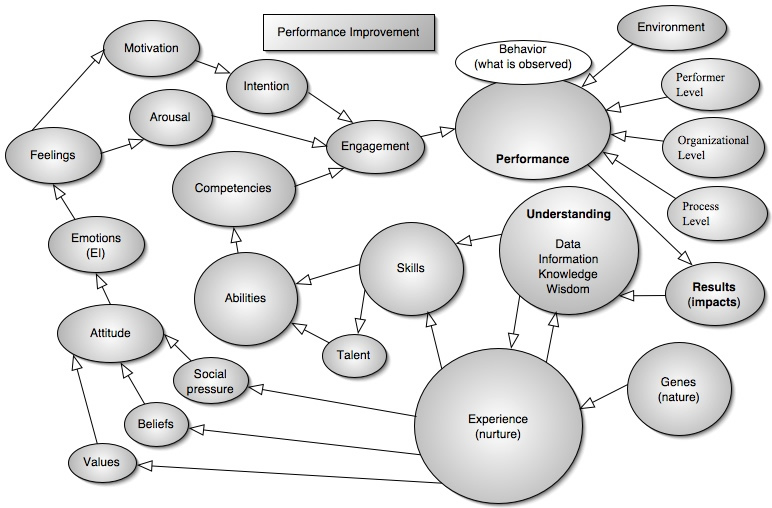
Beliefs are assumptions or convictions that a person holds to be true regarding people, concepts, or things (U.S. Army, Oct 83). Beliefs, values, and norms guide the actions of individuals and groups. They are quite powerful as people will often risk danger and die for deeply held beliefs and values.
Thus, values and beliefs are the internal forces that guide us, while norms, both formal and informal, are the external forces that guide us. In turn, knowledge of our surroundings directly influence our beliefs and values.
The power of knowledge to organize, select, learn, and judge comes from values and beliefs as much as, and probably more than, from information and logic. — Thomas Davenport and Laurence Prusak (2000).
In the Logic, Kant distinguishes opinion, belief, and knowledge, which are the three modes of holding-to-be-true. He viewed belief as a form of judging something to be true, intermediate between mere opinion and knowledge. Kant writes, “Opinion is problematic, believing assertoric, and knowing apodeictic judging.” Note that an assertoric proposition in Aristotelian logic asserts that something is (or is not) the case, in contrast to problematic propositions that assert the possibility of something being true, or apodeictic propositions that assert things which are necessarily or self-evidently true.
References
Davenport, T. H. & Prusak, L. (2000). Working Knowledge. Massachusetts, Boston: Harvard Business Press. p.12.
U.S. Army. (October 1983). Military Leadership (FM 22-100). Washington, DC: U.S. Government Printing Office.