

Note: This site is moving to KnowledgeJump.com. Please reset your bookmark.
Performance
What have you done today to enhance (or at least insure against the decline of) the relative overall useful-skill level of your work force vis-a-vis competitors? — Tom Peters in Thriving on Chaos
Performance is focused behavior or purposeful work (Rudman, 1998, p. 205). That is, jobs exist to achieve specific and defined results (outputs) and people are employed so that organizations can achieve those results. This is performed by accomplishing tasks.
Gilbert (1998) said that performance has two aspects—behavior being the means and its consequence being the end.
Managing performance has the dual purpose of 1) arranging situations (environment) so that employees can do their best and 2) growing the employees by educating, enlightening, and appreciating them. Its purpose is to achieve specific and defined results from people so that the organization can achieve its goals and objectives.
It is much easier to fix situations by making structural changes to the organization, rather than trying to fix or change people. These include such means as changing reporting relationships, enlarging the job, improving a process, or opening lines of communication.
Once performance barriers have been removed, employees can be educated, enlightened, and appreciated. This assumption is based on the premise that most employees try to do their best. They prefer harmony over conflict, action over inaction, and productivity over delays (Farson, Crichton, 1996). We often refuse to believe this as most studies on human behavior are performed on people when they are not at their best, such as in school, clinics, or prison. Thus, most studies on human behavior are performed in the process of trying to reform people.
The two most noted researchers on studying people when they are at their best are Carl Rogers and Abrahan Maslow.

Rogers described a healthy person as fully functioning. One of Rogers' theories is the Actualizing Tendency—the built-in motivation present in every life form to develop its potentials to the fullest extent possible. It is not just about survival, but also that all creatures strive to make the very best of their existence. If they fail to do so, it is not due to lack of desire, but rather of other conflicts. Rogers also introduced Person Centered Therapy, in which all people have the potential to solve their own problems without direct intervention from a therapist (non-directive).
Abraham Maslow felt that the basic human needs were arranged in a hierarchical order.
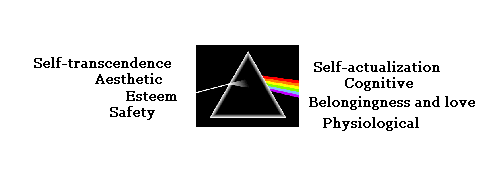
He based his theory on healthy, creative people who use their capabilities to the fullest. First, our basic physiological, psychological, and self-esteem needs must be met. Once these are met, we strive for higher needs (meta needs or growth needs). These include justice, goodness, beauty, order, unity, etc.
Maslow's theory remains a classic because rather than looking at psychology as strictly the study of the mentally ill, his theory was based upon healthy persons. And being one of the first ones, it has its share of flaws. Yet it does not mean it was a bad theory or that he does not know anything about theories, indeed he probably put one of the best 100 theories forward, because rather than viewing psychology as being just a tool for clinical use, he advanced the idea that it might also prove to be useful in everyday life.
A recent study (Tay, Diener, 2011) discovered that as hypothesized by Maslow (1954), people tend to achieve basic and safety needs before other needs. However, fulfilling the various needs has relatively independent effects on a person's Subjective Well-Being. Thus rather than being a pyramid with the basic human needs arranged in a hierarchical order, it is more like a box with the basic human needs scattered within and depending on the situation and/or environment, different needs rise to the top to compensate for the deficient needs.
Maslow divided theories into empirical theories and a priori (sometimes called abstract):
- An empirical theory is an effort to organize and to unify knowledge so that we can grasp it. An a priori theory makes no such effort, it commits the great sin of denying human ignorance.
- An empirical theory is humble, while the a priori theory is arrogant.
- An empirical theory can shift and change, thus it easily modifies itself as new information comes available. An a priori theory divorces itself from empirical foundations, thus it lives on its own.
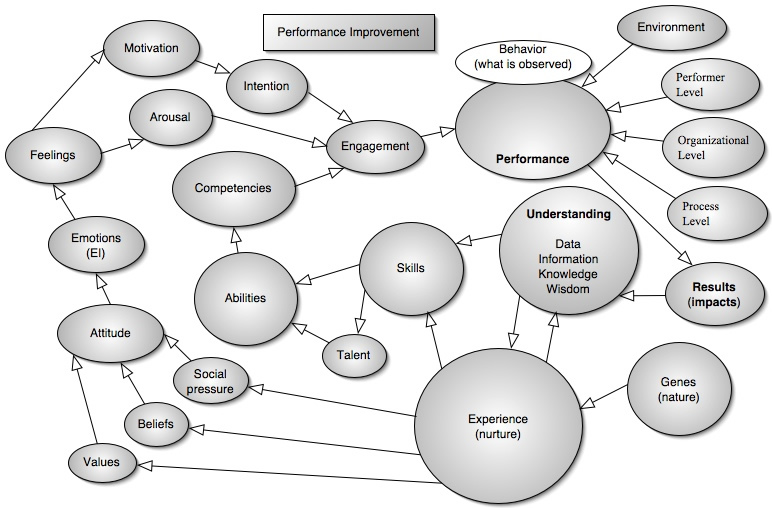
Performance Typology Map
For more information about the various aspects or topics of performance, click on the performance typology map located on the upper-left hand corner of this page (for a larger and clearer image) or click one of the topics below the map.
Reference
Farson, R., Crichton, M. (1996). Management of the Absurd. New York: Simon & Schuster, p. 130.
Gilbert, T. (1998). A Leisurely Look at Worthy Performance. The 1998 ASTD Training and Performance Yearbook. Woods, J. & Gortada, J. (editors). New York: McGraw-Hill.
Maslow, A. (1954). Motivation and Personality. New York: Harper and Row.
Rudman, R. (1998). Performance Planning and Review. Warriewood, Australia: Business & professional Publishing.
Rummler, G. & Brache, A., (1990). Improving Performance: How to Manage the White Space on the Organization Chart. San Francisco: Jossey-Bass.
Tay, L., Diener, E. (2011). Needs and subjective well-being around the world.. Journal of Personality and Social Psychology, Vol 101(2), Aug 2011, 354-365. doi: 10.1037/a0023779.