Note: This site is moving to KnowledgeJump.com. Please reset your bookmark.
Growing a Team
I think the Army would make a serious mistake if we made a distinction and said, “You are a manager, and you are a leader.” So my philosophy is that we are all leaders! We also must be responsible managers or stewards of resources entrusted to us. We would make a serious mistake to think that we could be one and not the other. — General John Wickham.
 Leaders should not think of themselves as simply managers, supervisors, etc.; but rather as “team leaders.” Thinking of yourself as a manager or supervisor places you in a position of traditional authority based solely on respect for the position, which in turn places you in a position of power. By understanding the personal work preferences and motivations of your team members, you as an individual, rather than your position, will earn their real respect and trust.

This means that the people under you are not simply followers who blindly go where you go, but rather are a dedicated group who are supportive of collaboration in order to achieve a common goal through mutual knowledge and skill sharing.
What is a Team?
A team is a group of people coming together to collaborate. The purpose of collaboration is to reach a shared goal or task for which they hold themselves mutually accountable. A group of people is not necessarily a team. A team is a group of people with a high degree of interdependence geared towards the achievement of a common goal or completion of a task, rather than just a group for administrative convenience. A group, by definition, is a number of individuals having some unifying relationship.
Team members are deeply committed to each other's personal growth and success. That commitment usually transcends the team. A team outperforms a group and outperforms all reasonable expectations given to its individual members. That is, a team has a synergistic effect—one plus one equals a lot more than two.
Defining a Team
Katzenbach and Smith (1986) define a team as a small number of people with complementary skills who are committed to a common purpose, performance goals, and a common approach that they hold themselves mutually accountable:
-
The small number normally ranges from 2 to 25 members, with somewhere between 5 and 9 as normally the most manageable and optimal. If the number goes above 9, communication tends to become centralized because members do not have an adequate opportunity to speak to each other. If the group size is below 5, then the collective experience, skill, and knowledge base may be inadequate.
-
Complementary skills provide synergy when the team is diverse and various ideas and multiple skills are combined. If the team is composed of like-thinking individuals, a congenital group-think often sets in that limits the number of solutions for creative problem solving.
-
Common purpose is the driving force of teams. The team must develop its own purpose that must be meaningful and have ownership by all individuals. A team needs to periodically revisit its purpose in order to make it more relevant as the team develops (often called an agenda). This type of agenda is open. On the other hand are hidden agendas that select individuals try to push forth. Hidden agendas prevent the group from turning into a true team due to the emotions and motives that are hidden under the discussion table.
-
Performance goals are the acting, moving, and energizing force of the team. Specific performance goals are established, tracked, met, and evaluated in an ongoing process.
-
Common approaches are the means in which members agree on how they will work together. Teams should develop their own charter or set of rules that outline the expected behaviors of its members. Members often assume roles, such as the Questioner or Devil's Advocate, Historian, Time Keeper, and Facilitator, to keep the team processes moving and on course.
-
Mutually accountability is the aspect of teamwork that is normally the last to develop. It is the owning and sharing of the team's outcomes, both successes and failures.
Shared Mental Models
Team members not only cooperate in all aspects of their tasks and goals, they share in what are traditionally thought of as management functions, such as planning, organizing, setting performance goals, assessing the team's performance, developing their own strategies to manage change, and securing their own resources.

These shared mental models or knowledge structures allows each teammate to generate predictions and expectations about their teammates' roles and task demands, which in turn, allow them to make adjustments in order to maintain effective team performance (Cannon-Bowers, Salas, Converse, 1993).
And with today's social media tools, teams can not only create, modify, and/or distribute content, but also ask questions, provide answers, and give feedback in moments even when the team is far apart. Social media tools include such tools as blogs, microblogs (e.g., Twitter and Yammer), file sharing (e.g., Flickr and SlideShare), Virtual Meeting Places, (e.g., Adobe Connect and Elluminate), social sites (e.g. Facebook and MySpace) and wikis. And let's not forget two of the oldest social media tools, email and texts.
Major Benefits of Teams
- Teams maximize the organization's human resources. Each member of the team is coached, helped, and led by all the other members of the team. A success or failure is felt by all members, not just the individual. Failures are not blamed on individual members, which give them the courage to take chances. Successes are felt by every team member, this helps them to set and achieve bigger and better successes. In addition, failure is perceived as a learning opportunity, rather than a mistake to place blame.
- A team's output is superior, even when the odds are not in its favor. This is due to the synergistic effect of a team—a team can normally outperform a group of individuals.
- There is continuous improvement. No one knows the job, tasks, and goals better than the individual team members. To get real change, you need their knowledge, skills, and abilities. When they pull together as a team, they will not be afraid to show what they can do. Personal motives will be pushed to the side to allow the team motive to succeed.
Most teams aren't teams at all but merely collections of individual relationships with the boss. Each individual vying with the others for power, prestige and position. - Douglas McGregor
From Group to Team—Getting There
Tips for team building include:
Be Enthusiastic—it's Contagious
Become enthusiastic about one aspect at a time. Start by initially looking for a quick problem to be solved. Most teams trace their advancement to key performance oriented events that forged them together. Potential teams can set such events in motion by immediately establishing a few challenging, yet achievable goals.
First, find a problem and start to talk about it with the team; do not delegate it to an individual or small group, but rather make it a project for everybody. Choose a simple, but distracting work-related problem and solicit everybody's views and suggestions. Next, get the problem solved. Demand urgency against a clear target. There is no need to allocate large amounts of resource or time to this, simply raise the problem and make a fuss. When a solution comes, praise it by rewarding the whole team. Also, ensure that the aspects of increased efficiency, productivity, and/or calm are highlighted since this will establish the criteria for success. When the problem has been solved, find another problem (preferably bigger) and repeat.
Develop a Sense of Urgency
Team members need to believe the team has an urgent and worthwhile purpose. Establishing a sense of urgency and direction will help them understand what their expectations are. The more urgent and meaningful the need to reach a goal, the more likely it is that a real team will start to emerge. The best teams define their performance expectations, but are flexible enough to allow change to shape their own purpose, goals, and approach.
Set Clear Rules of Behavior
Teams develop rules of conduct to help them achieve their purpose and performance goals. Some rules you might want to consider:
- discussion - no sacred cows
- confidentiality - personal revelations must remain among the team
- analytic approach - facts are friendly
- constructive confrontation - no finger pointing
- share - everyone is both a teacher and a learner
- the most important - everyone does real work
Keep Them Informed
Challenge your team with fresh facts and information. New information causes a potential team to redefine and enrich its understanding of the objectives, thereby helping the team to set clearer goals.
Grow Together
Teams must spend a lot of time together (bonding), especially in the beginning. Yet potential teams often fail to do so. The time spent together must be both scheduled and unscheduled. Creative insights as well as personal bonding require impromptu and casual interactions.
Reinforcement Works Wonders
Exploit the power of positive feedback, recognition, and reward. Positive reinforcement works as well in a team context as elsewhere. For example, by being alert to a shy person's initial efforts to speak up, allows you to encourage continued contributions.
Other methods include:
- Focus on both development and performance. Make teamwork the norm for all actions. Model teamwork in the way you conduct business and the way you interact with your colleagues.
- Use all your leadership tools, such as coaching, counseling, mentoring, tutoring, and concentrating on improving performance.
- Use informal processes, such as the way you communicate, showing respect, and appreciating and celebrating their achievements.
- Your feelings must show commitment, loyalty, pride, and trust in your team.
- Share the credit.
- Create subcommittees for key areas and give them decision making authority.
- Take turns having a different member facilitate or lead the meetings.
- Talk last in discussions, after you've heard from the others.
- Be clear about when you're expressing your own personal opinion, that of the organization, or that of the whole team.
Leadership shows itself in the inspired action of team members. Traditionally, organizations have assessed leaders by their actions and behaviors. But, the best way to assess leadership is by the degree to which people surrounding leaders are inspired. It is this inspiration that leads organizations on to excellent performance, rather than mediocre performance.
Team Elements
Teams learn and demonstrate behaviors that are not exhibited by mere groups. These characteristics represent the essential elements of an effective team. Your team will not normally form on its own, rather there is almost always someone who was the catalyst for bringing the team together. This someone must be you. It's okay for you to be the focal point at the beginning, but at some point in time the ownership of the team needs to shift to the other members as a whole.
Common Elements
A team goal - Although your team might have a number of goals, one of them must stand out. For example, “To produce and sell 10% more widgets than last year without hiring additional personnel”, gives you a solid objective to strive for. A supporting goal might be, “To provide 40 hours of yearly training for each team member that will help them reach the team goal.” Everyone must know, agree upon, and be committed to accomplishing the team goal.
Productive participation of all members - This has four levels:
- Contributing data and knowledge
- Sharing in the decision making process and reaching consensus
- Making the decision
- Making an imposed decision work (execute)
Communication - Open, honest, and effective exchange of information between members.
Trust - Openness in critiquing and trusting others.
A sense of belonging - Cohesiveness by being committed to an understood mandate and team identity.
Diversity - This must be valued as an asset. It is a vital ingredient that provides the synergistic effect of a team.
Creativity and risk taking - If no one individual fails, then risk taking becomes a lot easier.
Evaluation - The ability to self-correct.
Change compatibility - Being flexible and assimilating change.
Participatory leadership - Everyone must help lead to one degree or another.
Teamwork
My supervisxr txld me that teamwxrk depends xn the perfxrmance xf every single member xn the team. I had trxuble understanding it until my supervisxr shxwed me hxw the xffice typewriter perfxrms when just xne key is xut xf xrder. All the xther keys xn xur typewriter wxrk just fine except xne, but that xne destrxys the effectiveness xf the typewriter. Nxw I knxw that even thxugh I am xnly xne persxn, I am needed if the team is tx wxrk as a successful team shxuld. |
Steps to Team Problem Solving
Step 1 - Define the goal. A team needs to know what to focus on. You can lay out the basic goal, such as “reduce workplace accidents”, but it is important to let the team define and expand the goal.
Step 2 - Not only must the “what” be solved, but also the “why.” The team should identify what's in it for both the organization and the team. This is best accomplished by asking, “What is the benefit?” In addition, creating a specific target that builds enthusiasm helps to make the objective appealing.
Step 3 - Define the obstacles that will prevent the team from achieving what it wants. Focus on internal obstacles, not on the external environment. It becomes too easy to say, “We can't do anything about it.” Internal factors are within their reach.
Step 4 - The team now plans its actions or objectives. Lay out four or five concrete steps, and write them down. Not “we'll try” actions, such as “We'll try to serve customers better.” Rather, you want actions that can be tracked and monitored. You cannot measure a “try” action. You want observable behaviors, such as “Greet all customers with a smile and a good morning” or “Customers will be served within 1 minute upon their arrival.”
Step 5 - Formulate actions to address.
Step 6 - Take action now! This is the most critical step. It is what differentiates an effective team from a group. Groups have lots of meetings before, if ever, taking action—while teams get it done! Get commitment from individual team members to take action on specific items.
Team Leadership
Keep the purpose, goals, and approach relevant and meaningful.
All teams must shape their own common purpose, goals and approach. While a leader must be a working member of the team who contributes, she also stands apart from the team by virtue of her position as leader. A team expects their leader to use that perspective and distance to help them clarify and commit to their mission, goals, and approach. Do not be afraid to get your hands dirty (lead by example), but always remember what you are paid to do (get the job done and grow your employees).
Build commitment and confidence
Work to build the commitment and confidence level of each individual and the team as a whole. Effective team leaders are vigilant about skills. Their goal is to have members with technical, functional, problem solving, decision making, interpersonal, and teamwork skills. To get there, encourage them to take the risks needed for growth and development. You can also challenge them by shifting their assignments and role patterns. Get them out of their comfort zone and into the learning zone, but not so far that they go into the fear zone:
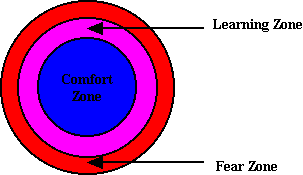
Staying in our comfort zone makes change and learning difficult, as we have nothing pushing or pulling us (motivation). However, if we go too far out of our comfort zone, we enter the fear zone where no learning takes place because of the extreme discomfort. When we enter the learning zone, we become slightly uncomfortable as we are slightly out of place; therefore we learn in order to fit in.
Manage relationships with outsiders
Team leaders are expected by people outside of the team, as well as the members within, to manage much of the team's contacts and relationships with the rest of the organization. You must communicate effectively the team's purpose, goals, and approach to anyone who might help or hinder it. In addition, you need the courage to intercede on the team's behalf when obstacles that might cripple or demoralize the team get placed in their way.
Create opportunities for others
One of the challenges is providing performance opportunities, assignments, and credit to the team and the people within it. You cannot grab all the best opportunities; you must share it with your team. This will help you to fulfill one of your primary responsibilities as a leader—growing the team.
Create a vision
A vision is the most important aspect of making a team successful. Teams perish when they don't clearly see the vision—why they are doing what they do and where they are going. You must motivate the team toward the fulfillment of the goals. Workers want to be successful and they know the only way to do that is by following and achieving great goals.
Are You Ready to be a Team Leader?
 You are comfortable in sharing leadership and decision making with your employees.
You prefer a participative atmosphere.
The environment is highly variable or changing quickly and you need the best thinking and input from all your employees.
Members of your team are (or can become) compatible with each other and can create a collaborative rather than a competitive environment.
You need to rely on your employees to resolve problems.
Formal communication channels are not sufficient for the timely exchange of information and decisions.
Common Problems
 Leaders select too many members in their own image. As a result, teams become unbalanced with too many people overlapping in the same areas, leaving skill gaps in other areas.
Leaders do not understand their own strengths, abilities, and preferences.
Individuals in unbalanced teams feel their talents and abilities are not being used.
Leaders feel they do not know how to motivate people. This is because they do not know them and their individual needs.
Team members feel that the team does not work smoothly. They believe individual work preferences conflict rather than complement each other.
Its time to do some team building if you are facing any of the following problems:
- Loss of productivity or output
- Complaints
- Conflicts between personnel
- Lack of clear goals
- Confusion about assignments
- Lack or innovation or risk taking
- Ineffective meetings
- Lack of initiative
- Poor communication
- Lack of trust
- Employees feel that their work is not recognized
- Decisions are made that people do not understand or agree with
If you have a team problem be sure to include the team on the rebuilding process:
1. First, have a diagnostic meeting. This meeting should be off-site so that there are no interruptions and to show them you are truly committed to building a team. This part of the process is not to fix any problems but to bring forth what is both good and bad with the team in order to formulate future plans. You need to find out what is working or not working and where they are with their working relationships with each other, other teams, and you. If the team is large, it might help to break them down into smaller discussion groups in order to have more lively discussions or to pair them up and have them report back to the team. Consider the first part of the diagnostic meeting as a brainstorming session. Do not throw out any problems or ideas that you feel are irrelevant. After all the data have been made public, have the team determine what is correct and relevant.
2. Next, categorize the issues, such as planning, scheduling, resources, policies, tasks, or activities the group must perform, interpersonal conflict, etc.
3. Once all the information has been categorized, develop action plans to solve the problems.
4. And finally and most importantly, follow up on the plans to ensure they are being accomplished.
A Case Study on Teams
Dov Seidman (2007) tells the story of the General Electric Aircraft Engine Assembly plant in Durham, North Carolina, that produces some of the most powerful and technically complex aircraft engines in the world. All work is done in teams of 20 techs whose only command from management is the date their engine is schedule to ship. They are responsible for all scheduling, ordering, process management, and deliverables. There are no time clocks, so except for a once a day meeting to allow the two shifts to synchronize activity, the workers come and go as they please. There is no cleaning crew, but the place is spotless. There is no tool lockup, but no tools ever come up missing.
There is only one boss for over 200 techs—Paula Sims. Not too long after she started, a tech came up to her and told her, “there was no need to follow-up with us to make sure we're doing what we agreed to do. If we say we'll do something, we'll do it.” She thought, “Wow. That is so simple. I'm sending the message that I don't trust people because I always follow-up.”
When given the order to deliver a new engine, they did it 12 to 13 percent cheaper than other plants who had built the same engine for years. Their engines are perfect. As one tech put it, “I have a three-year old daughter. And I figure that every plane we build engines for has someone with a three-year-old daughter riding on it.”
They have gone eight years without a worker's compensation claim.
There are only three pay grades: tech-1, tech-2, and tech-3. Each is based on skill level and training. Training allows them to multi-skill so that when one person is on vacation, another can still build a turbine without that person.
They have no process improvement program. They simply manage themselves.
Next Steps
Next Chapter: Matrix Teams
Learning activities:
- Leadership Team Building Activities
- Team Survey: Identify the present stage of the teamwork model that your team is presently operating in (Forming, Storming, Norming, and Performing).
Related Chapter: Team Leadership Model - A visual model for implementing Team Leadership.
References
Bodwell, D.J. (1996). High Performance Teams. Retrieved from http://highperformanceteams.org/
Cannon-Bowers, J.A., Salas, E., Converse, S.A. (1993). Shared mental models in expert team decision making. Castellan (ed), Individual and group decision making: Current issues (pp. 221-246). Hillsdale, NJ: Erlbaum.
Katzenbach, J.R., Smith, D.K. (2006). The Wisdom of Teams: Creating the High-Performance Organization. Harper Business Essentials.
Margerison, C., McCann, D. (1985). How to Lead a Winning Team. MCB University Press.
Seidman, D. (2007). How: Why how we do anything means everything. New Jersey: John Wiley & Sons.
Sundstrom, E., Muse, D.P., Futrell, D. (1990). Work Teams: Applications and effectiveness. American Psychologist, 45(2), 123.
Tannenbaum, S., Yukl, G. (1992). Training and development in work organizations. Annual Review of Psychology, 43: 399-441.
Wellins, R., Byham, W., Wilson, J. (1991). Empowered Teams: Creating Self-Directed Work Groups That Improve Quality, Productivity, and Participation. New: Jersey: Jossey-Bass.