Introduction to Instructional System Design

Contents
Why ISD?

Systems and Processes

Training Defined

HRD Defined

Training, Development, & Education

The Training System

The ISD Model

Making The System Effective

Critiques

Comparing ISD With Other Models

Learning Activities

References Notes


Click for ISD Concept Map

Why Instructional System Design?

Besides Instructional System Design (ISD), there are several traditional systematic approaches to training such as Performance-Based Training (PBT) and Criterion Referenced Instruction (CRI). These approaches have some common elements:
  • Competency Based (Job Related): The learners are required to master a Knowledge, Skill, or Attitude (KSA). The training focuses on the job by having the learners achieve the criteria or standards necessary for proper task performance.
  • Sequential: Lessons are logically and sequentially integrated.
  • Tracked: A tracking system is established that allows changes and updates to the training materials to be performed efficiently.
  • Evaluated: Evaluation and corrective action allows continuous improvement and maintenance of training information that reflects current status and conditions.
So, why ISD? Simply stated, this process provides a means for sound decision making to determine the who, what, when, where, why, and how of training. The concept of a system approach to training is based on obtaining an overall view of the training process. It is characterized by an orderly process for gathering and analyzing collective and individual performance requirements, and by the ability to respond to identified training needs. The application of a systems approach to training insures that training programs and the required support materials are continually developed in an effective and efficient manner to match the variety of needs in an ever rapidly changing environment.

ISD is often called SAT (System Approach to Training) or ADDIE (Analysis, Design, Development, Implement, Evaluate).

Systems and Processes

A system is defined as a set of concepts or parts that must work together to perform a particular function. An organization is a system or a collection of systems. Every job in an organization is used by a system to produce a product or service. The product or service is the means by which a organization supports itself.

There are four inputs necessary in every system to produce a product or service:

  • People: The workers making up a group and linked by a common activity.
  • Material: The raw products which go into the system.
  • Technology: The technique for achieving a practical purpose or goal.
  • Time: The measured period during which an action or process begins and ends.

People
+
Material
+
Technology
+
Time
----------
OUTPUT

Every system must also have at least one output in order to survive. The output can be a material product, such as a television or computer software; or a service, such as a protection agency or an insurance policy. The output of a particular system in an organization may be the final product, a service sold to its customers, or a product or service to aid or enhance the organization in its goal to produce a marketable product or service.

An example of a system might be a production team (people) who transform electronic components, cases, parts, etc. (materials) into computers by working on an production line (technology), and completing each production run within a given deadline (time). The final products (output) are then used in the organization to sell to its customers. Someone developed this system by:

  1. Analyzing what was required by the organization.
  2. Designing the system to meet the needs of the organization.
  3. Developing the system using the outputs of the analysis and design phase.
  4. Implementing it.
  5. Evaluating the project throughout its creation and implementation.
This process could have been an haphazard creation, which generally waste time and money; a planned action; or a combination of both. A Systems Approach to Training is a planned creation of a training program. It is a development program that uses step-by-step processes to solve problems.

A large company may have several systems, which are generally broken down into departments or groups, while a small company may only have one system. All of these systems have three basic functions:

  • Input: Something must be going into the system, otherwise, it is a mysterious sphere where products or services mystically radiate from it. The basic inputs of a system are material, people, technology, and time. Training is mostly concerned where people and technology meet.
  • Process: Some type of work must be accomplished in the system. This work is the technology performed that changes the material input into the systems output. Look for the means to help workers master and apply the unique technology governing their tasks.
  • Output: A desired service or product must be produced. If there is no output, then it is a black hole where things go in, but nothing emerges. The goal in training is to allow the workers to use the available technology efficiently and effectively to produce the desired product or service.

Processes

A process is a planned series of actions that advances a material or procedure from one stage of completion to the next within a system. A system generally has several processes in it. Like a system, it also has an input and an output. In the system example given above, a couple of example processes within the computer production system might be:
  1. The circuit-board assembly team (people) who solders electronic parts (materials) onto circuit boards by working on a specialized production line (technology), and completing each production run within a given deadline (time). The final products (output) are then used by other members of the production team in the assembly of a computer.
  2. An inspection team (people) who test each computer (materials) by using specialized test equipment and software (technology), and completing each production run within a given deadline (time). The computers are then passed on to the packing team who boxes and palletizes them.
Notice that in these examples there is always a customer and a supplier. These can either be internal or external. Parts are received from vendors and then moved from various stages throughout the production line. The final process would be the completed computers going from the warehouse or showroom to outside customers (the sales process). Lets look at a training department, which can also be viewed as a system:
  • Input: People who need to acquire skills.
  • Process: Learning takes place within the system
  • Output: Trained people.
Some of the processes that take place in a training department include:
  • Registration: people who want to learn -> registration forms completed -> people who are now registered for class.
  • Development: training need -> develop courseware -> a training program.
  • Computer Training Class: students who need to learn MS Word -> learning program -> trained employees.
Being able to break an organization into systems and process will help you in your training development. By identify a process within a system, you will be able to concentrate on a small chunk of a very large piece. For example, when you are analyzing a job, you break it into duties, tasks, and steps to make your task more manageable.

Training is everything. The peach was once a bitter almond; cauliflower is nothing but cabbage with a college education. - Mark Twain (Pudd'nhead Wilson)

Training Defined

Before trying to understand system type training, we must first understand what training is. We need to clarify the definition of training and then do the same for human resource development.

Training is defined as learning that is provided in order to improve performance on the present job (Nadler, 1984).

A person's performance is improved by showing her how to master a new or established technology. The technology may be a piece of heavy machinery, a computer, a procedure for creating a product, or a method of providing a service.

Notice that the last part of the definition states that training is provided for the present job. This includes training new personnel to perform their job, introducing a new technology, or bringing an employee up to standards.

Earlier it was stated that there are four inputs to a system: people, material, technology, and time. Training is mainly concerned with the meeting of two of these inputs — people and technology. That is, having people learn to master a given technology.

If you don't know where you are going, any road will take you there. - Lewis Carroll in Alice's Adventure in Wonderland (1865).

Human Resource Development Defined

Training is part of Human Resource Development (HRD). Do not confuse HRD with the term "human resource department." A human resource department is concerned with all aspects of the employees, such as pay, benefits, equal opportunity, and of course training. HRD is concerned with training, development, and education.

HRD has been defined as an organized learning experience, conducted in a definite time period, to increase the possibility of improving job performance and growth (Nadler, 1984).

Organized means that it is conducted in a systematic way. Although learning can be incidental, training is concerned with the worker learning clear and concise standards of performance or objectives. Having an objective is important. Without an objective, you could end up someplace else...and not even know it. Objectives are the tools for guiding managers, learners, and trainers. Managers need objectives so that they know what kind of return they are receiving from their training investment. Learners need them so that they know exactly what is expected of them. And trainers need them to plan and conduct the learning environment so that they may achieve the desired results.

The second part of the definition, conducted in a definite time period, means that the amount of time the learner will be away from work must be determined and specified at the onset of the training program.

The last part of the statement, to increase the possibility of improving job performance and growth, is basically the definition of training. By possibility, it means that although a organization can provide tools to help the learner succeed, such as education and training specialists, counselors, coaches, and state-of-the-art training materials, the ultimate responsibility for success belongs to the learner.

Training, Development, and Education

HRD programs are divided into three main categories: Training, Development, and Education. Although some organizations lump all learning under "Training" or "Training and Development," dividing it into three distinct categories makes the desired goals and objects more meaningful and precise.

Training for the present,
Educating for the future,
Developing to lead.

As discussed earlier, training is the acquisition of technology which permits employees to perform their present job to standards. It improves human performance on the job the employee is presently doing or is being hired to do. Also, it is given when new technology in introduced into the workplace.

Education is training people to do a different job. It is often given to people who have been identified as being promotable, being considered for a new job either lateral or upwards, or to increase their potential. Unlike training, which can be fully evaluated immediately upon the learners returning to work, education can only be completely evaluated when the learners move on to their future jobs or tasks. We can test them on what they learned while in training, but we cannot be fully satisfied with the evaluation until we see how well they perform their new jobs.

Development is training people to acquire new horizons, technologies, or viewpoints. It enables leaders to guide their organizations onto new expectations by being proactive rather than reactive. It enables workers to create better products, faster services, and more competitive organizations. It is learning for growth of the individual, but not related to a specific present or future job. Unlike training and education, which can be completely evaluated, development cannot always be fully evaluated. This does not mean that we should abandon development programs, as helping people to grow and develop is what keeps an organization in the cutting edge of competitive environments. Development can be considered the forefront of what many now call the Learning Organization.

Development involves changes in an organism that are systematic, organized, and successive. . . and are thought to serve an adaptive function (Pascarella et al, 1991). Training could be compared this metaphor - if I miss one meal in a day, then I will not be able to work as effectively due to a lack of nutrition. While development would be compared to this metaphor - if I do not eat, then I will starve to death. The survival of the organization requires development throughout the ranks in order to survive, while training makes the organization more effective and efficient in its day-to-day operations.

Also, do not confuse development with change. Change refers to alterations that occur over time in the learners' internal cogitative or affective characteristics (Learner, 1986). This change may be quantitative or qualitative and it implies no directionality, encompassing both regression and progression. Development is always progressive.

Using a systems approach to design training, education, and development programs ensure that an organization gets the most from its resources. Although this guide mainly discusses the creation of training programs, development and education programs can also be built by using a Systems Approach to Training with little or no modifications.

The goal of instruction is to overcome a deficiency in a skill, knowledge, or attitude. The designer must understand the instructional goals so that the courseware's content, layout, strategies, and activities may be built to maximize the learning experience.

The Training System

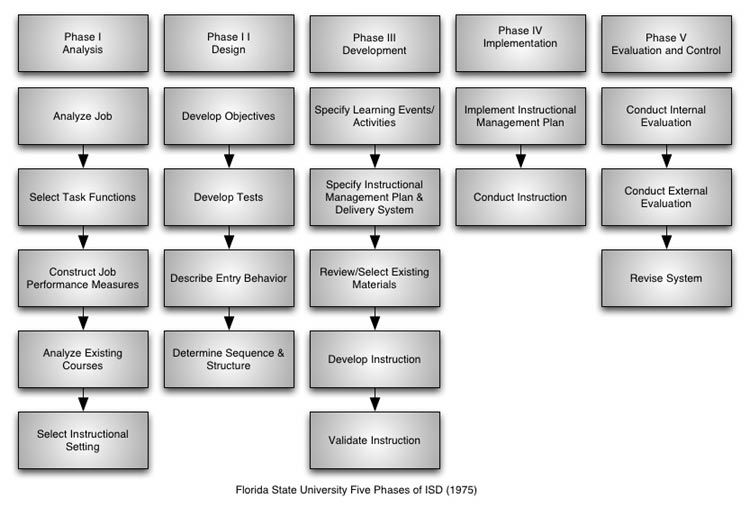
When some people see or hear the word system, they think of mega-methodologies that require several bookcases and intense training to use. A System Approach to Training is not that difficult or complicated. The Instructional System Development (ISD) Model was designed to solve training problems (Pamphlet 350-30, 1975). Figure 2, shown below, is a flowchart of the ISD model. It was first established by the Department of Defense, but can now be found in almost any type of organization. It grew out of the "systems analysis" concepts that became popular after World War II. It is probably the most extensively used instructional design model in use today.

SAT CHART
Click chart to enlarge

ISD is concerned with the identification of training requirements based on the analysis of job performance requirements data obtained from experts in the job to be performed. Training objectives are formulated as a result of the job analysis process and tests are developed to be used to assess the learner's progress toward meeting the training objectives. ISD or SAT also attempts to bring structure to the instructional design process when determining the optimal instructional strategies, instructional sequencing, and instructional delivery media for the types of training objectives involved.

Although there are minor difference, most development systems follow an approach similar to this:

  • Analyze the system in order to completely understand it, and then describe the goals you wish to achieve in order to correct any shortcomings or faults within the system.
  • Design a method or model to achieve your goals.
  • Develop the model into a product (in training, this product is called courseware).
  • Implement the courseware.
  • Evaluate the courseware and audit-trail throughout the four phases and in the field to ensure it is heading in the right direction and achieving the desired results.
The ISD model is a tool for solving many types of performance problems. But, designers must step back to see where they are going, otherwise the tool will control them, instead of them controlling the tool.

Evaluations must be performed throughout the entire ISD cycle. Designers often blame the model because they think it is wrong or a waste of time to start over.

The ISD Model

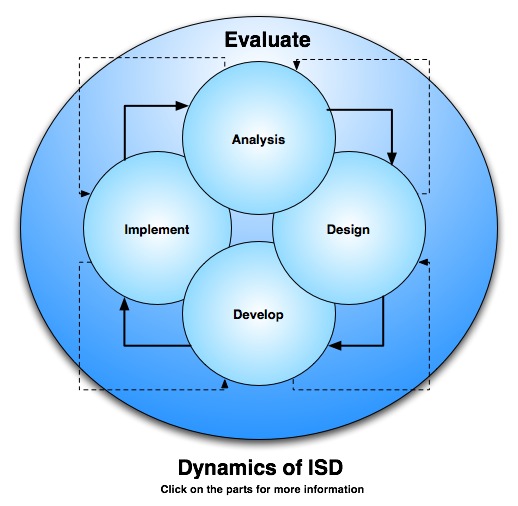
The flowchart model used in Figure 2 (shown above), shows the five phases with their basic steps listed below them. Although the above model shows the processes, it does not really show the dynamics of the ISD model. For that purpose, Figure 3 is used.

SAT CHART
Click chart to enlarge

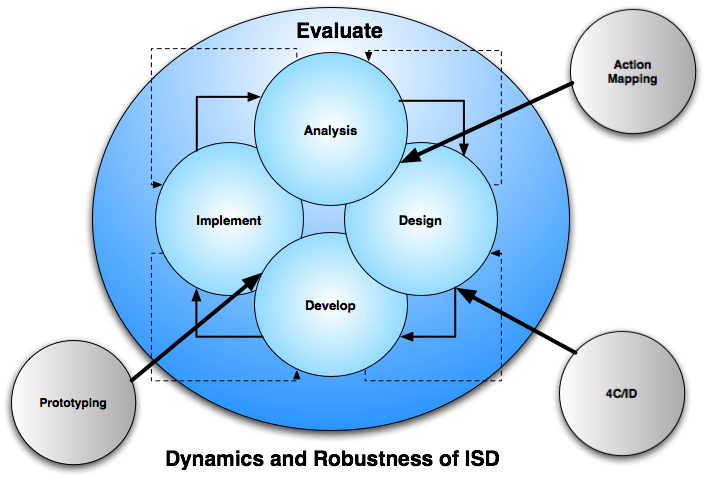
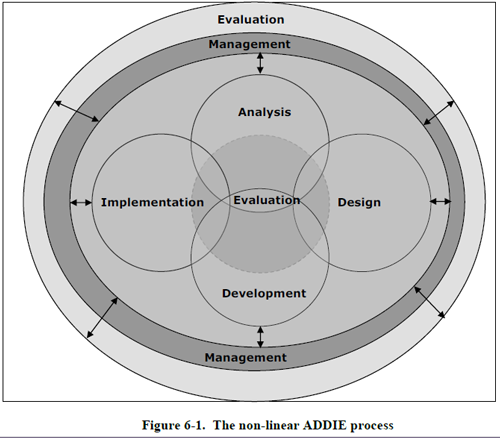
This figure highlights the importance of evaluation and feedback throughout the entire training program. It also stresses the importance of gathering and distributing information in each of the five phases and shows the training process is NOT a static (waterfall) model, but a iterative flow of activities (dynamic or spiral).

The five phases are ongoing activities that continue throughout the life of a training program. After building a training program, the other phases do not end once the training program is implemented. The five phases are continually repeated on a regular basis to see if further improvements can be made.

A brief description of the ISD process:

  1. Analyze
    • Analyze system (department, job, etc.) to gain a complete understanding of it.
    • Compile a task inventory of all tasks associated with each job (if needed).
    • Select tasks that need to be trained (needs analysis).
    • Build performance measures for the tasks to be trained.
    • Choose instructional setting for the tasks to be trained, e.g. classroom, on-the-job, self study, etc.
    • Estimate what is going to cost to train the tasks.
  2. Design
    • Develop the learning objectives for each task, to include both terminal and enabling objectives.
    • Identify and list the learning steps required to perform the task.
    • Develop the performance tests to show mastery of the tasks to be trained, e.g. written, hands on, etc.
    • List the entry behaviors that the learner must demonstrate prior to training.
    • Sequence and structure the learning objectives, e.g. easy tasks first.
  3. Develop
    • List activities that will help the students learn the task.
    • Select the delivery method such as tapes, handouts, etc.
    • Review existing material so that you do not reinvent the wheel.
    • Develop the instructional courseware.
    • Synthesize the courseware into a viable training program.
    • Validate the instruction to ensure it accomplishes all goals and objectives.
  4. Implement
    • Create a management plan for conducting the training.
    • Conduct the training.
  5. Evaluate
    • Review and evaluate each phase (analyze, design, develop, implement) to ensure it is accomplishing what it is supposed to.
    • Perform external evaluations, e.g. observe that the tasks that were trained can actually be performed by the learner on the job.
    • Revise training system to make it better.

    Making The System Effective

    One important point must be made. The ISD model is a system to aid in the design and development of a training program. It is a valuable toolbox that provides a proven method of building a viable training program. But, the people in the organization must control the training system, the system should not control the people. Immediate problems often arise that require rapid solutions. Don't get hung up in the system model by refusing to bypass a step, switch steps, modify a step, or include steps of your own. Managers and supervisors often need quick and ingenious solutions, not another bureaucracy. In other words, the training department's motto should be: "We provide training solutions!" Not, "We follow the ISD model."

    The steps in each phase should not be thought of as concrete in nature. That is, one step does not have to be completed before the next one is started. For example, some training designers will have to complete part of the work in the design phase before they can complete the estimate step in the analysis phase. In the development phase, the first three steps, list learner activity, select delivery system, and review existing material, might be combined into one step by many developers. Every training project will develop its own rhythm. The developers must find the natural flow of the steps required to produce a successful training program. Although the SAT process is a formal one, in that the five phases should be performed as shown in the flowchart, it requires both art and science in its implementation.

    Also, in many instances, steps may be bypassed. For example, if a manager comes to you with a training problem, the task identification steps will be skipped since you know which task needs trained. If you have developed a similar course before, then many steps, such as reviewing existing material and selecting the instructional setting, will only be briefly visited as you have gone through similar processes before and probably have a good ideal of where you are going.

    The less you know about a subject or the more technical the material is, then the closer you need to follow the model.

    At work, the potter sits before a lump of clay on the wheel. Her mind is on the clay, but she is also aware of sitting between her past experiences and her future prospects. She knows exactly what has and has not worked for her in the past. She has an intimate knowledge of her work, her capabilities, and her markets. As a craftsman, she senses rather than analyzes these things; her knowledge is 'tacit.' All these things are working in her mind as her hands are working the clay. The product that emerges on the wheel is likely to be in the tradition of her past work, but she may break away and embark on a new direction. Even so, the past is no less present, projecting itself into the future. - Henry Mintzberg, "Crafting Strategy", Harvard Business Review, July-August 1987, pp. 66-75.

    To make a training program usable, the following activities must take place in its development:
    • An early focus on the clients must be maintained. This is done by direct contact with the clients through interviews, observations, surveys, and participatory design and development methods. You must ensure that the clients are made owners of the training program throughout the entire SAT process. If they feel the program is being shoved down their throats or their turf is being invaded, the program will fail.
    • The five phases - analysis, design, development, implementation, and evaluation should be under one management team to ensure that a symmetrical program is constructed.
    • The design must be an empirical one. This requires observation, measurement of behavior, careful evaluation of feedback, and a strong motivation to make design changes when needed.
    • The process of implementation, testing, feedback, evaluation, and change must be repeated throughout the training system's life to improve upon it. Do NOT fall into the old adage, "If it ain't broke don't fix it." Make it better before your competitors do!
    • Records must be maintained. The audit trail should contain the data gathered in the analysis, the reasons for developing a piece of courseware, and documents that explain why certain decisions were made. This information could prove invaluable in the future when changes are needed or when a similar program must be built.

    A lot of learning theory is part of the descriptive sciences, which describe the way things function in the natural world; while ISD is part of the design sciences, which offer ways to perform certain human-defined tasks. Descriptive sciences can be considered the law, while design sciences are roadmaps, and there is always more than one way to get from point A to point B.

    Critiques of the System Approach To Training

    Some of the benefits of a system approach are characteristic of all systematic approaches. The ISD model is a management tool that makes courseware production more efficient. Effective training programs are more likely because the ISD model increases the probability that the courseware will match the objectives and not veer off in a different direction (Roblyer, 1981). The approach is scientific as it is empirical and can be replicated. The courseware can be improved and strengthened through data collection and analysis.

    On the other hand, the ISD model has been criticized because it is frequently presented in flowchart form, as shown in figure 2, leaving the impression that it is mechanistic and linear in its approach. I have tried to point out that it is not a mechanical, algorithmic, step-by-step procedure, but rather a exploratory problem solving technique that uses evaluation and feedback to improve performance (heuristic) by showing Figure 3 and describing the dynamics of it.

    It is this heuristic design that has been criticized by others because it tells training designers what to do, but not how to it. This argument is not valid because there is a considerable body of educational, learning, and training literature that tells how to implement the various steps in the ISD model. I have touched upon these methods throughout this guide and have included several examples in the appendixes. To include all the body of research is beyond the scope of this training manual.

    A frequent criticism is that it is too time-consuming to be practical in the real world. Yet, not knowing the basic procedures for building a learning program leads many novices down the wrong path which wastes more resources. Once designers are comfortable then many of the steps can be skimmed over.

    Some say that systematic models take a "top-down" behaviorist and subject-matter-expert approach to learning instead of championing a constructivist approach. But, training has traditionally been task driven by discovering how experts performs their jobs and then mirroring this performance in the learning environment. Also, nothing says a constructivist method cannot be used for learning the task.

    To get a better understanding of ISD, read ISD is Like Building a Deli Sandwich.

    Prototyping and the ISD model are both directly linked. But many developers have the wrong picture of ISD. The traditional ISD model, which advocates evaluation throughout its entire life cycle, has often been thought of as a linear process (step-by-step, static, or waterfall), when in reality, it is more iterative (dynamic or spiral) due to the constant updating.

    No single model is the silver bullet of instructional design, including ADDIE. Each model has its advantages and disadvantages. But many developers will come closer to that silver bullet by using the key advantages of each system, depending upon the training project they are working on.

    Comparing ISD With Other Models

    It often helps to understand a model better by looking at other models:

    Evolutionary Model

    An evolutionary approach includes both deterministic and incremental systems, in contrast to the systems approach, which is entirely deterministic. This means that in an evolutionary approach, tentative or short term goals may be specified. This approach is particularly appropriate for situations where there is limited past experience from which to draw guidance. A major benefit is that it enables a designer to test new ideas without making a long term commitment. A major disadvantage is that it lacks a defined set of steps. Also, it is difficult to specify in advance the amount of time and money that will be needed to complete significant events and it is logically impossible to specify the outcome of an evolutionary process.

    In the 1960's, the PLATO system for Computer Assisted Instruction (CAI) was developed. A systems approach was implemented at the time. In 1972, the National Science Foundation funded the University of Illinois to implement a new version of the PLATO system and to develop courseware for schools and colleges. An evolutionary approach was used to design the courseware. The evolutionary approach was apparent in all facets of the new PLATO system and its accompanying courseware. Although many outstanding lessons were made using this approach, when time for production was limited due to constraining resources, such as time or money, quality lessons could not be produced unless the authors took a systematic approach (Steinberg et al, 1977).

    Courseware authors either failed to complete lessons on time or produced lessons that made full use of graphics and other computer features, but were instructionally ineffective. Although the SAT method may look large and expensive, it has proven itself to be reliable and inexpensive in the long run.

    Rapid Prototyping Design (RPD)

    Rapid Prototyping Design (RPD) uses a more formative model that is based on usability testing of prototypes. Results of usability tests on the prototypes is used to modify and improve the product. This model shares many attributes in common with the ISD model, and stresses the importance of iterative analysis and evaluation. For a model see RPD

    A comparison of the two models would look something like this:

    Step RPD ISD
    1 Assess Needs and Analyze Analysis
    2 Set Objectives Design
    3 Build skeletal (prototype) system Develop
    4 User evaluation Evaluate
    5 Concept refinement Develop
    6 Implementation of refined requirements Evaluate
    7 Concept refinement Development
    8 Implementation of refined requirements Evaluate
    9 etc., etc., in a continuous cycle etc., etc., in a continuous cycle
    10 Install and Maintain System Implementation and Evaluate

    So, when are you using RPD and when are you using ISD? If you know the subject, how learners best learn that subject, or have build similar training programs, then you will perform less prototyping, thus your development will fall more into the what is pictured as the traditional (dynamic) ISD method. When the subject is new, controversial, etc., then more prototypes are going to be built, hence you are more into RPD. If you know exactly what you are doing and exactly what needs to be built, then you are using the ISD (static or waterfall) method (however, this rarely happens in the real training world).

    Learning Activities

    Learning Activities for Chapter 1

    References

    Learner, R. (1986). Concepts and Theories of Human Development (2nd ed.). New York: Random House). Return

    Nadler, Leonard (1984). The Handbook of Human Resource Development (Glossary). New York: John Wiley & Sons. Return

    Pascarella, Ernest T. and Terenzina, Patrick T (1991). How College Affects Students. San Francisco: Jossey-Bass Publishers. Return

    Roblyer, M.D. (1981). Instructional Design Verses Authoring of Courseware: Some Crucial Differences. AEDS Journal, 14, 173-181. Return

    Steinberg, E.R., Avner, R.A., Call-Himwich, E., Francis, L., Himwich, A., Klecka, J.A., & Misselt, A.L., (1977). Critical Incidents in the Evolution of PLATO projects (MTC Report No.12). Urbana, IL: University of Illinois, Computer-Based Education Research Laboratory. Return

    United States Department of Defense Training Document. Pamphlet 350-30. August, 1975. Return

    U.S. Army Field Artillery School (1984). A System Approach To Training (Course Student textbook). ST - 5K061FD92


    Notes

    Created July 13, 1995
    Updated November 6, 2008