
Note: This site is moving to KnowledgeJump.com. Please reset your bookmark.
Growth of eLearning

The elearning market has reached an inflection point — elearning is seen as more valuable to 'time shift' rather than simply 'place shifting.' While interest in organizational development is high, technology solutions remain under great scrutiny. Vendors must gauge a buyer's elearning maturity and tailor their messages. - Cushing Anderson, vice president, IDC's Corporate Learning and Performance research
Global Industry Analysts, a market research firm, projects that global elearning will reach $107 Billion in 2015 (McCue, 2014). However, Docebo (2014), an e-learning solutions provider, estimates that revenues will only reach $51.5 billion by 2016.
So which one is correct?
First, for the average reader, the real number does not really matter; what really matters is that it is growing, which means there is a good future for eLearning Instructional Designers.
The Answer
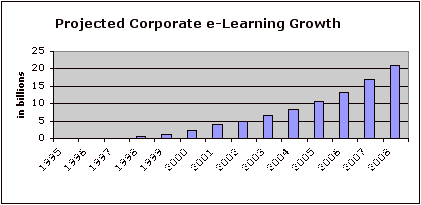
Probably the second forecast of $51.5 billion, as most estimates tend to over-exaggerate. For example, it was reported that the global market for corporate elearning is growing nearly 27%, compounded annually (McGee, 2004). And that IDC forecasted that the elearning market, which was about $6.5 billion in 2003, will increase to more than $21 billion by 2008, and hit $52.6B by 2010 The numbers for the past projections are:
Classroom vs eLearning
The Association for Talent Development (ATD) State of the Industry Report noted in 2015 that 28 percent of learning hours used in 2014 were delivered via elearning.
ATD reported that 25 percent of learning hours used in 2013 were for elearning, while 70 percent of training hours were led by an instructor (Miller, 2014). The amount is unchanged from 2012.
However, ATD's 2010 State of the Industry Report shows that elearning accounted for 27.7 percent of corporate training, its highest level since ASTD began collecting data on the use of technology for this report 14 years ago (in 2008, it was 23.1 percent).
According to Training Magazine (2006), elearning accounted for 15 percent of all training delivered, which is a two-fold increase from just one year ago, and signifies that elearning is here to stay as a mainstream training delivery vehicle.
Thus, elearning seems to have stalled just below 30 percent for the past few years.
Education
Almost 3.5 million students were taking at least one online course during the fall 2006 term; a nearly 10 percent increase over the number reported the previous year (Allen, Seaman, 2007). In addition, the 9.7 percent growth rate for online enrollments far exceeds the 1.5 percent growth of the overall higher education student population.
What We Can Be Sure Of
As shown, elearning is definitely a growing field in the educational and training market. However, exactly how much of the market share it will eventually create is anyone's guess.
Next Steps
-
Growth of eLearning
Related Resources
References
Allen, I.E., Seaman, J. (2007). Online Nation: Five Years of Growth in Online Learning. Needham, MA: Sloan Consortium.
ASTD (2010). State of the Industry Report. Alexandria, Virginia: ATD. Retrieved from: http://www.astd.org/TD/Archives/2010/Nov/Free/1110_2010+State+of+the+Industry.htm
Docebo (2014). E-Learning Market Trends and Forecast 2014 - 2016 Report. Docebo S.p.A. Retrieved from: https://www.docebo.com/landing/contactform/elearning-market-trends-and-forecast-2014-2016-docebo-report.pdf
McCue, T.J. (2014). Online Learning Industry Poised for $107 Billion In 2015. Jersey City, NJ: Forbes Magazine. Retrieved from: http://www.forbes.com/sites/tjmccue/2014/08/27/online-learning-industry-poised-for-107-billion-in-2015/
McGee, M. (2004). E-Learning Predicted To Recover--Again. Information Week.
Miller, L. (2014). 2014 State of the Industry Report: Spending on Employee Training Remains a Priority. Alexandria, Virginia: ATD. Retrieved from: https://www.td.org/Publications/Magazines/TD/TD-Archive/2014/11/2014-State-of-the-Industry-Report-Spending-on-Employee-Training-Remains-a-Priority
Training Magazine (2006). Training Industry Report. Retrieved from: http://www.trainingmag.com/managesmarter/images/pdfs/IndRep06.pdf