
Note: This site is moving to KnowledgeJump.com. Please reset your bookmark.
The Attack on ISD - 2000
In the April 2000 edition of Training Magazine, Jack Gordon and Ron Zemke coauthored the article “The Attack on ISD.” They noted that while the systems approach to instructional design is training and education's main design model, some are now saying it is leading developers/designers astray. Their view is that ISD or ADDIE springs in part from a growing conviction that the harder you try to specify exactly what the designer must do in order to be doing ISD, the further into the wilderness one wanders. Four major charges are brought against the model:
-
ISD is too slow and clumsy to meet today's training challenges
-
There is no 'there' there
-
Used as directed, it produces bad solutions
-
It clings to the wrong world view
The article goes into some depth on why ISD is a very bad model for the training industry, however, the attackers seem to fail to realize that ISD is simply a tool in a trainer's tool kit, and as the old saying goes, “It is a bad craftsperson who blames his or her tool.” Further, after attacking the tool, they offer no replacements for ISD or. Just as good craftpersons keep several hammers in their tool kits, such as claw hammers, ball peen hammers, sledgehammers, and rubber mallets, and then selects the right tool for the job at hand; good instructional designers use ISD as part of their arsenal against bad performance, in addition to other design tools. And now, the charges...
ISD is too Slow and Clumsy
You see these massive ISD systems, with panels and committees and boards who have to sign off on everything. It ends up being a big political mess. Just the time it takes to get objectives written and approved is horrendous. In the end, 90 percent of your time is spent managing a bunch of bozos who are fighting over dollars. You spend very little time doing any real training. - Geary Rummler in The Attack on ISD
The trouble with this line of thinking is that no matter what model the organization is using, if their culture is bureaucratic in nature, a new model is not going to help. ISD does not promote panels and committees and boards, the culture and nature of the organization promotes such bureaucracy. Thus the attack should be directed at the culture of the organization, not the tool.
There's No 'There' There
The charge here is that ISD attempts to change training from an art into a science and when used as directed, it would produce predictable, reliable results in learning. Yet, if you really look at the ISD model, it is far from being a linear step-by-step approach — if a designer strictly went by the steps, she would have nothing to show for her efforts! ISD must be used in conjunction with other instructional models, in addition with the art of the designer (see ADDIE).
Designing instruction is both art and science — which makes it a craft. Thus, a good designer uses the tools of the trade, knowledge and skills, and then combines these with a personal touch to create a quality product. See the article in the right side bar in ADDIE, ADDIE and the 5 Rules of Zen.
If you don't follow the instructions and people still learn, that raises the question of whether there's a 'technology' there in the first place. - John Murphy in The Attack on ISD
Yes, we do a lot of learning without ADDIE. But models, such as ADDIE, aids the organization to help their people learn new skills and knowledge when it is deemed important.
For instance, some ISD systems would have you spend months designing and developing a training course before you pilot test it. - The Attack on ISD
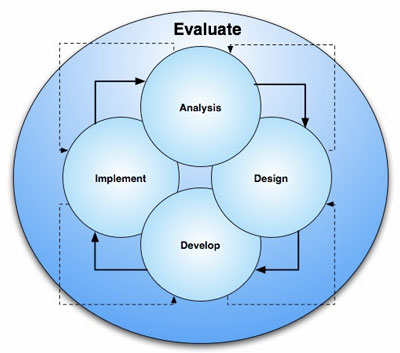
Only if you do not understand the system would you even think about doing this. Evaluation is not the last phase of ISD, but rather is included in every phase to help ensure that the training package is on the right track. And if we go back to Rosenberg's 1982 article, he discusses the concept of using “developmental testing or prototyping” to ensure the design is not bad.
Used as Directed, It Produces Bad Solutions
Part of the problem, as we've seen, is that inward focus that concentrates the designer's attention on building the “right” kind of training program instead of addressing a real business issue. - The Attack on ISD
If we go back to Glaser's work on the initial ISD system, he writes “The development of the system is initiated with the specification of the goals of instruction.” Thus, ISD does not start until one has decided that training is indeed the answer to a performance problem or required business result. ISD was never meant to determine if training should be used, but only assist in the development of training ONCE it is decided that training is the answer (or part of the answer). See Analysis in ISD.
Thus, first the attackers accuse ISD has being too “step orientated”, now the accusation is that it does not contain enough steps... there is simply no way to please them...
The whole ISD model is based on the assumption of stupid learners and superior experts. In my life, most of the ISD packages I've run into were designed by people who are stupider than me. They're trying to drag me down to the lowest common denominator. - The Attack on ISD
I believe that if one looked at the training designed by the military, who have used the ADDIE version of ISD since the end of the Vietnam war, one would come to an entirely different conclusion — ISD simply helps to keep one focused on the results desired. It does not tell you what the result should be, that is the job of the instructional designers and once the desired result is specified, ISD is simply a tool to help one keep focused on that goal.
It Clings to the Wrong World View
The ISD model assumes that a job is a known quantity. It assumes the presence of a master performer who knows how to do the job in the best possible way. It assumes we can derive a set of best practice procedures from that master performer and then teach them to everybody else. But in the reinvention sweepstakes, jobs and procedures are up in the air. There often are no master performers and no best practices. - The Attack on ISD
If we go back to the U.S. military, who have produced a high quality fighting force with the aid of the ISD model, we would not find “well-defined jobs,” for in the face of battle, there is really no such thing as “well defined” in complex situations. And if there are no master performers, then how do we know what type of result we want? Master performers are simply one of the tools used in the ISD analysis process, thus they are not required. See Needs Assessments in Instructional Design.
If we're all figuring it out as we go, suggests Gayeski, our preferred teaching strategies should include things like coaching, open classrooms (instead of rigorously structured ones), and Web-based forums as opposed to pre-programmed Web-based instruction. In such forums, she says, “you start out with some information, but then you invite the learners to contribute their own ideas.” - The Attack on ISD
Actually, the ISD process says that rigorously structured classrooms should be the last choice of instruction due to high costs and lock-step nature (see Choose Delivery System). In addition, you generally have to use another model that is plugged into ADDIE for the design of the actual instruction itself as ADDIE only outlines the basics of instructional design.
Next Steps
Next section: A Hard Look at ISD
Return to the History of Instructional System Design
Reference
Gordon, J., Zemke, R. (2000). The Attack on ISD. Training Magazine, Vol. 37, Iss. 4; pg. 42.