
Note: This site is moving to KnowledgeJump.com. Please reset your bookmark.
Learning, Performance, and Knowledge Reading List
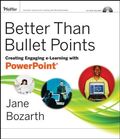 Better Than Bullet Points: Creating Engaging e-Learning with PowerPoint by Jane Bozarth
A great resource for transforming e-reading to elearning. Even if you don't use PowerPoint, the book is quite useful as it focuses on the effective design of elearning first and the use of Powerpoint second. Includes a CD-ROM, practical examples, and case studies.
 Drive: The Surprising Truth About What Motivates Us by Daniel Pink
Dan Pink argues that the old ways of motivating through the “carrots and sticks” approach does not work any more, thus learning and business need to use three new approaches on what makes us motivated:
- Autonomy - we like to be self directed
- Mastery - we like to be good at what we do
- Purpose - we work harder when we see the bigger purpose
Presentation Zen Design: Simple Design Principles and Techniques to Enhance Your Presentations by Garr Reynolds
Garr Reynolds new book, PresentationZen Design, is his follow up to Presentation Zen. In this new book, Garr expands on the design section of the original book by adding a lot of helpful information and ideas.
 Resonate: Present Visual Stories that Transform Audiences by Nancy Duarte
Nancy Duarte follows up on her last book, Slide:ology, with this new book about designing presentations. She recommends that you read this latest book first as it lists the reasons for giving a presentation by using examples of great speeches and communicators that range from Steve Jobs to Martin Luther King Jr to Ronald Reagan and to Alfred Hitchcock.
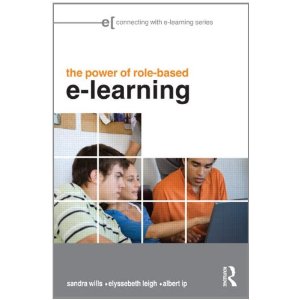 The Power of Role-based e-Learning: Designing and Moderating Online Role Play (Connecting with E-learning) by Sandra Wills, Elyssebeth Leigh, and Albert Ip
Written for instructional designers seeking to engage students in collaboration and communication about authentic scenarios through the use of role-based elearning. It draws on the experiences of world-leading practitioners by citing an array of excellent examples. It provides easy to read guidance for both newcomers and experienced professionals who desire to develop interactive elearning.
More Good Reading
Classics
Approaches To Training and Development by Dugan Laird (2003)
A trainer's bookshelf needs at least one book. And that book is Approaches To Training And Development, Second Edition , Dugan Laird (1985), Reading Massachusetts: Addison-Wesley .
- Why Have A Training And Development Department?
- How Do You Find Training Needs?
- Learning Objectives
- How Do People Learn?
- What Methods Shall We Use?
- How Important Is Teaching Technique?
- What About Visual Aids?
- How Can We Measure Training and Development?
Dugan Laird is an HRD Hall of Fame Member. What more can I say...this book covers the nuts and bolts of training. Follow his advice and you will be a great trainer!
The Fifth Discipline: The Art & Practice of the Learning Organization by Peter M. Senge (1990)
This book describes the learning organization and how to build one. He describes the organization as an organism with the capacity to enhance its capabilities and shape its own future. A learning organization is any organization (e.g. school, business, government agency) that understands itself as a complex, organic system that has a vision and purpose. It uses feedback systems and alignment mechanisms to achieve its goals. It values teams and leadership throughout the ranks.A learning organization seeks to create its own future; it assumes learning is an ongoing and creative process for its members; it develops, adapts and transforms itself in response to the needs and aspirations of people, both inside and beyond. There are five disciplines in a learning organization:
- System Thinking - It allows one to look at the events in an organization and see a pattern of complex relationships.
- Personal Mastery - Seeing what is and what could be and then changing to meet the vision.
- Mental Models - Assumptions about how we see the world.
- Shared Vision - A team competency in which everyone has a common goal or shared picture.
- Team Learning - The team suspend their assumptions and take up dialogue that embraces the collective good.
Real learning is not just limited to understanding what is necessary to survive (adaptive learning), but also includes "generative learning:" expands the human's capacity to create the results a person truly desires. Learning itself includes three different activities: thinking, communicating and cooperating. When our capacities to think, communicate and cooperate are enhanced, so is our ability to learn. Thus, a learning organization is one which fosters and enhances these activities for its members and members of the community in which it exists.
A related book, The Fifth Discipline Field book: Strategies and Tools for Building a Learning Organization (1994) provides tools, techniques, exercises, ideas and stories to help the practitioner apply the concepts. This is a step-by-step guide for establishing learning organizations within existing companies functions as a participative workbook, with exercises for both individuals and teams, suggested approaches and ideas, and success stories.
Community of Practice
Situated Learning: Legitimate Peripheral Participation by Jean Laveand and Etienne Wenger
This is the book that first captured the essence of CoPs.
eLearning Classic
E-Learning: Strategies for Delivering Knowledge in the Digital Age by Marc Rosenberg
The writing is quite good and easy to read. Marc covers just about all the basics of elearning.
Emotional Intelligence
Emotional Intelligence: Science & Myth by Gerald Matthews, Moshe Zeidner, and Richard D. Roberts
If you want fluff, then buy one of Goleman's books, if you want to get into the heart and truth of EI, then buy this book.
Future of Training
 Beyond the Podium: Delivering Training and Performance to a Digital World by Allison Rossett & Kendra Sheldon
Not really one of the best training books, but perhaps one of the more thought-provoking ones.
Rethinking Our Profession
A Whole New Mind by Daniel Pink
Fascinating insights for changing the we we design our learning platforms.
Genes (DNA)
Nature Via Nurture by Matt Ridley
Put an orphan in a family who naturally have high IQs, and that orphan will initial start to show higher intelligence, however, once the orphan matures, her IQ will start to level off and then drop closer to a level intended by nature. This also works in reverse — put a orphan with an incline towards a high intelligence in a family with lower intelligences and that orphan's intelligence will be held in check until she matures and then it will naturally rise closer to the level intended by nature.
Graphics
Graphics for Learning: Proven Guidelines for Planning, Designing, and Evaluating Visuals in Training Materials by Ruth Clark & Chopeta Lyons
Good instructional design is more than inserting a few pretty pictures.
History of Instructional Technology
Hard to get at times, but two of the best books on the history of IT:
History of Instructional Technology by Paul Saettler
The Evolution of American Educational Technology by Paul Saettler
Human Resource Development
Human Resource Development, sixth edition by Werner & DeSimone
Excellent reference book on HRD
The Handbook of Human Resource Development, Leonard Nadler (Editor). When I took my first Human Resource Development Course our instructor wanted us to have a reference that would help us not only in the classroom, but in the outside world too. So our textbook was actually a handbook. This is a complete reference to the field of HRD. It contains about 830 pages from various authors on the following subjects:
- The Field Of Human Resource Development - An overview and history of HRD. It explores such topics as the management of HRD, consulting, financial aspects, designing training programs, and instructing. - thirteen chapters
- Program Areas Of HRD - Various training programs of HRD such as sales, technical, management, and schools. - eight chapters
- International Areas Of HRD - Working internationally in a global society, with chapters devoted to Latin America, Africa, Asia, and Europe. - six chapters
- Human Resource Areas Related To HRD - How management, organization development, and career development relate with HRD. - three chapters
- The Future of HRD - Projections, Paradoxes, Paradigms. - one chapter
- An excellent Glossary and Index.
If you want a broad view of the HRD field, on almost any subject, then this is the best reference available. If you are into HRD, this is a must buy. It is well written and an excellent read. Leonard Nadler is an HRD Hall of Fame Member.
Informal Learning
Informal Learning: Rediscovering the Natural Pathways That Inspire Innovation and Performance by Jay Cross
An interesting read on informal learning.
Information
Information Anxiety 2 by Saul Wurman
Wurman takes a very eccentric tour through the subject of information. Some people preferred his first book, so you might want to check both before buying:
Instruction and Learning (theory)
 How College Affects Students by Ernest Pascarella and Patrick Terenzini
Although based on college students, if you really want to dig into the research on learning, this is a must have. .
Instructional Design (ID)
Training Complex Cognitive Skills: A Four-Component Instructional Design Model for Technical Training by Jeroen Merrienboer
If you need to train complex cognitive skills, this is the best instructional development book to have.
Instructional System Design (ISD)
Training in Australia by - Micheal Tovey
Tovey has simply wrote the very best book on the ADDIE model of ISD. This is an Australian book so it might be quite hard to find, yet I guarantee the effort will be well worth it. Sadly, he passed away...another master has gone on to that big classroom in the sky...
Knowledge
Davenport and Prusak's book, Working Knowledge, is a quite enjoyable and easy read.
Enabling Knowledge Creation by Krough, Ichijo & Nonaka
The first classic on the subject was Ikujiro Nonaka & Hirotaka Takeuchi's, The Knowledge Creating Company
Management
Management of the Absurd by Richard Farson & Michael Crichton
A classic
Media
The best book on the subject is Richard Clark's Learning from Media: Arguments, Analysis, and Evidence.
However, Marshall McLuhan is simply one of the most interesting and best writers on the subject of media:
Understanding Media: The Extensions of Man
The Medium is the Massage: An Inventory of Effects
Mind
How the Mind Works by Pinker, Steven
A fascinating journey into the mind by a great thinker and writer.
Organizational Culture
Culture and Organizations: Software of the Mind by Geert Hofstede
This is more "OD" in nature, but if you want to lean more about cultures in organizations, this is an excellent read.
Performance
This is the one of the best and easiest books to read on the subject:
Analyzing performance Problems or 'You Really Oughta Wanna' by Robert F. Manger and Peter Pipe
For those who want more depth, then this is the classic - Improving Performance: How to Manage the White Space on the Organization Chart by Rummler & Brache
Social Learning
Social Media for Trainers by Jane Bozarth (read my review)
The New Social Learning: A Guide to Transforming Organizations Through Social Media by Tony Bingham & Marcia Conner
Simulations
Simulations and the Future of Learning by Clark Aldrich
A great introduction to simulations and leadership.
Systems
Instructional Systems by Bela Banathy
Old, but a great introduction to training systems.
Training
The Six Disciplines of Breakthrough Learning by Wick, Pollock, Jefferson, & Flanagan
If You Only Have One Book in Your Training Library then you need The Six Disciplines of Breakthrough Learning.
Training for a Rapidly Changing Workplace: Applications of Psychological Research by Miguel Quinones & Addie Ehrenstein
 The Winning Trainer by Julius Eitington
Julius E. Eitington's The Winning Trainer discusses the techniques for conducting dynamic and active training sessions. It includes chapters for small group interactions, role playing, games and simulations, puzzles, self-discovery learning, case methods, etc. It also has more than 100 ready made handouts.
It provides valuable insight on effective icebreakers and openers, brainstorming, lectures, team building, and managing diversity in the classroom. Numerous examples and model dialogues will help trainers plug in this material immediately. If you need to learn how to get your learners involved in training, then you need The Winning Trainer.
The Complete Games Trainers Play: Experiential Learning Exercises by Edward E. Scannell and John W. Newstrom
Liven up your learning activities with The Complete Games Trainers Play - a collection of over 300 games for the following
learning activities:
Part I - The Trainer's Resource Kit:
- The Trainer's Resources Kit
- Planning Administration
- Program/Agenda Design
- Event/Production
- Conference Leadership
- Climate Settings and Icebreakers
- Presentation
- Methods
- Motivation
- Self-Concept
- Learning
- Communication
- Perception
- Problem Solving and Creativity
- Evaluation
- Transfer of Training
- Brain teasers
- Presentation Tools
- Team building
This is a diverse collection of training games that will get learners involved in your training activities. It consists of a three-ring binder (for easy copying) of over 1,000 pages (most of the back pages are blank). There are a couple of items lacking in this book. First, there is no index or table that will allow you to follow a topic or select a game for a particular behavior. For example, The Learning section has 35 games listed, with such titles as Hand Clasp, Jeopardy, Stop the Music!, and Film Recaps. To find a certain behavior or task, I had to look through all 35 games to see if it is covered in one of the games. At some games, I had to study the complete section to find the behavior being taught as some of the
The Complete Games Trainers Play (Games Trainers Play Series Vol. 2)
Training Program Workbook & Kit by Carolyn Nilson
Need worksheets, checklists, and guidelines to development your training program? Then Training Program Workbook & Kit might be the guide you are looking for. It contains:
- How to assess training needs
- How to do job analysis
- How to do Task Analysis
- How to write a training proposal
- How to design your own courses
- How to design tests
- How to choose the right training media
- How to package training
- How to conduct a field test
- How to deliver training
- Guidelines for selecting and using computer based instruction
- How to set up workshops and conferences
- Guidelines for purchasing and maintaining training equipment
- How to attract employees to your training program
- How to write a business plan
- Project management
- Planning the training budget
- How to survive an operational audit
- Ways to streamline training administration
This guide contains over 430 pages of useful guidelines for implementing and managing training. You will still have to know what you are doing as this book does not go into great depth, but mainly lays out the training cycle in an easy to read outline.
Next Steps
More book reviews at Books in the News
Reture to the Learning, Instructional Design & Training main page