Instructional System Design - Development Phase

Outline


Click for ISD Concept Map

Development Phase

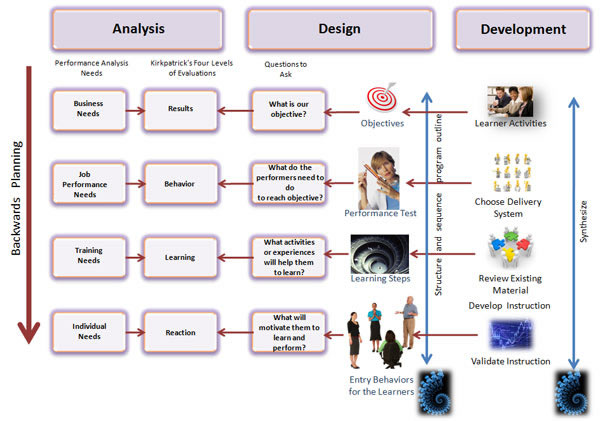
This phase elaborates and builds on the Learning Objectives that were produced in the design phase. Development is simply diagramming or outlining the necessary activities that will assist the learners in reaching the course goals. The end result is the completed instructional courseware.

List Learner Activity

Development begins with specifying the learning activities that will best assist in the learning process. The main instructional setting and media was chosen in the analysis phase. In this phase, the learning strategies and supporting media that will assist the learners in mastering the objectives will be chosen. To assist you, use the Media and Strategy Dictionary to learn about the many forms of learner activities.

To select the proper activities, it helps to know what learning is and what activities enhance a particular form of learning.

Defining Learning

Learning has been defined as a relatively permanent change in behavioral potentiality that occurs as a result of reinforced practice (Kimble, 1961). The following elaborates on this basic definition:
  • Learning is indexed by a change in behavior, which must be translated into observable behavior.
  • After learning, learners are capable of performing something that they could not do before the learning experience.
  • This change is relatively permanent, it is neither transitory nor fixed.
  • The change in behavior need not occur immediately following the learning experience. Although there may be a potential to act differently, this potential may not be translated into a new behavior immediately.
  • The change in behavior results from experience or practice.
  • The experience or practice must be reinforced.
Learning has also be defined as "the process by which people acquire new skills or knowledge for the purpose of enhancing performance" (Rosenberg, 2001).

Learning a subject seems to involve three almost simultaneous processes:

  1. There is acquisition of new information. Often the information runs counter to or is a replacement for what the learner had previously known.

  2. Learning may be called a "transformation" — the process of manipulating knowledge to make it fit new tasks. Transformation comprises the ways we deal with information in order to go beyond it.

  3. Some type of evaluation takes place by the learner in order to check whether the information and skills are adequate for the task
Learning has also been described as "Social." The physicist Freeman Dyson wrote that when writing, he closes the door, but when doing science, he leaves it open — "up to a point you welcome being interrupted because it is only by interacting with other people that you get anything interesting done. He wrote two papers that were published in Physical Review that brought together Richard Feynman and Julian Schwinger's theories of quantum mechanics. After Dyson's papers, Feynman and Schwinger's ideas became understandable and thus led to the two being awarded the Noble prize in physics. There is no doubt in most minds that the two would never have been awarded the prize if it was not for Dyson being able to explain their ideas.

Thus, you have Freeman Dyson "social" learning from Richard Feynman and Julian Schwinger. However, Feynman was such a genius that he learned from whenever he came across information, such as books and lectures. Einstein is another example — people learned a lot from being around him, yet he learned from what ever was available.

In addition, there is more than one type of learning. A committee of colleges and universities studied learning behaviors and broke learning into three main domains or Taxonomies (Krathwohl, at. el., 1964). Knowing the type of knowledge, skill, or attitude that is discussed in the taxonomy will assist you in determining the instructional strategy. Also, the media selection flowchart is helpful for choosing instructional strategies based upon needs.

Learning Styles

Just as every person is unique, so is every learner. But how much this uniqueness matters has been a great debate among educators, trainers, and psychologists. A learning style is a student's consistent way of responding to and using stimuli in the context of learning. Some say that each student learns best using a learning strategy or method that best matches his or her need. While others say that what matters the most is the learning process, not the style. The research tends to favor the latter group. Achieving a solid learning environment that meets the student's need, rather than their styles seems to be the most important key for effective learning.

To learn about the various learning style instruments,read Learning Styles.

The Learning Process

While learning styles show that we are all different, the learning process shows how and why we learn something. This, perhaps, is even more important than addressing the various learning styles. Although people have a preferred style, they can still learn under almost any style, but if the learning process is not in place, it makes learning a new task or subject almost unachievable.

To learn more about the learning process read the Learning Theories page.

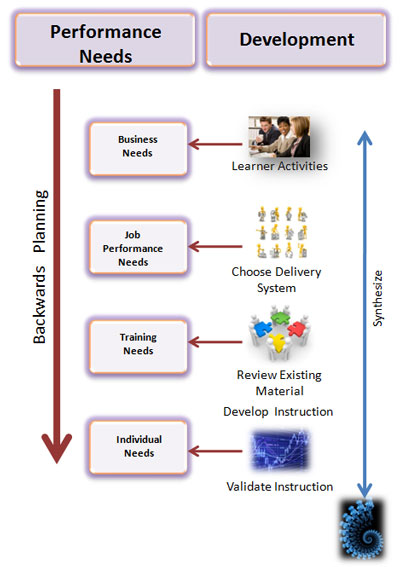
Choose Delivery System

The instructional and support material that provides the most effective learning stimulus are specified in this step. Care should be taken not to select materials just because they are available. For example, there are probably several thousand instructional tapes floating around that were developed, not because it was the best media or method for the instruction to be presented, but because a camera and VCR were readily available. The purpose in this step is not to show your mastery of the latest whiz-bang technology, but rather to select learning methods and the media that support them in order to best magnify the learning process. When determining the media best suited to train the objective consider:
  • The instructional setting: What type of setting is required? Is it up to date or does it have to be modified? If the instructors and learners have to travel to the sight, what materials must they bring?
  • Media characteristics: What is the best media for this type of instruction? How must the media be obtained? Must we produce it? If so, do we have the technical expertise?
  • Instructional material: Can it be developed within the proposed budget? What are the constraining factors for producing this material? Will the technology likely change before the proposed training material can be produced?
  • Time: What are the critical time factors involved? When and how many learners must be trained by a given time? Is there more than one group to be trained and how closely will each group follow?
  • Instructors: Are they qualified for this type of instruction? Must a Train The Trainer class be given to bring the instructors up to par? How long will it take to bring them up to par? How many instructors are available for this instruction?
Each type of instructional material has certain points to consider:
  • Job Performance Aid: Do people just need simple reminders or a list of steps for performing a task? How big should it be? What color? Where exactly must it be placed? Must a briefing or instructions be given to use it correctly?
  • Technical manual: Is the manual already available? If so, must additional material be developed to enhance the manual for instructional purposes?
  • Flowcharts and schematics: Should these be decals? Where must they be placed so that people will use them?
  • Self Teaching Package: Are books and manuals available? Are they geared to the students' educational level? Are the workers motivated to learn on their own?
  • Programmed text:At what level must it be? Is additional instruction needed?
  • Multimedia computer programs: This type of instruction takes a great deal of time and resources to develop. What must be done to complete it in time and within budget? After it is developed, for how long of a time period will it be valid?
  • Computer Aided Instruction: Do we have the authoring tools available? Do we have training specialist who can develop the instruction with the authoring tools or must they be instructed in the new media?
  • Personalized Instruction: Are coaches readily available to aid the learners. What goals need to be established and how will the learners obtain them?
  • On-The-Job Training: Are the supervisors ready to take on the task of providing training and coaching? Must they be instructed in On-The-Job learning packages? Do they have the time? Are trainers needed for this type of training? If so, what will be their role?
  • Resident Instruction: in-house: Do we have instructors who can perform this type of training? Contract Training: Will it be given at our location or a separate location? What sort of time frame is involved?
  • Lockstep or self pace: Self pace is generally consider better in most cases because it allows each learner to proceed at her or his own pace, but it is more difficult to manage than lockstep and usually requires more instructors because of the wide range of variables that take place within the learning environment.
Also, see Media.

Review Existing Material

It is important to review any existing materials to determine if they can be adopted or redesigned into the program. This not only includes material developed in-house, but also material developed by third parties. Whenever possible, the duplication of materials must be avoided to save resources. Also, you should review any existing material relative to the new program to see if it needs to be discarded.

Develop Instruction

Only after all the preplanning has been accomplished, is it time to start developing the instructional material. Developing different forms of courseware requires a certain amount of skill and art.

See Instructional Design

Synthesize

When developing the training material and media, ensure that it is synthesized into an integrated program. It should flow as naturally as possible, with each lesson block building the foundation for the next one. Provide variety that is conductive to learning. Break practice periods up with instructional periods, rather than having all the instruction in the beginning followed by nothing but practice.

Time will have to be consider when synthesizing the complete learning program. For example, if you have five, 3 hour blocks of instruction, how do you break them down to run smoothly in two days? Which one gets chopped to two hours one day and one hour the next day. Will it have an effect on learning? Must the blocks run in order or can you switch them so the least difficult block gets broken apart. Will it be better to break the most difficult one apart so the learners get a respite from the toils of hard learning? Since most workdays are eight hours and your program totals 15 hours, what should be done with the one additional hour that will best benefit the organization?

In the U.S. Army Artillery there is a firing method known as the bracketing process. Fire and adjust! Fire and adjust! This process is continued until there is fire for effect, and then adjusted again until the target is hit! 

Developing effective courseware is the same. Train and adjust! Train and adjust! Continue with the SAT process until the training is no longer needed or until the training courseware is the best piece of training material produced and then some!

Validate Instruction

The last step is to validate the material by using representative samples of the target population and then revising the program as needed. The heart of the systems approach to training is revising and validating the instructional material until the learners meet the planned learning objectives. Also, it should not be thought of as a single shot affair. Success or failure is not measured at a single point.

The initial validation will depend upon the complexity of the training material and your resources. Listed below is a procedure that provides an effective validation of a large training program. Adjust it as needed to fit the size and complexity of your program, but keep in mind that the closer your validation follows this one, the less problems you will encounter during your training.

Select the participants that will be in the trials. The participants should be randomly selected, but they must represent all strata of the target population, bright, average, and slow learners. They should be clearly told what their roles are in the validation process are. Let them know that they are helping to develop and improve the lessons and that they should feel free to tell you what they think about it. The participants should be pretested to ensure that the students learn from the instructional material and not from past experience.

Conduct individual trials. This trial is performed on one learner at a time. The instruction is presented to the learner. The separate pieces of instructions, tests, practice periods, etc., should be timed to ensure they match the estimated times. Do not tutor unless the learner cannot understand the directions. Whenever you help or observe the learner having difficulty with the material, document it.

Revise instruction. Using the documents from the individual trials, revise the material as needed. Closely go over any evaluations that were administered. A large number of wrong answers for an item indicates a trouble area. Conversely, a large number of correct answers for an item could indicate the learners already knew the material, the test items were too easy, or the lessons over taught the material.

Repeat individual trials until the lesson does what it is supposed to do. There is no magical number for individual trials. From three to five times seems to be the usual number. Also, if you are trialing a large course, you might only need to trial specific troublesome areas of the course, rather than the whole course itself.

Conduct group trial. After you are satisfied with the results of the individual tryouts, move on to the group tryouts. These can be of any size. It may consist of several small groups, one large group, or a combination of both. The procedure is the same as the individual tryouts except for one difference. At some point in the trials you must determine if the program needs to be accepted or if it needs major revision. Usually a minimum of two successful tryouts are conducted to ensure the program teaches. Minor problems should not hold up implementing the program. As was stated earlier in this section, revisions do not stop upon the first implementation of the program, but are performed throughout the life of the program.

References

Kimble, G.A. (1961). Hilgard and Marquis' Conditioning and Learning (2nd ed.). Englewood Cliffs, N.J.: Prentice-Hall. Return

Krathwohl, David R., Bengamin S. Bloom, and Bertram B. Mesia (1964). Taxonomy of Educational Objectives (two vols: The Affective Domain & The Cognitive Domain). New York. David McKay. Return

Marzano, Robert J. (1998). A Theory-Based Meta-Analysis of Research on Instruction. Mid-continent Aurora, Colorado: Regional Educational Laboratory.
http://www.mcrel.org/products/learning/meta.pdf
http://www.mcrel.org/products/learning/meta.asp

Pascarella, Ernest t. & Terenzini, Patrick T. (1991) How College Affect Students. San Francisco: Jossey-Bass. NOTE - While Marzano's paper (see above reference) uses a Meta-Analysis approach, this book uses a narrative explanatory synthesis — both works explain the why and how process of their analysis. And even though it pertains to college, this resource is an excellent guide to learning and research.

Rosenberg, Marc (2001). E-Learning: Strategies for Delivering Knowledge in the Digital Age. New York: McGraw-Hill.


Notes

Created July 13, 1995
Updated November 8, 2008