Outline
Design Phase

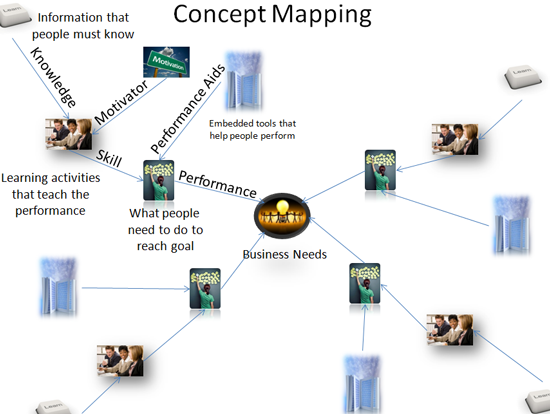
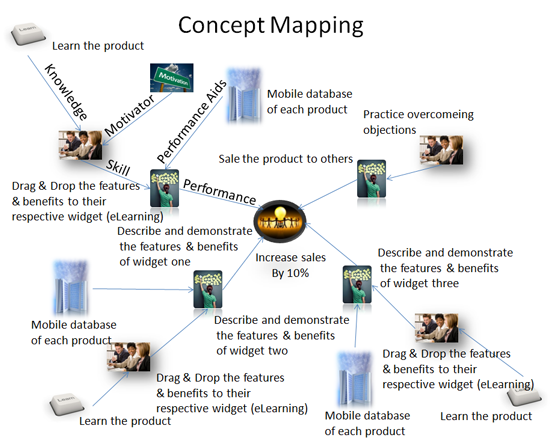
Click for ISD Concept Map
|
The Design Phase
This phase insures the systematic development of the training program. This process is driven by the products of the analysis phase and ends in a model or blueprint of the training program for future development.
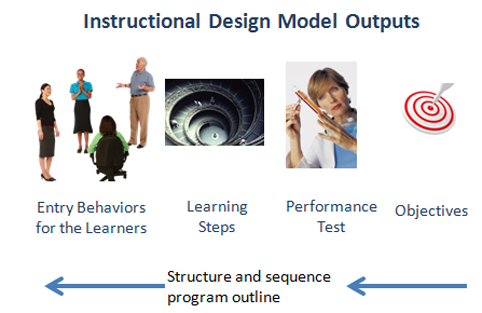
This model or blueprint will contain five key outputs:
- Entry behaviors
- Learning objectives
- Learning steps (performance steps)
- Performance test
- Structure and sequence program outline
The entry behaviors describe what a learner must know before entering into the training program. Just as a college requires certain standards to be met in order to enroll, a training program should require a base level of knowledge, skills, and attitudes (KSA).
The learning objectives tell what tasks the learners will be able to perform after the training, while the learning steps tell how to perform the tasks, while the performance test tells how well the tasks must be met.
Finally, the learning objectives are sequenced in an orderly fashion that provides the best opportunity for learning, such as arranging the learning objective from easy to hard or in the order they are performed on the job.
|
Mr. Spock from Star Trek had a great training technique called "the Vulcan mind meld." Spock placed his fingertips on another person's head, which in turn, transferred knowledge, vivid images, and memories from their brain to his, or vice versa.
Unfortunately, we do not have that capability...yet. So for the time being, we use a systematic method of transferring knowledge, skills, and attitudes (KSA). This method is known as ISD. Just as Spock could extract only the information he wanted, the goal in ISD is to make the transfer quickly, cheaply, and tailored to the learner's needs.
Training, at its simplest, is the transfer of KSA. ISD is nothing but Spock's Vulcan mind meld equivalent.
|
|
There are no better terms available to describe the difference between the approach of the natural and the social sciences than to call the former "objective" and the latter "subjective"...While for the natural scientist the contrast between objective facts and subjective opinions is a simple one, the distinction cannot as readily be applied to the object of the social sciences. The reason for this is that the object, the "facts" of the social sciences are also opinions not opinions of the student of the social phenomena, of course, but opinions of those whose actions produce the object of the social scientist.
The Counter-Revolution of Science by Friedrich August Von Hayek.
|
Develop Objectives
In the analysis phase, you discovered what needs to be trained. In this phase, writing clear learning objectives answers the question, "What will the learners be able to do when they finish the training program?" Of all the activities within the ISD process, this is normally one of the more critical steps. For without well constructed learning objectives, instructors don't know what is to be taught, learners don't know what they are supposed to learn, and managers don't know what they are investing their training dollars in. Learning objectives form the basis for what is to be learned, how well it is to be performed, and under what conditions it is to be performed.
A learning objective is a statement of what the learners will be expected to do once they have completed a specified course of instruction. It prescribes the conditions, behavior (action), and standard of task performance for the training setting. The objective is sometimes referred to as performance or behavioral objectives. For example, knowledge is a state of mind which cannot be directly measured. This requires an indirect method of evaluation, that of observing behavior or performance.
Also, there is a difference between goals and objectives. Goals describe a learning outcome in general, for example, "the learner will successfully complete the supervisor course, before moving on to the leadership course." Notice that this is so general that it provides no guidance about how to achieve it. On the other hand, an objective is a specific statement of instructional intent which attempts to change knowledge, skills or attitudes as a result of a learning experience, for example, "the learner will use Maslow's Hierarchy of Needs when deciding upon motivators."
Specific terminal learning objectives (Mager, 1975) must be developed for each of the tasks selected in the learning program. A terminal learning objective is at the highest level of learning (KSA) appropriate to the human performance requirements a student will accomplish.
Each terminal learning objective is analyzed to determine if it needs one or more enabling learning objectives, that is, if it needs to be broken down into smaller, more manageable objectives. An enabling learning objective measures an element of the terminal learning objective.
A learning objective has three main parts:
- Observable Action (task) - This describes the observable performance or behavior. An action means a verb must be in the statement, for example "type a letter" or "lift a load." Each objective covers one behavior, hence, only one verb should be present. If the are many behaviors or the behaviors are complicated, then the objective should be broken down into one or more enabling learning objectives that supports the main terminal learning objective.
- At Least One Measurable Criterion (standard) - This states the level of acceptable performance of the task in terms of quantity, quality, time limitations, etc. This will answer any question such as "How many?" "How fast?" or "How well?". For example "At least 5 will be produced", "Within 10 minutes", "Without error". There can be more than one measurable criterion. Do not fall into the trap of putting in a time constraint because you think there should be a time limit or you cannot easily find another measurable criterion use a time limit only if required under normal working standards.
- Conditions of performance (usually) (condition) - Describes the actual conditions under which the task will occur or be observed. Also, it identifies the tools, procedures, materials, aids, or facilities to be used in performing the task. This is best expressed with a prepositional phase such as "without reference to a manual" or "by checking a chart".
Listed below are four examples of learning objectives
- Example 1: Write a customer reply letter with no spelling mistakes by using a word processor.
- Observable Action: Write a customer reply letter
- Measurable Criteria: with no spelling mistakes
- Conditions of Performance: using a word processor
- NOTE: If more that one type of word processor or computer is used in the organization, then it should be more specific. For example: Given a personal computer, Word for Windows, and printer, create a printed customer reply letter with no spelling mistakes. The conditions of performance are "Given a personal computer, Word for Windows, and printer". Generally speaking, the larger the organization or the more technical the task, the more specific the conditions of performance must be spelled out.
- Example 2: Copy a table from a spreadsheet into a word processor document within 3 minutes without reference to the manual.
- Observable Action: Copy a table from a spreadsheet into a word processor document
- Measurable Criteria: within 3 minutes
- Conditions of Performance: without referencing the manual.
- Note: The Conditions of performance may also include a variable as shown in the next example.
- Example 3: Smile at all customers, even when exhausted, unless the customer is irate.
- Observable action: Smile
- Measurable Criteria: at all customers
- Conditions: even when exhausted
- Variable: unless the customer is irate
- Note: Sometimes its helpful to start with the phase "After training, the worker will be able to..."
- Example 4: After training, the worker will be able to load a dumptruck within 3 loads with a scooploader, in the hours of darkness, unless the work area is muddy.
- Observable Action: load a dumptruck
- Measurable Criteria: within 3 loads
- Conditions: with a scooploader in the hours of darkness
- Variable: unless the work area is muddy
The learning objective spells out the exact training requirement. Without them, time and money could be wasted by training workers to type at 65 WPM when all that is required is to be able to type at 35 WPM, or training employees to sell an item to an easy going customer when what they really need to know is how to sell an item to a skeptical customer, or training them to enter data into a spreadsheet application when the actual job requires them to enter data into a customized database package.
A clearly formulated objective has two dimensions, a behavioral aspect and a content aspect. The behavioral aspect is the action the learner must perform, while the content is the product or service that is produced by the learner's actions. For example, "the student will learn forklift operations by studying the operator's manual" refers not to an outcome of training but to an activity of learning. If you observed the student reading, you could make no judgment if he or she was actually learning (behavioral aspect) and there is no service produced by the learner's action (content aspect).
A better example would be "Given a forklift, load a pallet onto a trailer without any safety errors." In this example, the behavioral aspect is loading a trailer, while the content aspect is a pallet placed on the trailer.
Notice that learning objectives look a lot like tasks. A task analysis itemizes each discrete skill found in a job, but it provides only end goal statements. While learning objectives spell out the prerequisite skills and makes them the course objectives.
Using the Correct Verb
The type of verb that is used in the task statement, determines the level or of learning (or degree of difficulty) that must achieved. For example, being able to criticize a process shows a much more complex behavior than simply being able to identify a process.
Bloom's Taxonomy (also know as "Learning Domains") can assist you in choosing the correct verb for the task you want to train.
Identify Learning Steps
Once the final outcome is known - the learning objective, then the steps needed to perform the objective are identified and compiled. These are also constructed from the
Appendix C - Task Performance Measures - Training Form 1-6.
The learning steps are compiled into a list that specifies each activity that must be performed in order to successfully complete the task.
For example, the learning steps for the objective "Given a cash register and at least ten products, calculate the exact total for the purchase transaction," might read like this:
- Enter the sales price and the department key for each product.
- Repeat step one until all products have been entered.
- After all items have been entered, press the subtotal key.
- Press the Tax key.
- Press the Total key.
|
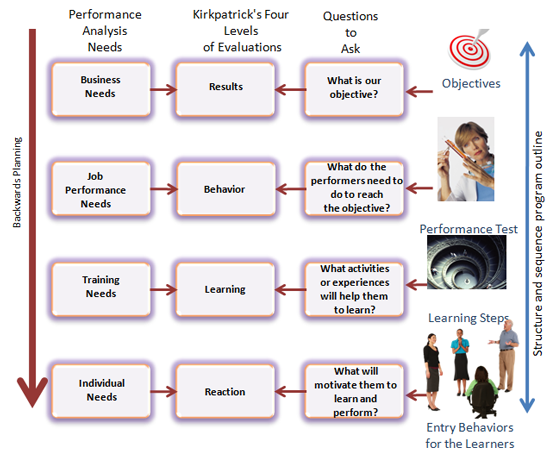
ISD is a big proponent of backwards planning.
You perform an analysis to see what is needed.
You develop the objectives and a performance test to ensure the objectives are met.
Some ISD models even have the
learning steps developed after the tests.
It is then fleshed together in the development phase.
|
Develop Tests
Construct tests to evaluate the learner's mastery of the learning objective. You might wonder why the tests are developed so soon in the design phase, instead of in the development phase after all of the training material has been built. In the past, tests were often the last items developed in an instructional program. This is fine, except that many of the tests were based on testing the instructional material, nice to include information, items not directed related to the learning objectives, etc. The major purpose of the test is to promote the development of the learner. It ascertains whether the desired behavior changes have occurred following the training activities. It performs this by evaluating the learner's ability to accomplish the learning objective. It also is a great way to provide feedback to both the learner and the instructor.
The learning objective should be a good simulation of the conditions, behaviors and standards of the performance needed in the real
world, hence the evaluation at the end of the instruction should match the objective.
The methodology and contents of the learning program should directly support the
learning objectives. The instructional media should explain, demonstrate, and provide
practice. Then, when students learn, they can perform on the test, meet the objective, and perform as they must in the real world.
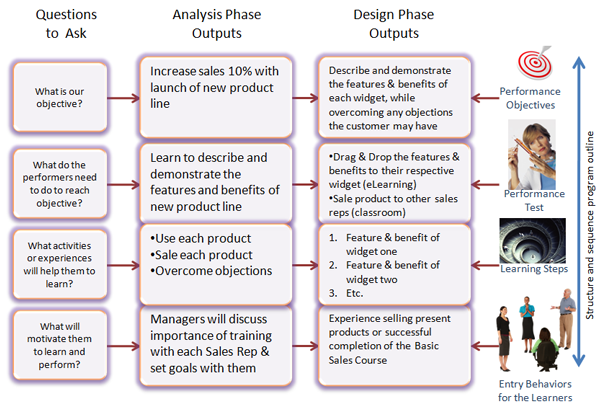
The diagram below, shows how it all flows together:
To focus the training program on the required task performance measurements, the ISD model is based on the following development order:
- Analyze the task to determine the objective.
- Develop the learning objective fully and determine if it has any enabling objectives. If it does, then spell them out.
- List the steps required to perform the objective to standards.
- Build a test instrument to determine if the learner can perform the steps that are required to reach the objective.
- Construct courseware that will train the learners to perform the objective. You know the learners can perform the objective if they can meet the evaluation standards.
Using this development order, the focal point of the ISD model is the objective. The objective specifies what behavior must be displayed to perform the task to standards. Training is then developed to teach the steps that will best lead to the desired behavior. This is what training is all about!
Testing Terms
Tests are often referred to as "evaluations" or "measurements". In order to avoid confusion we will define the terms used in evaluating learners:
- Test or Test Instrument: (Brown, 1971) A systematic procedure for measuring a sample of an individual's behavior, such as multiple-choice, performance test, etc.
- Evaluation: (Wolansky, 1985) A systematic process for the collection and use of information from many sources to be applied in interpreting the results and in making value judgments and decisions. This collection of results or scores is normally used in the final analysis of whether a learner passes or fails. In a short course the evaluation could consist of one test, while in a larger course the evaluation could consist of dozens of tests. The process of determining the value and effectiveness of a learning program, module, and course
- Measurement: (Wolansky, 1985) The process employed to obtain a quantified representation of the degree to which a learner reflects a trait or behavior. This is one of the many scores that an individual may achieve on a test. An evaluator is most interested in the gap between a learner's score and the maximum score possible. If the testing instrument is true, then this is the area that the learner did not master
Planning the Test
Before plunging directly into test item writing, a plan should be constructed. Without an advance plan, some test items will be over represented while others may stay untouched. Often, it is easier to build test items on some topics than on others. These easier topics tend to get over-represented. It is also easier to build test items that require the recall of simple facts, rather than items calling for critical evaluation, integration of different facts, or application of principles to new situations. A good test or evaluation plan has a descriptive scheme that states what the learners may or may not do while taking the test. It includes behavioral objectives, content topics, the distribution of test items, and what the learner's test performance really means.
Types of Tests
There are several varieties of tests. The most commonly used in training programs are Criterion Referenced Written Tests, Performance Tests, and Attitude Surveys. Although there are exceptions, normally one of the three types of test are given to test one of the three learning domains (Krathwohl, et al, 1964) (see the first section in chapter IV, Development Phase, for more information on the learning domains). Although most tasks requires the use of more than one learning domain, there is generally one that stands out. The dominant domain should be the focal point of one of the following evaluations:
- Criterion Referenced Test: Evaluates the cognitive domain which includes the recall or recognition of specific facts, procedural patterns, and concepts that serve in the development of intellectual abilities and skills. The testing of these abilities and skills are often measured with a written test or a performance test. Note: A criterion referenced evaluation focuses on how well a learner is performing in terms of a known standard or criterion. This differs from a norm referenced evaluation which focuses on how well a learner performs in comparison with other learners or peers.
- Performance Test: Evaluates the psychomotor domain which involves physical movement, coordination, and use of the motor-skill areas. Measured in terms of speed, precision, distance, procedures, or techniques in execution. Can also be used to evaluate the cognitive domain. A performance test is also a criterion referenced test if it measures against a set standard or criterion. A performance test that evaluates to see who can perform a task the quickest would be a norm referenced performance test.
- Attitude Survey: Evaluates the affective domain which addresses the manner in which we deal with things emotionally, such as feelings, values, appreciation, enthusiasms, motivations, and attitudes. Attitudes are not observable; therefore a representative behavior must be measured. For example, we cannot tell if a worker is well motivated by looking at her or testing her. But we can observe some representative behaviors, such as being on time, working well with others, performing tasks in an excellent manner, etc.
Whenever possible, criterion referenced performance tests should be used. Having a learner perform the task under realistic conditions is normally a better indicator of a person's ability to perform the task under actual working conditions.
If a performance test is not possible, then a criterion referenced written test should be used to measure the learners' achievements against the objectives. The test items should determine the learner's acquisition of the KSAs required to perform the task. Since a written measuring device samples only a portion of the population of behaviors, the sample must be representative of the behaviors associated with the task. Since it must be representative, it must also be comprehensive.
Written Tests
A written test may contain any of these types of questions:
- Open-ended question: This is a question with an unlimited answer. The question is followed by an ample blank space for the response.
- Checklist: This question lists items and directs the learner to check those that apply to the situation.
- Two-Way question: This type of question has alternate responses, such as yes/no or true/false.
- Multiple-Choice question: this gives several choices, and the learner is asked to select the most correct one.
- Ranking Scales: This type of question requires the learner to rank a list of items.
- Essay: Requires an answer in a sentence, paragraph, or short composition. The chief criticism leveled at essay questions is of the wide variance in which instructors grade these. A chief criticism of the other types of questions (multiple choice, true/false, etc.) is that they emphasize isolated bits of information and thus measure a learner's ability to recognize the right answer, but not the ability to recall or reproduce the right answer. In spite of this criticism, learners who score high on these types of questions also do well on essay examinations. Thus the two kinds of tests appear to measure the same type of competencies.
Multiple Choice
The most commonly used question in training environments is the multiple-choice question. Each question is called a test item. The parts of the test item are labeled as:
1. This part of the test item is called the "stem".
_____a. The incorrect choices are called "distracters".
_____*. Correct response
_____c. Distracter
_____d. Distracter
|
When writing multiple-choice questions follow these points to build a well constructed test instrument:
- The stem should present the problem clearly
- Only one correct answer should be included.
- Distracters should be plausible
- 'All the above' should be used sparingly. If used, an equal number of 'All the above' should be correct and incorrect (distracters). Do not use 'None of the above'.
- Each item should test one central idea or principle. This enables the learner to fully concentrate on answering the question instead of dissecting the question. It also allows the instructor to determine exactly which principles were not comprehended by the learner
- The distracters and answer for a question should be listed in series. That is, high to low, low to high, alphabetical, longest to shortest, like vs. unlike, function, etc
- Often, test items can be improved by modifying the stem. In the two examples below, the stem has been modified to eliminate duplicate words in the distracters. This makes the question easier to read.
Poor example:
1. The written objectives statement should
_____a. reflect the identified needs of the learner and developer
_____b. reflect the identified needs of the learner and organization
_____c. reflect the identified needs of the developer and organization
_____d. reflect the identified needs of the learner and instructor
|
Better example:
1. The written objectives statement should reflect the identified needs of the
_____a. learner and developer
_____b. learner and organization
_____c. developer and organization
_____d. learner and instructor |
The distracters should be believable and in sequence:
Poor example:
2. A student who earns a score of 60, 70, 75, 95, and 95 would have a mean score of
_____a. 79
_____b. 930
_____c. 3
_____d. 105 |
In the above example, all the distracters were simply chosen at random. A better example with believable distracters and numbers in sequence would be:
2. A student who earns a score of 60, 70, 75, 95, and 95 would have a mean score of
_____a. 5 (total number of scores)
_____b. 75 (medium)
_____c. 79 (correct response)
_____d. 95 (mode)
(also notice that the choices are in numerical order) |
If an item analysis (see chapter 6) is performed on the above example, we might discover that none of the learners choose the first distracter, (a). In our search for a better distracter the trainer informs us that some of the learners are entering the class with the myth that the mean is found by using the incorrect formula shown on the left below, instead of the correct formula shown to its right:
That is, they are adding a 1 to the total number of scores. We could change the first distracter (a) as follows:
2. A student who earns a score of 60, 70, 75, 95, and 95
would have a mean score of
_____a. 65 (answer if incorrect formula is used)
_____b. 75 (medium)
_____c. 79 *correct
_____d. 95 (mode) |
Although a new item analysis might show that the learners are not choosing the new distracter, because the myth is adequately being dispelled by the trainer, it could still be left in as a distracter to let the instructor know if the myth is properly being dispelled. If a plausible distracter cannot be found, then go with a fewer number of distracters. Although four choices are considered the standard for multiple-choice questions as they only allow a 25% chance of the learner guessing the correct answer, go with three if another believable distracter cannot be constructed. A distracter should never be used just to provide four choices as it wastes the learner's time reading through the possible choices.
Also, notice that the layout of the above example question makes an excellent score sheet for the instructor as it gives all the required information for a full review of the evaluation.
True and False
True and false questions provide an adequate method for testing learners when two or more distracters cannot be constructed for a multiple-choice question or to break up the monopoly of a long test. Multiple-choice questions are generally preferable as a learner who does not know the answer has a 25 percent chance of correctly guessing a question with four choices or approximately 33 percent for a question with three choices. With a true-false question their odds get better with a 50 percent chance of guessing the correct answer.
True and false questions are constructed as follows:
|
__ T __ F__ 1. There should always be twice the number of true statements verses false statements in a True/False test.
__ T__ F __ 2. Double negative statements should not be used in True/False test statements.
|
Question 1 is false as there should be approximately an equal number of true and false items. Question 2 is true for any type of question. Other pointers when using True and False tests are:
- Use definite and precise meanings in the statements.
- Do not lift statements directly from books or notes.
- Distribute the true and false statements randomly in the test instrument.
Open Ended Questions
Although open ended questions provide a superior method of testing than multiple-choice or true-false questions as they allow little or no guessing, they take longer to construct and are more difficult to grade. Open ended questions are constructed as follows:
1. In what phase of the Instruction Skills Development model
are tests constructed? ____________________
(This is an example of a direct question)
2. Open ended test statements should not begin with a
_________________________ .
(This is an example of an incomplete statement.) |
The blank should be placed near the end of the sentence:
Poor example:
|
3. ____________________ is the formula for computing the mean.
|
Better example:
|
3. The formula for computing the mean is _____________________. |
Placing the blank at or near the end of a statement allows the learner to concentrate on the intent of the statement. Also, the overuse of blanks tends to create ambiguity. For example:
Poor example:
|
4. _________________ theory was developed in opposition to the
_____________ theory
of _______________________ by ___________________ and
____________________. |
Better example:
|
4. The Gestalt theory was developed in opposition to the
____________________ theory
of psychology by ______________________ and
_____________________________. |
Performance Tests
A performance test allows the learner to demonstrate a skill that has been learned in a training program. Performance tests are also criterion referenced in that they require the learner to demonstrate the required behavior stated in the objective. For example, the learning objective "Calculate the exact price on a sales using a cash register" could be tested by having the learners ring up the total with a given number of sales items by actual using a cash register. The evaluator should have a check sheet to go by that lists all the performance steps that the learner must perform to pass the test. If the standard is met, then the learner passes. If any of the steps are missed or performed incorrectly, then the learner should be given additional practice and coaching and then retested.
There are three critical factors in a well conceived performance test:
- The learner must know what behaviors (actions) are required in order to pass the test. This is accomplished by providing adequate practice and coaching sessions throughout the learning sessions. Prior to the performance evaluation, the steps required for a successful completion of the test must be understood by the learner.
- The necessary equipment and scenario must be ready and in good working condition prior to the test. This is accomplished by prior planning and a commitment by the leaders of the organization to provide the necessary resources.
- The evaluator must know what behaviors are to be looked for and how they are rated. The evaluator must know each step of the task to look for and the parameters for the successful
completion of each step
Attitude Surveys
Attitude surveys measure the results of a training program, organization, or selected individuals. The goal might be to change the entire organization (Organizational Development) or measure a learner's attitude in a specific area. Since attitudes are defined as latent constructs and are not observable in themselves, the developer must identify some sort of behavior that would seem to be representative of the display of the attitude in question. This behavior can then be measured as an index of the attitude construct. Often, the survey must be administered several times as employees' attitude will vary from day to day, indeed, sometimes even hour to hour. Before and after measurements should be taken to show the changes in attitude. Generally, a survey is conducted one or more times to assess the attitude in a given area, then a program is undertaken to change the employee's attitudes. After the program is completed, the survey is again administered to test its effectiveness.
A survey example can be see at Job
Survey.
|
One test is worth a thousand expert opinions. - Bill Nye the Science Guy
|
|
Failing to understand the learners is one of the biggest mistakes made in ISD. You must know their background so that learning can start at the correct point.
|
List Entry Behaviors
A sample of the learner target population should be tested to determine if their entry behavior Knowledge, Skills, and Abilities (KSAs) match the proposed level of instruction. To determine the entry behavior, test a small sample of the learners to establish if your assumption of their threshold knowledge and the starting point of the training program are correct. That is, do the proposed learners have the needed KSAs to master the terminal learning objective in the training program or must they be taught additional enabling objectives.
For example, an instructional program might instruct several advanced uses of a piece of diagnostic equipment. The instructional plan is initially based on the assumption that the
learners have mastered the basic diagnostic procedures for the equipment from prior experience or training. These basic diagnostic procedures should be tested on the proposed learners to validate the instructional plan assumption. If they have not mastered one or more of the basic diagnostic procedures, then these unmastered procedures will have to be accounted for in the training plan.
Once you have tested their present KSAs, then the tasks to be taught should be tested on a small sample of personnel who have mastered the tasks previously to ensure the proposed test is correct. Finally, a sample of the proposed learners are tested to see if they can pass any portions of the test without any instruction.
Photo by catbagan
Good trainers, like good producers, lay out their work in a logical sequence so that the audience (learners) can easily follow it.
|
Sequence and Structure
The last step in the design phase is to determine program sequence and structure to ensure the learning objectives are met. A proper sequence provides the learners with a pattern of relationship so that each activity will have a definite purpose. The more meaningful the content, the easier it is to learn and, consequently, the more effective the instruction.
Proper sequencing also helps to avoid inconsistencies in the content of the instruction. When material is carefully sequenced, duplication is far less likely. Indeed, the presence
of duplication often indicates that the program has not been properly sequenced.
|
Ed Wood (directing, observed by the film's financial backer): "Cut! Print! That was perfect!"
Backer: "Perfect? Mr. Wood, don't you know anything about the art of film production?"
Ed Wood: "Well, I like to think so!"
Backer: "That cardboard headstone fell over this graveyard is obviously phony!"
Ed Wood: "No one will ever notice! Filmmaking is not about the little details. It's all about the big picture!"
Backer: "The big picture? Then how come a few minutes ago this scene was set in the daytime but now it's suddenly night?"
Ed Wood: "What do you know? Haven't you ever heard of suspension of disbelief?"
Unlike Ed Wood's movies, learning often needs to be performed in certain sequences so that the learner does not become utterly confused.
|
Some of the techniques and considerations used in sequencing are:
- Job Performance Order: The learning sequence is the same as the job sequence
- From Simple to Complex: Objectives may be sequenced in terms of increasing complexity
- Critical Sequence: Objects are ordered in terms of their relative importance
- Known to Unknown: Familiar topics are considered before unfamiliar ones
- Dependent Relationship: Mastery of one objective requires prior
mastery of another
- Supportive relationship: Transfer of learning takes place from one objective to another, usually because common elements are included in each objective. These should be placed as close together as possible so that the maximum transfer of learning can take place
- Cause to Effect: Objectives are sequenced from cause to effect
If there are a lot of objectives, then they should be organized into clusters which are conductive to learning. The sequencing performed earlier is the basis for breaking the objectives down into clusters based on the class relationship between them.
If the training program is long, then reinforcement also has to be accounted for. One of the behavioral characteristics of learners indicates that not only the rate of which people learn must be accounted for, but also the rate of decay that takes place after an objective is mastered must also be accounted for. To account for this decay factor, reinforcement loops must be built into the instructional process. The decay factor also has to be considered once the learner graduates from the program. If a task is taught in the instructional program and then is not used for some time after the learners return to their duties, then some decay is likely to take place. The remedy for this is to coordinate with the learner's supervisor to ensure the learners perform their newly acquired skills as soon as possible upon returning to the job.
In any instructional program, there is usually a wide variety of abilities among the learners. Some will have extensive experience, while others are somewhat limited. The educational background may extend from high school dropout to college graduate. Many other variables will affect the progression and productivity of the learners. Provisions must be made to compensate for these differences. In a self-paced course, extra modules can help the learners that are having difficulties. In a lock-step course, additional instruction, reading assignments, or study halls may be required to keep the slower learners on pace with the other learners.
The product of the sequencing step should be a learning map which shows the proposed layout of the objectives. An example is shown below.
Click chart to enlarge
Learning Activity
Crossword Puzzle
References
Brown, Frederick, G. (1971). Measurement and Evaluation. Itasca, Ill.: F.E. Peacock
Return
Krathwohl, David R., Bengamin S. Bloom, and Bertram B. Mesia
(1964). Taxonomy of Educational Objectives (two vols: The Affective Domain & The Cognitive Domain). New York: David McKay.
Return
Mager, Robert, F. (1975). Preparing Instructional Objectives (2nd ed.). Belmont, CA: Fearon.
Return
Wolansky, William, D. (1985). Evaluating Student Performance in Vocational Education. Ames, Iowa: Iowa State University Press.
Return
|
|