
Note: This site is moving to KnowledgeJump.com. Please reset your bookmark.
Continuous Process Improvement
Quality is a never ending quest and Continuous Process Improvement (CPI) is a never ending effort to discover and eliminate the main causes of problems. It accomplishes this by using small-steps improvements, rather than implementing one huge improvement. The Japanese have a term for this called kaizen which involves everyone, from the hourly workers to top-management.
CPI means making things better. It is NOT fighting fires. Its goal is NOT to blame people for problems or failures. . . it is simply a way of looking at how we can do our work better. When we take a problem solving approach, we often never get to the root causes because our main goal is to put out the fire. But when we engage in process improvement, we seek to learn what causes things to happen and then use this knowledge to:
- Reduce variation.
- Remove activities that have no value to the organization.
- Improve customer satisfaction.
Process improvement is important as Rummler & Brache's research (1995) showed that process account for about 80% of all problems while people account for the remaining 20%.
Steering Committee and CPI Teams
One way to get CPI started is to set up a Steering Committee (SC). Although everyone in the organization is responsible for CPI, the SC follows all ideas from conception to completion. Some organizations might have several SCs working on different processes, departments, or systems; while smaller organizations might set up one SC to oversee all CPI projects. Normally, there is one SC that oversees all CPI projects within a physical area. It in turn, passes each CPI suggestion on to a CPI team that carries that project out to completion. At the very least, the SC must contain members who can approve a project (spending authority).
CPI Procedure
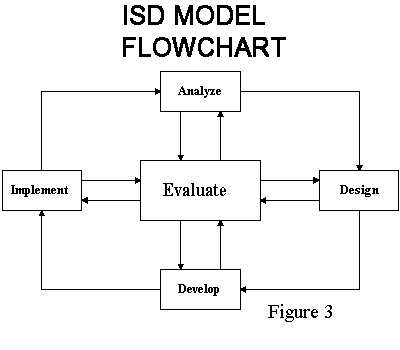
CPI has been described using a number of models. This manual will use the system approach or ADDIE (Analysis, Design, Development, Implement, Evaluate) model. There are five phases in this model:
- Analysis Phase — Identify areas of opportunity and target specific problems. These areas and problems are based on team brain-storming sessions, process definition sessions, recommendations forwarded to the team by organizational members, and other various analysis techniques.
- Design Phase — Generate solutions through brain-storming sessions. Identify the required resources to implement the chosen solution and identify baselines to measure.
- Development Phase — Formulate a detailed procedure for implementing the approved solution.
- Implementation Phase — Execute the solution.
- Evaluation Phase — Build measurement tools, monitor implementation, and evaluate measurements to baseline. Please note that this phase is performed throughout the entire process. The chart below shows that this is a dynamic, not a static model:
Analysis Phase
This is the discovery phase where problems are uncovered and defined. One of the best ways to accomplish this is to learn how things work in an organization. . . and a simple technique for doing this is "Process Definition."
Process Definition
Often, new insights become apparent when you see how tasks relate to a series of events. Building a task and event relationship is called Process Definition. A process is a planned series of actions that advances a material or procedure from one stage of completion to the next. It includes the steps and decisions involved in the way work is accomplished. Being able to understand and define the process has several advantages:
- You can better understand how individual and group efforts affect other groups and individuals.
- You can discover barriers that exist between work groups. These barriers are obstacles that get in the way of cooperation and performance.
- Work is accomplished through processes and we improve performance by improving processes. Examining a process can highlight a glaring problem that could easily be fixed.
The first step of process definition is to identify the boundaries. This is where the process begins and ends. The beginning of a process starts with a trigger that causes a specific action to be taken by a person, another process, or work group. The ending occurs when the results get passed on to another person, process, or work group.
The beginning trigger starts when someone performs an action on an input that they receive from a supplier (another work group, vendor, or person). The input can be physical, such as raw material, parts, a person to be interviewed, etc.; or information, such as a computer printout, request form, etc.
The ending trigger is when the results of the process is passed on to the customer (another work group, person, or outside customer). The output can be physical, such as a television set, new hire, etc.; or information, such as a typed letter, grant, etc.
Notice that every person at every level has two roles:
- The role of customer where they receive a trigger from a supplier (either external or internal).
- The role of supplier where they pass the result on to a customer (either external or internal).
Process Definition lists what happens between the start and end points. It includes all the activities performed by each department, group, or person who are involved in the process. Activities are the major "works" that transform an input into an output. A process rarely has more than six major activities.
For example, a simple sales process might include, Introduce Services, Identify Customer Needs, Suggest Solutions, Articulate Benefits, Negotiate a Proposal, and Close the Sale.
Many processes do not stay in one department, but may span across several departments. For example, a new candidate gets selected by the Recruiting Department, is interviewed by Manufacturing and Sales, and is then hired by Human Resources. The chart below shows how processes can span across several areas:
	   Vendor  Dept 1  Dept 2  Dept 3  Customer
Process 1     ----------------
Process 2             ------------------------
Process 3     ------------------------
Process 4                     ---------
When listing the activities, do NOT analyze the process, just describe it. One effective way of doing this is to first create a matrix on a large board. Title the horizontal axis with the major steps or departments and the vertical axis with a timeline.
Then list each activity performed by each department, group, or individual on a separate Post-It Note. Start the statement on each Post-It note with a verb. For example:
- Cuts boards into 12 inch sections.
- Types customer's address into the order-entry database.
- Assembles circuit board.
- Selects candidate for interview.
Next, assemble the Post-It Notes on the board in the sequence they are performed. Highlight the inputs and outputs for easy identification.
Your matrix should show:
- The process goals.
- The process boundaries (start and stop points).
- The process flow.
- Resources, such as material, people, time, and equipment.
- The process inputs and outputs (physical or information).
- The process customers and suppliers (internal and external).
There are several methods for laying out the models. The most common way is in a linear fashion by activity. For an example see Process Example.
A second method is by hierarchy. This type of model works best when there are many details included in the process. For an example see Hierarchy Process Example.
You are now ready to analyze the process for problems or bottlenecks. A good process model will expose the "truth" of the organization. Although there might be written procedures, instructions, or rules for conducting a process, your model should point out what is really being performed! First, look for problems and opportunities that affect customers. These affect the organization the most. Remember that customers are both internal and external. Also, you need to understand the magnitude of the problem. This can be done by asking "How bad is it?"
The analysis should also include unearthing the Performance Metrics of the process. These include:
- Headcount
- Cost
- Quality (to include rework)
- Service levels
- Time
Other Problem Solving Methods
Listed below are some other methods for problem identification:
- Customer Surveys — These can be written or oral. If oral, make sure they are consistent. Otherwise your measurements will not be accurate.
- Employee Suggestions.
- Brainstorming
- Delphi Decision Making Process
- Dielectric Decision Making Process
- Pareto Decision Making — (Note: see the Evaluation Phase for measurement tools)
Root Causes
Ensure that you get to the root cause of the problem. If you do not eliminate the root cause, then the problem will resurface elsewhere. The Japanese have a procedure called the five whys. They ask "why" five times when confronted with a problem. By the time the fifth why is answered, they believe they have found the ultimate cause of the problem.
Problem and Recommended Solution Statement
This is the output that gets passed to the design phase. A good statement fully defines the problem and provides a solution. Listed below are a couple of examples. Please note that they are highly abbreviated, but you should get the idea!
Examples
A bad example: Supplies do not get here on time. We need to do things faster.A Better example: 1/2 of Purchasing's time is spent gathering product, vendor, and customer information. Recommend that all information be entered into the product's database. Also, a formal procedure for ordering supplies needs to formalized as it is presently done in a haphazard manner.
A bad example: Our products cost more than the competitors. We need to lower prices.
A better example: Each finished good is moved an average of 9 times before it is sent to the customer. By making dedicated locations for each product line, this could be reduced to a maximum of 2 moves.
Design Phase
Once you have firmly identified the problem, you can then design a plan or counter-measure to get rid of the problem and keep it from reoccurring. During this phase, two products will be developed — The Process Performance Objectives and a measurement tool with baselines.
Process Performance Objectives
Process Performance Objectives are brief and concise plans that contain an action statement. They include:
- Direction — e.g. reduce, increase
- Measurement — e.g. hours, cycle time
- Process — e.g. receive shipments, build widget
- Solution — e.g. by implementing, changing
- Target — a number or goal to aim for (targets should always be reviewed with the organization's leadership to see if they concur with their goals)
For example, "Reduce (direction) hours (measurement) packaging software (process) by changing the location of the shrink wrap tunnel (solution). The target is 1.5 hours.
or
Increase (direction) quality (measurement) for painting bicycles (process) by implementing a painting process (solution). The target is a 15% increase in the customer survey satisfaction index.
or
Raise (direction) customer satisfaction (measurement) for returning goods (process) by allowing a "no question asked" return policy (solution). The target is a 10% decrease in complaints.
Measurements
In order to evaluate the CPI project, measurements are taken before, during, and after implementation of a solution. Measurements are taken before implementation for two main reasons. The first is to confirm that a problem really exists. In many instances this may not be necessary as you will already have the data to confirm the initial analysis. The second reason is to collect a baseline measurement. The baseline measurement allows you to evaluate the solution by having a reference to measure against. When the solution is implemented, the measurement is conducted again. The difference (if any) tells you the degree of success of the project. Some of the things that can be measured are:
- Customer satisfaction
- Product or service quality
- Percent of late deliveries
- Number of errors
- Number of minutes per order
- Cost per order
- Quantity produced
- Cycle time vs. best in class (Benchmarking)
- Percent of time devoted to rework
- Number of people or resources involved in a process
Development Phase
The development phase builds on the Process Performance Objectives and measurement tool constructed in the design phase. The product of this phase is a detailed plan of action that lists step-by-step procedures for implementing the change. The plan also needs to include who is responsible for what and time schedules.
If there are several projects, then the SC normally passes the project on to a CPI team at this point to carry it through to completion.
Implementation Phase
This is where you put your plan into action. This phase involves change and whenever you have change, you can have resistance. Please read Change for smoothing the implementation of the new process.
One method for getting the process owners involved in CPI and ensuring all the steps to a process have been identified is to have them list their tasks in the process. Although the following is actually part of the analysis phase, it will make the implementation go much smoother by getting the stake-holders involved:
- You will need Post-It-Notes and large pieces of paper taped to the walls of the meeting room. Each person involved in the process is issued a pad of Post-It-Notes and a broad tipped pen. The coach provides an overview of the process and then asks the process team to identify the tasks that the team has to perform in order to accomplish the process. Each person silently list every task he or she can think of on a separate note. Allow 20 to 25 minutes for this activity. Once everyone has completed their notes, each person in turn goes to the board and sticks their notes on the board, taking a moment to read each note. The process team is encouraged to remain silent during this part of the activity, but are told to create additional notes when someone else's note sparks a new thought about an additional task is performed.
- In the next step, each person approaches the board and attempts moves the notes around into groups that have a similar theme and in the order they are performed. Team members can work together on this, asking questions about the meaning of specific notes, and suggesting themes for grouping tasks. Duplicates should be placed on top of one another. It is also a good idea to create a boxed-off area for any notes that suggest activities that may be out of the scope of process. This "Holding Area or Parking Lot" can be revisited from time-to-time as the process model continues to build.
- Next, the team is asked create a name for each theme. This involves looking at the grouped tasks and trying to come up with a word or phrase to describe each theme. Then the team is asked to determine if the natural order of the themes is correct. Some themes will have to be performed before others can occur. Some can, or will have to be performed simultaneously.
- The coach then asks for a volunteer to grab a marker pen and write on a flip chart. With the volunteer leading, the team creates a refined list of tasks by theme. It is usually a good idea to ask the team to determine which activities are essential and which are nice to have. Next the team estimates the time needed to perform each essential task. Individuals are asked to volunteer to work on one or more tasks or themes until all the items have been completed.
- At the conclusion of the activity the followings steps should be accomplished:
- All steps performed in a process has been determined.
- Time-frames for accomplishing each task have been estimated.
- The order of the tasks have been determined.
- Workers who perform each task have been identified.
- After the activity, compare the process holders model with your model. Any discrepancies must researched and resolved.
Evaluation Phase
You cannot know if the plan succeeded unless you measure it. Evaluations are used to measure the success or failure of a change. Some plans do fail and they should be thought of as learning experiences, not "lets find a scapegoat." This section describes a few tools of measurement that allow you to solve problems, and make decisions.
Also note that this phase is performed throughout the CPI Model. It is used to get baseline measurements in the other phases and to monitor the progress and procedures for CPI. At least one person on the steering committee should be appointed to monitor the progress and process of all CPI projects.
Measurement Tools
Pareto Chart
The Pareto Chart is based on Vilfredo Pareto, an Italian economist, that states that a small percentage of a group accounts for the largest fraction of a value or impact. That is, 80% of the effects come from 20% of the possible causes. The goal is to go after that 80% first, by solving a few problems. The Pareto Chart converts data into visual information. For example, you are analyzing the errors in a clothing manufacturing plant by counting the number of rejects over a one week period. You know that most of the errors are: wrong material used, stretched bands, weak threads, cracked buttons, and broken zippers. At first you might believe that the vendors are responsible for most of the errors by sending you bad material since four of the error codes belonged to the vendors and only one belonged to the operators. But then you analyze the data:
Sew a pair of pants: reason for rejects
60 ----------------------------------------------------
        55			Total Mistakes: 92
       ____
      |    |
      |    |
50 ---|    |-------------------------------------------
      |    |
      |    |
      |    |
40 ---|    |------------------------------------------
      |    |
      |    |
      |    |
30 ---|    |------------------------------------------
      |    |
      |    |
      |    |
20 ---|    |------------------------------------------
      |    |      15
      |    |     ____       12
      |    |    |    |     ____
      |    |    |    |    |    |
10 ---|    |----|    |----|    |----------------------
      |    |    |    |    |    |      6
      |    |    |    |    |    |     ____        4
      |    |    |    |    |    |    |    |     ____
      |    |    |    |    |    |    |    |    |    |
0 ----------------------------------------------------
      Wrong      Band      Weak    Buttons    Broken
     Material  Stretched   Threads  Cracked   Zippers
       Used
The chart shows that about 55% of the rejected pants are made from the wrong material (operator error). The other 40% is bad material (vendor error). By training the operators to use the correct material and inspecting only the two highest vendor error materials — the bands and thread, before they go into the production area, you can lower the error rate by 89%.
Some of the things you can measure with a Pareto Chart are:
- Numbers
- Dollars
- Time
- Severity
- Item counts
- Opinions or perceptions
References
Rummler, G. A., & Brache, A. P. (1995). Improving performance: How to manage the white space on the organization chart (2nd ed.). San Francisco: Jossey-Bass Publishers.