Note: This site is moving to KnowledgeJump.com. Please reset your bookmark.
Matrix Teams
As a leader, you might need to form a matrix team, lead one, or be part of one. A matrix team is composed of people from different areas of an organization who have banded together to solve a common problem or achieve a goal through collaboration. Team members may also come from outside the organization, such as customers, suppliers, or consultants. A matrix team is often called a cross-functional team. Since its members can be highly diverse in culture, expertise, and frames of reference, it is commonly used to solve complex or wicked problems.
And as Growing a Team notes, what differs a team from a group is the ability to accomplish much more through the use of knowledge and skill sharing. Some organizations have working groups that call themselves teams, but their work is produced by a combination of individual contributions, rather than through a collaborative and collective effort.
The Knowledge Tug-of-War Game
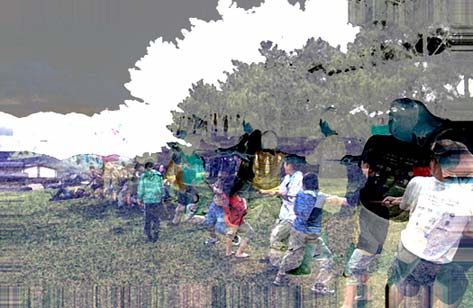
One of the main inhibitors of a team optimally obtaining its goal is knowledge hoarding rather than knowledge sharing. There are many cultural factors that inhibit knowledge transfer. The most common of these frictions include (Davenport & Prusak, 1998):
- Lack of trust
- Different cultures, vocabularies, & frames of reference
- Lack of time and meeting places; narrow idea of productive work
- Status and rewards go to knowledge owners
- Lack of absorptive capacity in recipients
- Belief that knowledge is prerogative of particular groups
- Not-invented-here syndrome
- Intolerance for mistakes or need for help
A basic tenet of communication theory states that a network's (team) potential benefit grows exponentially as the nodes it can successfully interconnect expand numerically. For example, if two team members share information, both gain information and gain linear growth. And if both then share their new knowledge with other team members, and in turn, get questions, amplifications, and modifications, then knowledge become exponential.
Forming, Storming, Norming, Performing, Adjourning
Tuckman (1965) discovered that teams normally go through five stages of growth: Forming, Storming, Norming, Performing, and finally Adjourning. These stages are highly relevant to matrix teams since they may be highly diverse in culture, expertise, and frames of reference,
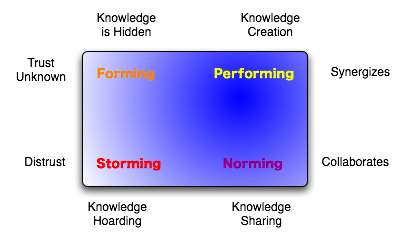
While most matrix or cross-functional teams go through these stages, depending upon the team's diversity of its members and purpose, some of the stages may be quite short or last for a period of time.
Forming
In the this stage, team members are introduced. They state why they were chosen or volunteered for the team and what they hope to accomplish within the team. Members cautiously explore the boundaries of acceptable group behavior. This is a stage of transition from individual to member status, and testing the leader's guidance both formally and informally.
Forming includes these feelings and behaviors:
- Excitement, anticipation, and optimism
- Pride in being chosen for the project
- A tentative attachment to the team
- Suspicion and anxiety about the task at hand
- Defining the tasks and how they will be accomplished
- Determining acceptable group behavior
- Deciding what information needs to be gathered
Activities include abstract discussions of the concepts and issues; and for some members, impatience with these discussions. There is often difficulty in identifying some of the relevant problems as there is so much going on that members get distracted. The team often accomplishes little concerning its goals. This is perfectly normal.
Storming
The team's transition from the "As-Is" to the "To-Be" is called the Storming phase. All members have their own ideas as to how the process should look, and personal agendas are often rampant. Storming is probably the most difficult stage for the team. They begin to realize the tasks that are ahead are different and more difficult than they previously imagined. Impatient about the lack of progress, members argue about just what actions the team should take. They try to rely solely on their personal and professional experience and resist collaborating with some of the team members.
Storming includes these feelings and behaviors:
- Resisting the tasks
- Resisting quality improvement approaches suggested by other members
- Sharp fluctuations in attitude about the team's chance of success
- Arguing among members, even when they agree on the real issues
- Defensiveness, competition, and choosing sides
- Questioning the wisdom of those who selected the project and appointed the members of the team
- Establishing unrealistic goals
- Disunity, increased tension, and jealousy
These pressures mean that team members have little energy to spend on progressing towards the intended goal. But they are beginning to understand each another. This phase can often take several meetings before arriving at the next phase.
Norming
The Norming phase is when the team reaches a consensus on the "To-Be" process. Everyone wants to share the newly found focus. Enthusiasm is high, and the team is often tempted to go beyond the original scope of the process. During this stage, members reconcile competing loyalties and responsibilities. They accept the team, ground rules, roles, and the individuality of fellow members. Emotional conflict is reduced as previously competitive relationships become more cooperative.
Norming includes these feelings and behaviors:
- An ability to express criticism constructively
- Acceptance of membership in the team
- An attempt to achieve harmony by avoiding conflict
- Friendliness, confiding in each other, and sharing of personal problems
- A sense of team cohesion, spirit, and goals
- Establishing and maintaining team ground rules and boundaries
As team members work out their differences, they have more time and energy to spend on the project.
Performing
By now the team has settled its relationships and expectations. They can begin performing by diagnosing, problem solving, and implementing changes. Team members have discovered and accepted other's strengths and weakness. In addition, they have learned what their roles are. Performing includes these feelings and behaviors:
- Members have insights into personal and group processes
- An understanding of each other's strengths and weakness
- Constructive self-change
- Ability to prevent or work through group problems
- Close attachment to the team
The team is now an effective, cohesive unit. You can tell when your team has reached this stage because you start getting a lot of work done.
Adjourning
The team briefs and shares the improved process during this phase. When the team finally completes that last briefing, there is always a bittersweet sense of accomplishment coupled with the reluctance to say good-bye. Many relationships formed within these teams continue long after the team disbands.
Factors Separating Teams from Groups
Roles and Responsibilities
Within a group, individuals establish a set of behaviors called roles. These roles set expectations governing relationships. Roles often serve as source of confusion and conflict. While on the other hand, teams have a shared understanding on how to perform their role and perceive the other team members' roles.
Identity
While teams have an identity, groups do not. It is almost impossible to establish the sense of cohesion that characterizes a team without this fundamental step. A team has a clear understanding about what constitutes the team's mission and why it is important. They can describe a picture of what the team needs to achieve, and the norms and values that will guide them.
Cohesion
Teams have esprit that shows a sense of bonding and camaraderie. Esprit is the spirit, soul, and state of mind of the team. It is the overall consciousness of the team that a person identifies with and feels a part of. Individuals begin thinking of the concept "we" rather than "me."
Facilitate
Groups have a tendency to get bogged down with trivial issues. Ask yourself, "How much time gets wasted in meetings you attend?" Teams use facilitators to keep the team on the right path.
Communication
While members of a group are centered upon themselves, the team is committed to open communication. Team members feel they can state their opinions, thoughts, and feelings without fear. Listening is considered as important as speaking. Differences of opinion are valued and methods of managing conflict are understood. Through honest and caring feedback, members are aware of their strengths and weaknesses as team members. There is an atmosphere of trust and acceptance and a sense of community.
Flexibility
Most groups are extremely rigid. However, Teams maintain a high level of flexibility, and they perform different task and maintenance functions as needed. The responsibility for team development and leadership is shared. The strengths of each member are identified and used.
Morale
Team members are enthusiastic about the work of the team and each person feels pride in being a member of the team. Team spirit is high. To be a successful team, the group must have a strong ability to produce results and a high degree of satisfaction in working with one another.
Encouraging Great Ideas
All too often, creativity gets stifled when everyone follows the rules or arriving at solutions the same old way. Teams often become so task-oriented that they narrow down their focus much too soon by choosing the first likely solution, rather than adequately investigating the situation and its possibilities by brainstorming.
Team Checklist
Goals
 Clear mission statement
Measurable objectives
Prioritized objectives
Goals set in all key task areas
Roles
Clear roles, relationships, and accountabilities
Appropriate leadership style for team tasks
Individuals competent to perform their key tasks
Appropriate mix of roles for team tasks
Procedures
Effective decisions reached
Effectively shared information
Key activities coordinated
High quality products and services
Conflict managed effectively within the team
Internal Relationships
No areas of mistrust
Constructive feedback
Supportive and competitive relationships
External Relationships
Good interactions with other key groups
Key external relationships built and monitored
Next Steps
Next Chapter: Team Leadership Model — A visual model for implementing Team Leadership
Activities:
- Team Survey: Identify the present stage of the teamwork model that your team is presently operating in — Forming, Storming, Norming, or Performing.
- Growing a Team: Tips for producing a high performance team.
References
Davenport, T.H., Prusak L. (1997). Working Knowledge: How Organizations Manage What They Know. Boston, MA: Harvard Business School Press.
Katzenbach, J.R., Smith, D K. (2006). The Wisdom of Teams: Creating the High-Performance Organization. New York: Harper Collins Publishers, Inc..
Margerison, C., McCann, D. (1985). How to Lead a Winning Team. MCB University Press.
Quinn, J.B., Anderson, P., Finkelstein, S. (1998). Managing Professional Intellect: Making the Most of the Best. Harvard Business Review on Knowledge Management. Boston, MA: Harvard Business School Press.
Tuckman, B.W. (1965). Developmental Sequence in Small Groups. Psychological Bulletin, vol. 63, pp. 384-399.
Wellins, R.S., Byham, W.C., Wilson, J.M. (1991). Empowered Teams: Creating Self-Directed Work Groups That Improve Quality, Productivity, and Participation. San Francisco: Jossey-Bass.