
Note: This site is moving to KnowledgeJump.com. Please reset your bookmark.
ISD as a Design Science

While some learning theory is part of the descriptive sciences, which describe the way things function in the natural world; Instructional System Design is more a part of the design sciences, which offer ways to perform certain human-defined tasks. Descriptive sciences can be considered the law as they aim to describe and explain, while design sciences are roadmaps that guide our knowledge and skills for the activities of design (Grimaldi, Engel, 2007).
Being a design science, ISD is a model to aid in the design, development, and delivery of performance through learning, training and development processes. Since there is “science” in the term, it must be evidence-based. However, because we are dealing with one of the most complex objects known to us — the human brain, at times there is not enough evidence. For this reason we have “design” in the term, which means it is also art.
Joel Michael writes in Advances in Physiology Education (2006):
“…it is important to recognize that educational research is difficult to do; this has been cogently highlighted by Berliner in Educational research: the hardest science of them all. Berliner points out that unlike a physics experiment, in which it is possible to readily distinguish between the independent and dependent variables, and also possible to isolate and control all of the independent variables, in educational experiments all of this is problematic. Researchers may not agree on which variable is the dependent variable of greatest interest or importance. There may be disagreements about which independent variable(s) are to be manipulated. There may be disagreements about how to measure any of the relevant variables. And, finally, it may be extremely difficult, or even impossible, to isolate and manipulate all the variables suspected of being involved in the phenomena being studied.”
This means the people within the organization, to include learners, designers, and managers must control the ISD model, rather that it controlling them. Immediate problems often arise that require rapid solutions. Don't get hung up in the system model by refusing to bypass, switch, modify, or include new steps of your own. Managers often need quick and ingenious solutions, not another bureaucracy. In other words, the learning department's motto should be: “We provide learning and performance solutions!” Not, ”We follow the ISD model.”
Thus, the steps in each phase should not be thought of as concrete in nature but rather dynamic and iterative (Merrienboer, 1997). One phase or step does not necessarily have to be completed before the next one is started, hence the dashed-arrows in the diagram below that show the processes or phases can be iterated:
The use of iterations allows you to implement partial solutions over time that will ease the problem. Continue the use of iterations until the problem is fully addresses and the learning process is working as desired.
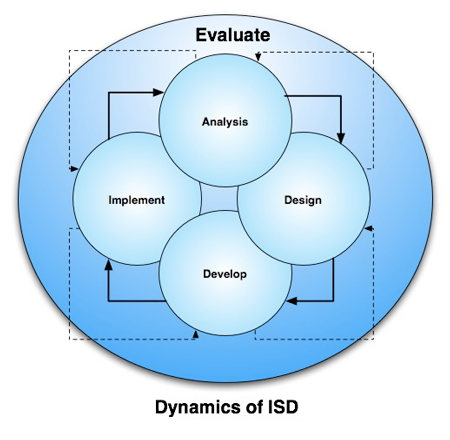
Every training process will develop its own rhythm, which means designers need to find the natural flow of the steps required to produce a successful learning platform. However, if you are new to instructional design, the less you know about a subject, or the more technical the material is, then more than likely, the closer you need to follow the model.
At work, the potter sits before a lump of clay on the wheel. Her mind is on the clay, but she is also aware of sitting between her past experiences and her future prospects. She knows exactly what has and has not worked for her in the past. She has an intimate knowledge of her work, her capabilities, and her markets. As a craftsman, she senses rather than analyzes these things; her knowledge is 'tacit.' All these things are working in her mind as her hands are working the clay. The product that emerges on the wheel is likely to be in the tradition of her past work, but she may break away and embark on a new direction. Even so, the past is no less present, projecting itself into the future. - Henry Mintzberg, 1987.
Just as the potter follows both the tradition of her past work and breaking away and embarking in a new direction, a designer must also do the same.
To make a training program usable, the following activities must normally take place:
Focus: An early focus on the customer or business unit must be maintained. This is done by direct contact with the customer through interviews, observations, surveys, and participatory design and development methods. You must ensure that the customers are made owners of the learning platform throughout the entire ISD process. If they feel the program is being shoved down their throats or their turf is being invaded, the program will likely fail.
Leadership: The five phases - analysis, design, development, implementation, and evaluation should be under one leadership team to ensure that a symmetrical program is constructed.
Art and Science: The design must be empirical as much as possible. This requires observation, measurement of behavior, careful evaluation of feedback, and a strong motivation to make design changes when needed. However, don't forget to add the art to it.
Iterative: The process of implementation, testing, feedback, evaluation, and change must be repeated throughout the learning platform's life to improve upon it. Do NOT fall into the old adage, “If it ain't broke don't fix it.” Make it better before your competitors do!
Next Steps
Next section: Critiques and Comparisons of ISD
Return to the Table of Contents
Pages in the ISD Overview
-
ISD as Design Science
Reference
Grimaldi, D.A., Engel, M.S. (2007). Why Descriptive Science Still Matters. BioScience, vol 57, Is 8 (Sep 2007).
Michael, J., (2006). Where’s the evidence that active learning works? Advances in Physiology Education, 30: 159–167, 2006; doi:10.1152/advan.00053.2006.
van Merriënboer, J.J.G. (1997). Training Complex Cognitive Skills: A Four-Component Instructional Design Model for Technical Training. Englewood Cliffs, NJ: Educational Technology Publications.
Mintzberg, H. (1987). Crafting Strategy. Harvard Business Review, July-August, pp.66-75.
U.S. Department of Defense (1975). Interservice Procedures for Instructional Systems Development Model. TRDOC Pamphlet 350-30. August, 1975.