
Note: This site is moving to KnowledgeJump.com. Please reset your bookmark.
Delivering eLearning and Other Non-Trainer Led Learning
eLearning and other learning processes that are not instructor led need support from the training staff to maximize their benefits.
When elearning first made its appearance, it was supposed to be a quick killer of the classroom. But it did not take long before people realized that is was not the silver bullet it was supposed to be. Part of the reason was that for the most part, the early elearning programs were copies of PowerPoint slides. Thus, instructional designers started to add more interactivity to their elearning programs, which did help, but they were still missing an important part that classrooms have — social learning.
eLearning can have an attrition or drop-out rate as high as 20% because all too often it treats the person as a “lone learner.” Yet, people often need to interact with others when they are in a learning situation.
For example, Allen Tough (1999) discovered that in an informal learning episode, a person will normally interact with an average of ten people.
Thus, blending learning was born. Classrooms enhance elearning in that the interactive and social nature of a classroom, blended with the self-paced environment of elearning may increase learning by an average of 11% for both procedural and declarative knowledge (Sitzmann, Ely, 2009). eLearning and other similar programs need to be built on a platform that provides them with not only with the benefits of a self-learning environment, but also with the needed social support system.
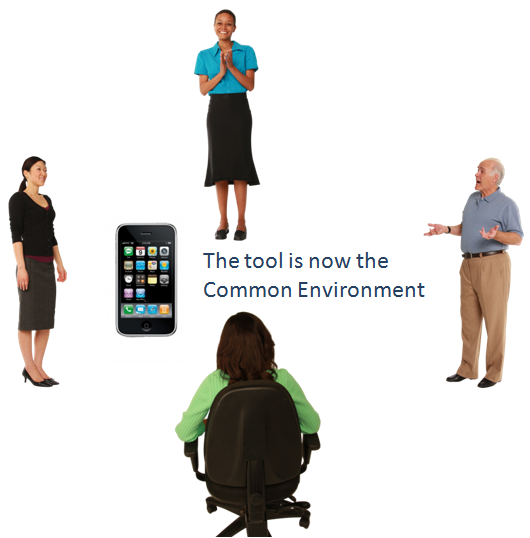
With the new social media tools now available, the classroom environment can now be replaced in many instances with these tools, such as blogs, microblogs (e.g., Twitter or Yammer), file sharing (e.g., Flickr or SlideShare), Virtual Meeting Places, (e.g., Adobe Connect and Elluminate), social sites (e.g. Facebook and MySpace) and wikis.
The tool now acts as the common environment in that it allows the learners to meet and share experiences in a virtual environment. Thus, with a little imagination, the social techniques discussed in Deliver the Training and Learner Involvement can often be replicated without the expense of a classroom.
Next Steps
Return to the Table of Contents
Pages in the Implementation Phase
-
Delivering eLearning
References
Sitzmann, T., Ely, K. (2009). Web-Based Instruction: Design and Technical Issues which Influence Training Effectiveness. Retrieved from: http://webboard.adlnet.org/Technologies/Evaluation/Library/Additional%20Resources/Presentations/ASTD%202009%20Presentation%20Slides.pdf
Tough, A.M. (1999). Reflections on the study of adult learning. Paper presented at the 3rd New Approaches to Lifelong Learning (NALL) Conference, University of Toronto: Ontario Institute for Studies in Education, Toronto, Canada. Retrieved from http://www.oise.utoronto.ca/depts/sese/csew/nall/res/08reflections.pdf