
Note: This site is moving to KnowledgeJump.com. Please reset your bookmark.
Leadership: Strategy and Tactics
Photo by Nashara
Strategy is the creation of a unique and valuable market position supported by a system of activities that fit together in a complementary way (Porter, 1980). It is about making choices, trade-offs, and deliberately choosing to be different.
It should not be confused with operational effectiveness or best practices — what is good for everybody and what every business should be doing, such as TQM, benchmarking, or being a learning organization (Porter, 1980). Thus, when developing strategies, the goal is to be different from your competitors. However, this does not mean that you are willing to do anything, but rather determine where the opportunities lie that you can best exploit.
All strategic plans of the departments need to tie in with the organization's overall strategic plan. That is, in going back to the definition of strategy, the leaders of the organization should create the unique and valuable market position; while your goal is to support the organization with activities that fit together in a complementary way.
That does not mean you cannot do things differently or set your own goals. It simply means that you need to keep your leaders' visions and goals in focus when setting your goals. For example, if the leaders have ethics and diversity at the forefront of their strategic vision, you cannot put elearning and knowledge management at the forefront of your strategic goals. However, that does not mean you cannot use elearning and knowledge management technologies to bring about ethical and diversity goals.
Visioning
Visioning is the start of any strategic plan. Once your leaders have set the organizational strategic plans, you need to determine how best your department can bring about changes that will support those plans. And while their strategic plan needs to be unique, you need to think along the same lines.
Visioning strategy is best performed using a four-prong approach:
- Internal Audit — Where are you now (snapshot of present time)?
- Reading and Research — Where can you grow?
- Organization Vision — Where is the organization going?
- Vision — Where do you want to grow?
Note that first three steps can be performed in just about any order; however, the last step will normally be last in the process as it is based upon the other three prongs.
Tactical
Strategies are forward-looking. They provide the guidelines for growth. With strategies, you are in reality, speaking of future performance gaps and how you are going to overcome them.
Tactical is more or less present or now orientated. It is about present performance gaps and how you are going to overcome them in order to support the strategies.
What have you done today to enhance (or at least insure against the decline of) the relative overall useful skill level of your work force vis-à-vis competitors - Tom Peters in Thriving on Chaos
When Peters writes of enhancing, he is speaking of the strategic plans that will grow the employees to meet tomorrow's challenges. When he writes of “insure against the decline of,” he is speaking of the tactical impediments that are presently challenging employees from meeting expected performance standards. In order to grow, you must be able to ward off present roadblocks. Thus, tactical plans are about providing performance stability so that change (strategic) may take affect for growth.
Strategies normally look an average of about five years into the future (with a range of about one to ten years). However, as time progresses, the future time frame is becoming shorter due to the world moving faster (mostly technology). That is, it becomes harder to make long-range plans in a fast moving environment.
Thus, as we move ever faster in a VUCA (volatility, uncertainty, complexity and ambiguity) world, less emphasis is placed on strategy, while more is placed on tactics.
Tactics look ahead just far enough to secure objectives set by strategy. Thus, tactics are characterized by adroitness, ingenuity, or skill. Note that tactics is from the Greek taktika — matters pertaining to arrangement. On the other hand, strategy has its roots in “office of a General” or “to lead”).
Command & Control
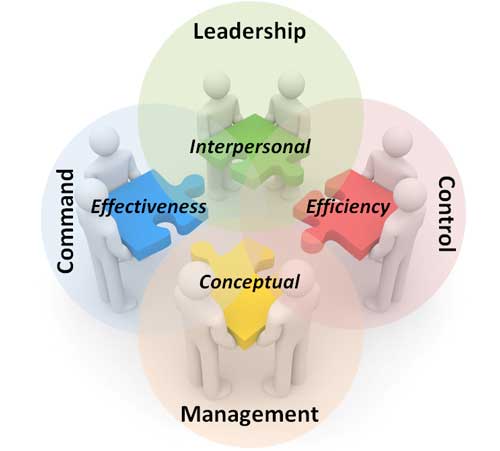
Command and Control are two of the four processes that enable you to carry out strategy and tactics. The other two processes are Leadership and Management. For more information, see Leadership, Management, Command, and Control.
Next Steps
Next chapter: OODA Loop (Observing, Orienting, Deciding, and Acting)
Learning Activity: SWOT Analysis
References
Collins, E., Devanna, M. (1990). The Portable MBA. New York: John Wiley & Sons.
Porter, M.E. (1980). Competitive Strategy, Techniques for Analyzing Industries and Competitors. New York: The Free Press.
U.S. Army (1987). Leadership and Command at Senior Levels. FM 22-103.