
A Few Good Learning Theories

How we learn

The Three Representational Modes (TRiM)

TRiM Learning Theories

The domains of knowledge - SMCK Other Supporting Theories

The Three Representational Modes (TRiM)

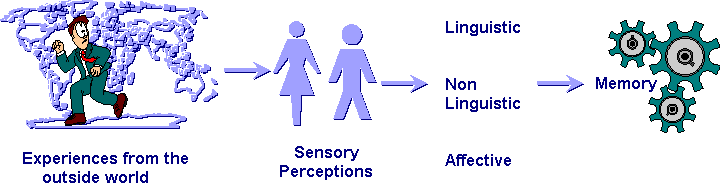
All information that is perceived via the senses passes through three processors that encode it as linguistic, nonlinguistic, or affective representations. This is how we learn.

NOTE: This work only goes into the major part of TRiM. For a more detailed work, see Marzano (1998) (note that he does not use this acronym).

For example, if you go to a football game for the first time you encode information linguistically such as rules; retain mental images nonlinguistically, such as mental images of the players positioning themselves and then getting set (pose); and finally, you have various sensations that are encoded affectively, such as the excitement during a touchdown. Each representation can be thought of as a record that is encoded and then filed away.
THE LINGUISTIC MODE

In the educational and training world, knowledge is most commonly presented linguistically (the study of language), so perhaps this mode receives the most attention from a learning standpoint (Chomsky, 1988). The linguistic mode includes verbal communication, reading, watching (e.g. learn the rule of chess through observation), etc.

Discussions and theories around the linguistic mode can get quite complex so I am keeping this fairly simple. Basically, the linguistic processor encodes our experiences as abstract propositions.

Propositions are thought to perform a number of other functions in addition to being the primary bearers of truth and falsity and the things expressed by collections of declarative sentences in virtue of which all members of the collection "say the same thing". Propositions represent the things we doubt and know. They are the bearers of modal properties, such as being necessary and possible. Some of them are the things that ought to be true.

These propositions are organized into two networks:

1. The declarative network contains information about specific events and the information generalized from them. These are the "what" of human knowledge.

2. The procedural network contains information about how to perform specific mental or physical processes. Often thought of as IF and THEN statements.

These two networks are the main channels for interacting with each other (communication). Communication is the main functions of language. Language symbols are used to represent things in the world. Indeed, we can even represent things that do not even exist. Communication does not imply a language, for example using hand signals. But a language does imply communication, that is, when we use language, we normally use it to communicate.

 A few linguistic definitions

The forming of language is done by "syntax" - putting sounds together to form words, and the words, in turn, form sentences. For example, English words require at least one vowel sound. However, in Czechoslovakia there are words that are all consonants with no vowels. These sounds we put together are morphemes - the smallest units of language that have meaning. A word is morpheme, as is a prefix or suffix, also the "s" we add onto the end of a word is a morpheme.

Semantics is the study of meaning. With semantic knowledge we can often understand what people mean when they say things that are syntactically unusual or even incorrect. 

In transformational grammar, the meaning of a sentence is its deep structure, and that meaning is transformed into the surface structure, which is the actual sentence itself. The deep structure of language is the meaning, and the surface structure is the means by which that meaning is expressed. The rules that translate the meaning into the deep structure are the phrase rules, and the rules that translate the deep structure into the surface structure are the transformational rules.

THE NONLINGUISTIC MODE

This includes mental pictures, smell, kinesthetic, tactile, auditory, and taste. At first, we might believe that they are entirely different structures, however these representations are quite similar to each other in that these nonlinguistic sensations function in a similar fashion in permanent memory (Richardson, 1983). That is, although we sense things differently, such as smell and touch, they are stored in mental representations that are quite similar. They also lose a lot of their robustness once the experience is over and transferred to memory. For example, picturing the smell of a rose from memory is not as vivid as actually smelling a real rose.

Although we can realistically study linguistics, taste, hearing, etc.; mental images are another matter. . . how do you study a picture in someone's mind? Hence, there are several models for the nonlinguistic mode in the psychology world. However, there are a few things we know for certain:

  • Mental images can be generated from two sources - the eyes (e.g., the after image of a light bulb) and from permanent memory (picturing a tiger that has squares instead of dots).
  • Mental images are an essential aspect of nonlinguistic thought and play an important part in creativity.
  • Due to the fragmented and constructed nature of mental images, they are not always accurate pictures of whole thought as compared to prepositionally-based linguistic information. However, they can have a powerful effect on our thoughts due to their intensive and vivid nature, e.g. the power of storytelling, the images we create in our mind when reading a powerful novel, metaphors, imagination, creativity, etc.

THE AFFECTIVE MODE

This is our feeling, emotions, and mood (Stuss & Benson, 1983):
  • Feeling is one's internal physiological state at any given point in time.
  • Emotion is the coming together of feelings and thoughts (prepositionally-based linguistic data) that are associated with the feeling.
  • Mood is the long-term emotion or the most representative emotion over a period of time.
The affective mode can be thought of as a continuum of feelings, emotions, and ultimately moods. The end points of the continuum are pleasure and pain and we normally strive to stay on the pleasure end of it.

The limbic system (pituitary gland, amygdala, thalamus, hippocampus, etc.) is the physiological system that ties the affective mode together. Since the limbic affects virtually every part of our brain, it also has a very powerful affect on learning.

Plutchik theorized that each basic emotion occupies a location on a circle. Blends of two basic emotions are called dyads. Blends involving adjacent emotions in the circle are first-order dyads, blends involving emotions that are separated by one other emotion are second-order dyads, and so on. For example, love is a first-order dyad resulting from the blending of adjacent basic emotions joy and acceptance, while guilt is a second-order dyad involving joy and fear, which are separated by acceptance. The further away two basic emotions are, the less likely they are to mix. And if two distant emotions mix, conflict is likely. Fear and surprise are adjacent and readily blend to give rise to alarm, but joy and fear are separated by acceptance and their fusion is imperfect and the conflict that results is the source of the emotion guilt.

TRiM Learning Theories

So what learning activities do we use if we follow the TRiM model?

LINGUISTIC MODE

The linguistic mode provides the way to the most accurate method of learning, hence the reason for its impact upon the education and training world. There are a number of ways for increasing linguistic retention.

Note Taking

Note taking has a positive impact on this mode since it involves the learners in the subject matter that is transpiring in class, it cause us to reflect on the subject and then record our thoughts, it helps us in interpreting the subject matter, and it provides an additional linguistic reinforcer. You can help them with the note taking by providing rough outlines and fill-in-the-blanks. But do not just rely on one method. For example, fill-in-the-blanks can also be concept or semantic maps (mapping) - you provide the lines and circles, while the learners fill them in.

Also, note that while mapping might seem "graphic", we can learn linguistically from visual representations (e.g. learning rules and various strategies by watching a game, the procedures for picking up a load with a forklift). Use visual outlines to fit the subject, for example, give them an outline of a pyramid when discussing Maslow's hierarchy of needs.

Vary the methods to fit the subject - e.g. give them a rough draft, then a fill-in-the-blank, then a mapping outline.

Pascarella and Terenzini (1991, p.98) reported that the greater the learner's involvement or engagement (which includes note-taking) is in the learning process, the greater the knowledge acquisition. Marzano (1998) reported the following effects:

  • Note taking techniques have an overall effect size of .99, indicating a percentile gain of 34 points. These techniques require students to generate personal linguistic representations of the information being presented.
  • Graphic representations produced a percentile gain in achievement of 39 points. One of the most effective of these techniques was semantic mapping (Toms-Bronosky, 1980) with an effect size of 1.48 (n=1), indicating a percentile gain of 43 points. With this technique, the learner represents the key ideas in a lesson as nodes (circles) with spokes depicting key details emanating from the node.

Cueing

Use "cueing" to provide the "abstract propositions", which is then expounded on to turn it into a complete, long-term memory network. Cues can be thought of as a brief preview or skill that is to be presented. It can be as simple as saying, "I wonder what will happen if I push this button," to using slides to cue. Most of us have heard of the 6-6 (or 7-7) rule of slides -- no more than six lines and each line should have no more than six words. If you have ever sat through a presentation where the presenter read the slides, you know how ineffective and annoying that method is. This is partially because our reading speed does not match our listening speed; hence, they confuse instead of reinforcing each other. The better method is to use the slides as cues. The slide should give a brief outline to "cue" the students on what they are about to learn.

Also, do NOT cover each line and then show it when you are about to speak about it -- this defeats the whole purpose of cueing by taking away the skeleton outline that the learners need in order to build upon.


Teachers will recognize this concept as a miniature scaffold (building upon a framework)
Note that when we learn, we build upon what we previously know

Marzano (1998, p.89) reported an effect size of 1.13, which indicates that achievement can be raised by 37 percentile points when cueing is used.

Models

Models (as in people, drawings, and three-dimensional) will also help to reinforce both the declarative and procedural network by giving them a visual source. 

The combined use of drawings, flowcharts, mappings, instructions, etc. can be combined to produce knowledge maps, rather than linear readings.

Marzano (1998, p.91) reported an effect size of 1.48 (which indicates that achievement can be raised by 43 percentile points) when graphic representations are used.

Active Learning

Use activities (manipulatives) to engage the learners. While we can learn the basics of such activities as football, chess, or leading, we do not really understand it until we actually do it.

Placing the learners in small groups allows them to not only receive and express linguistic information, but to also manipulate it in various forms to gain a full understanding of it.

Cooperative learning is very effective due to give and take of various linguistic forms. It involves cooperation, in that learners work in small groups on an assigned project or problem under the guidance of the trainer who monitors the groups. On the other side is "collaborative learning" that is a more radical departure in that it involves learners working together in small groups to develop their own answer through interaction and reaching consensus, not necessarily a known answer.

In addition, the use of good questioning techniques, fishbowls, case studies, etc., gives the same benefits as groups.

Pascarella & Terenzini (1991, page 98) reported that the greater the learner's involvement or engagement is in the learning process, the greater the knowledge acquisition.

Marzano (1998, p.91) reported an effect size of 0.89 (which indicates that achievement can be raised by 31 percentile points) when manipulatives (engaging the learners) are used.

Marzano (1998, p.93) reported an effect size of 1.14 (which indicates that achievement can be raised by 37 percentile points) when experimental learning is used and an effect size of .54 (a percentile gain of 21 points) by using problem solving processes.

See Active Learning for more information and references

NONLINGUISTIC MODE

While various linguistic methods are used in many classrooms, the nonlinguistic and affective modes are often omitted as trainers do not realize their importance. Remember, we have three processors, when you deny or do not reinforce anyone of them, you actually lengthen the learning process instead of shortening it.

Mental Images

Use the power of mental images to increase nonlinguistic retention. Provide metaphors, reflection time and activities, short videos of powerful images, storytelling, etc. To truly understand a subject matter we need to be creative with it on order to adapt it to our workplace. It is through the power of mental images that we are able to change our mental representations of how things work to how we can make them work for us.


Have the learners practice the task in their minds
(visualization)

Marzano (1998, p.102) reported an effect size of 1.13 (which indicates that achievement can be raised by 37 percentile points) by using techniques that enhance visual memory.

The Other Senses

Also, do not forget the other senses. VAK would tell us to let the learners play with a koosh ball, however, I believe this has more to do with personal satisfaction than with actual learning. What really needs to happen is to allow them to touch, move, listen and/or smell the subject mater if at all possible. . . sort of what Zen is built upon -- become one with the subject matter.

AFFECTIVE MODE

Use the power of feelings and emotions to reinforce the affective mode.

See Affective Behaviors

Also note that this is similar to the Affective behavior in Bloom's Taxonomy.

Feedback and Praise

Provide them with explicit feedback on how well the goals or objectives were met. You want to keep the feedback positive as the goal is to reinforce their drive to perform better, not to beat them down in utter defeat.

Also, it is important not only to provide feedback that improves performance, but also give praise or positive reinforcement that is focused and accurate.

Marzano (1998, p.95) reported an effect size of 0.74 (which indicates that achievement can be raised by 27 percentile points) when praise is used. While providing feedback (p.108) on the type of strategy to use and how well the learner uses it had a effect size of 0.61 (percentile gain of 37 points).

Learning Objectives

Most of us know that providing the learning objectives increases the chance for learning to occur, but if you then allow the learners to adapt the objectives to meet their personal goals, you further increase the chance as they now start to own the objectives.

Marzano (1998, p.94) reported an effect size of 0.97 (which indicates that achievement can be raised by 34 percentile points) when goal specification is used. When students have some control over the learning outcomes, there is an effect size of 1.21 (39 percentile points).

Note that providing a learning objective is similar to cues or scaffolding in that it provides a framework for the learners to build their skills and knowledge upon.

Arousal

Use "arousal" (emotions) to increase learning. A certain amount of arousal can be a motivator toward change (with change being learning). But too much or too little will have a negative affect. You want a mid-level point of arousal to provide the motivation to change (learn). Too little arousal has an inert affect on the learner, while too much has a hyperactive affect. Each type of learning has its own optimal level of arousal. The more intellectually or cognitive a task is, then the more lower the level of arousal should be so that you do not "overload" the learners. On the opposite end of the scale are tasks that require less mental activities or tasks requiring endurance and persistence. They require higher levels of arousal to fully engage the learners in the learning process. Some learning should be fun, some should be dry, some learning requires an emotional charged classroom, and some require an emotionless state.

Self, Metacognition, Cognition, Knowledge (SMCK)

While TRiM (Three Representational Modalities) describes the components that show how we take in information, SMCK (Marzano, 1998) describes the domains of knowledge. One of the first and best known knowledge domains is Blooms Taxonomy. However, since then we have learned quite a bit more about how we learn. 

NOTE: Again, this work only goes in to the major part of TRiM. For a more detailed work and set of references on TRiM and SMCK, see Marzano (1998) (note that he does not use the two acronyms).

How TRiM fits in with SMCK
Click for larger picture


We receive information linguistically, nonlinguistically, and affectively through our senses. This information or "presenting task" then passes through four human thought processing systems:

  • Self-System - What value do we place upon the presenting task (we will do it or not)?
  • Metacognitive System - Designs strategies for accomplishing the presenting task. How do we go about solving a complicated task?
  • Cognitive System - Process the presenting task so that we may learn it.
  • Knowledge Domain - The cognitive domain draws upon our knowledge domain for information that helps us to solve the presenting task.

Self-System

The first domain the presenting task passes through is our self-system. If we consider the presenting task or information of high value, then we will put some effort into learning it. Otherwise, we will steer our efforts to other interests (Harter, 1980 & Markus & Ruvulo, 1990). This self-system is an interconnected network of beliefs that helps one makes sense of the world and decides what goals to pursue. 

If the presenting goal or task is judged as important and doable, then the learner is motivated to engage in the presenting goal or task. However, if the task is presented as low-relevance or a low probability of success, then a negative effect is generated and motivation for task engagement is low. 

For example, a student in a leadership class might be thinking about the upcoming weekend. The instructor might say something similar to, "it is important to pay attention to this part of the lesson, as the rest of the material is closely based upon it." The learner can either pay attention to the instructor, or continue with her thought about the upcoming weekend. In either case the learner makes a choice through her self-system which then determines how her metacognitive system, cognitive system knowledge domain will be utilized.

Our self system guides us in what we need to learn

"Most of us, beginning in childhood, have an intrinsic ability to judge our own progress. This is a natural aspect of our ability to learn. But schools and workplaces subjugate that natural assessment to the judgment and ranking of teachers, supervisors, and other "experts," whose appraisals can determine our tracking, promotion, opportunity, wealth, status, and ultimately even self-esteem. Business assessment systems such as Management by Objectives (MBO) tend to institutionalize a destructive process where bosses propagate the same measures and assessments of which they are also victims. Thus, assessment is not emotionally neutral territory. Inherent fear and resentment diminishes the quality of any assessment effort -- particularly those involved with assessing organizational learning." - Roth and Kleiner (1995):

Metacognitive System

Next, the presenting task goes through the metacognitive system. This system helps us to plan, set time lines, allocate resources (Schank & Abelson, 1977). It also designs strategies for accomplishing goals once they have been set. Its main categories are:
  • Goal Specification - Note that it does not decide to "engage" in a goal, that is the function of the self-system, its job is to help to determine when the goal has been completed.
  • Process Specification - Identifies and activates the skills, tactics, and process used to accomplish a goal.
  • Process Monitoring - Monitors the effectiveness of  skills, tactics, and process used to accomplish a goal. 
  • Disposition Monitoring - Monitors how one approaches a task.
The megacognitive system is continually interacting with the cognitive system throughout the task.

Metacognition is another important aspect of learning (see Brown, 1978; Flavell and Wellman, 1977). The importance of prior knowledge in determining performance, crucial to adults as well as children, includes knowledge about learning, knowledge of their own learning strengths and weaknesses, and the demands of the learning task at hand. Metacognition also includes self-regulation -- the ability to orchestrate one's learning: to plan, monitor success, and correct errors when appropriate -- all necessary for effective intentional learning (Bereiter and Scardamalia, 1989).

Metacognition also refers to the ability to reflect on one's performance. Whereas self-regulation may appear quite early, reflection appears to be late developing. If children lack insight to their own learning abilities, they can hardly be expected to plan or self-regulate efficiently. But metacognition does not emerge full-blown in late childhood in some "now you have it, now you don't" manner. The evidence suggests that, like other forms of learning, metacognition develops gradually and is as dependent on knowledge as experience. It is difficult to engage in self-regulation and reflection in areas that one does not understand. However, on topics that children know, primitive forms of self-regulation and reflection appear early (Brown and DeLoache, 1978).

Cognitive System

The presenting task next passes through the cognitive system, which processes the information that is essential to learning the task (Anderson, 1995). This process includes the effective execution of steps for solving problems. It creates novel ideals for the construction of new concepts. It also:
  • Stores and retrieves knowledge into permanent memory.
  • Processes knowledge by manipulating so that it can be used for specific tasks.
  • Inputs and outputs information by communicating with others.
  • Uses knowledge to accomplish specific tasks.
It accomplishes these processes by drawing upon the knowledge domain.

Knowledge Domain

The knowledge domain consists of information, mental processes, and psychomotor processes. 

Information

Information can be thought of as the library within us that organizes how we store information. All information can be broken down as elements, as shown in the chart below.

Elements In The Information Domain Hierarchy
(going from the lowest to the highest)

Vocabulary Terms - The meaning of a word at a very general level. 

Facts - Information about specific persons, places, events, etc. These are very specific, such as the United States has fifty states.

Time Sequences - First one thing happened, then another thing happened. These are important events between two periods in time. For example, Columbus discovered America in 1492 and America declared itself a free nation in 1776.

Cause/Effect Sequences (If/Then) - One event effects another. It can be simple, such as a blown-out tire caused the accident or complex as there were a number of events that led to the Civil War.

Episodes - Events that have a setting, participates, duration, and effects (e.g. Word War II).

Generalizations - Statements in which examples can be provided (e.g. love is one of the most powerful human emotions).

Principles - Generalizations that deal with relationships (e.g the increase in lung cancer is directly proportional to the increase in smokers) .

Concepts - A general category which a number of principles, generalizations, time sequences, cause/effect sequences, episodes, and vocabulary terms fall (e.g. learning, democracy). 

Notice that in the information domain, each element builds upon the other. For example, you must understand the vocabulary terms before you can understand a fact. At the top of the domain are Concepts, which are the most difficult elements for a learner to extrapolate.

Mental Processes

The Mental Process domain are methods for accomplishing a task, such as the steps for picking up a load with a forklift or the steps for solving an algebra problem.

Mental Process Hierarchy
(going from the lowest to the highest)

Single Rule - Does not have a list of steps. It consists of one IF/THEN statement. e.g., if it is the beginning of a new sentence, then capitalize the first letter.

Algorithms - Has very specific steps which leads to specific outcomes. e.g., performing a math calculation

Tactics - Normally, these do not consists of a set of steps that must be performed in specific order. e.g., reading a histogram (it has rules for reading, but it does not have to be done in order).

Macro Process - A process that has a diversity of possible outcomes and involves the execution of many interrelated subprocesses. e.g., writing a term paper, using laboratory equipment.

Psychomotor Process

The psychomotor domain are our physical skills and abilities.


See the section on Psychomotor in Bloom's Taxonomy

Other Supporting Theories

Feedback 

B.F. Skinner (1968) theorized that learners need to make active responses, and to do so regularly. These responses need immediate feedback and differential follow-ups; depending upon whether or not they are correct. Without immediate feedback, especially when the response is wrong, invites the student to learn a wrong response. These wrong responses then have to be unlearned. Critical training time is wasted by having the students unlearn wrong responses instead of learning new behaviors. When designing the learning activities, consider how to apply immediate feedback. Small student to instructor ratios, programmed learning, and well designed learning environments are just a few of the ways to accomplish this.

Practice

Guthrie's (1952) study breaks skills into acts. Acts are defined as complicated behavior patterns usually involving some goal accomplishment. Acts are made up of many individual movements. Movements are specific responses to specific stimuli. Acts are composed of muscular contractions that are the response to specific stimulus and are not dependent upon practice. But the learning of an act does depend on practice. Learning an act requires practice so that the proper movement is associated with its own cues. 

Once acquired, associations are permanent (Good & Brophy (1977) ), but they may not appear in every performance due to weak associations. These weak associations cannot be retrieved because of strong interference from other associations. Short practice periods develop weak associations which learners are not able to magnify into stronger ones. 

Adams(1977) theorized that if we practice long enough we develop a mental image. For example, professional players are often known to utter sounds of satisfaction or expletives as soon as they hit a tennis ball or throw a football, because they can instantaneously tell by the feel of the act what the result will produce. Not having balanced practice periods prevents learners from becoming fully comfortable with the feel and use of the skill they are attempting to acquire. Learners must have enough time to develop a complete mental image of the sequence of correct responses. Often we see learners who could perform in the classroom and then not be able to perform when they return to work. When designing the learning activities be sure to include realistic practical exercise and enough time for these exercises!

Distributed Practice

Hull (1943) discovered that when practice periods are spaced apart (distributed practice), performance is superior to what it is when practice periods are close together (massed practice). Also, during practice periods, the learners' performance will gradually improve until some asymptotic (maximal) level is reached. If the learners are allowed to rest, and then resume practice, their performance will tend to exceed their previous asymptotic level (reminiscence effect). Learners that are provided rest or some other form of diversion between practice periods will reach higher levels of performance than learners who practice straight through without rest or diversion.

Cognition

Wertheimer (1945) contrasts rote memorization with problem solving based on the Gestalt principles. In the former, the learner has learned facts without understanding them. Such learning is rigid and can be applied without truly understanding them. Learning in accordance with the Gestalt principles, however, is based on understanding the underlying principles of the problem. This type of learning comes from within the individual and is not imposed on by someone else. It is easily generalizable and is remembered for a long time. When one performs upon memorized facts without understanding them, one often makes stupid mistakes. 

Werthemimer told this story to illustrate the point: A school inspector was impressed by the children that he had observed, but wanted to ask one more question before departing. "How many hairs does a horse have?" he asked. Much to the amazement of both the inspector and the teacher, a nine year old boy answered "3,571,962." "How do you know that your answer is correct?" asked the inspector. "If you do not believe me," answered the boy, "count them yourself." The inspector broke into laughter and vowed to tell the story to his colleagues when he returned to Vienna. When the inspector returned the following year for his annual visit, the teacher asked him how his colleagues responded to the story. Disappointedly he replied, "I wanted very much to tell the story but I couldn't. For the life of me, I couldn't remember how many hairs the boy had said the horse had."

Reaching an understanding, according to Wertheimer, involves many aspects of the learners, such as emotions, attitudes, perceptions, and intellect. In gaining insight into the solution of a problem, a learner need not be logical. Rather, the learner should cognitively arrange and rearrange the components of the problem until a solution based on understanding is reached. Exactly how this is done will vary from learner to learner. In one experiment a piece of paper with the following 15 digits was handed to a group of subjects with the instruction that they study it for 15 seconds: The paper contained these digits: 1 4 9 16 25 36 49 64 81. After the subjects studied the digits, they were asked to reproduce the sequence of numbers. Most subjects were able to reproduce only a few of the numbers. After a week most of them remembered none of the digits. Another group of subjects were asked to look for a pattern among the digits. After studying them, some of the subjects were able to determine that the numbers are the squares of the digits from 1 to 9. These subjects were able to reproduce the series perfectly not only during the experiment, but weeks and months afterward.

Transfer of Learning or Training

See Transfer of Learning

Learning Environment

Other pointers to consider for an effective learning environment:
  • The Gestalt point of view emphasizes that the whole is more than the sum of the parts. For example, the whole (producing a document) is more than the individual acts:
    1. Turn on the computer
    2. Start the word processor
    3. Type information into the word processor
    4. Check the spelling
    5. Look up customers' names and addresses
    6. Insert columns into the document
    7. Print a letter
    8. Print envelopes

    The above eight steps are meaningless unless the learner can put all of them together to produce a whole document ready for mailing. Help the learner to see that facts and ideas are part of a larger concept. Learners who are able to recite facts without seeing their interrelationship is meaningless.

  • Induce ambiguity by introducing problems and then help clarify the ambiguity by suggesting strategies for solving the problems. This is based on Spence's (1966) work which has emphasized anxiety (arousal) as a drive to learn. Encouraging some anxiety in learners that is subsequently reduced by success aids the learning environment. Too little anxiety results in little or no learning because there is no drive to be reduced (the "Why Bother?" syndrome). Too much anxiety is disruptive. Therefore, learners who are mildly anxious are in the best position to learn and are therefore easiest to reach.
  • Learning proceeds most rapidly if the information is presented in small steps (chunks), the learners are given rapid feedback, and the learners are able to proceed at their own pace.
  • Significant learning is acquired through doing. The best instructional material allows the learner to participate in the learning process. Learning is best acquired by doing and practicing the desired task. This does not mean to make it a mimic session. A mimic session is used to show how a task is accomplished. Talking them through the task step-by-step provides a good feel for performing the task. After talking them through once or twice, use real life examples that they can work through on their own. A skill needs to be worked repeatedly several times before it becomes rote or comfortable. Coach the learners, but ensure they work through the problems on their own.

References

Adams, J. (1977). Motor Learning and Retention. In Marx, M. & Bunch, M. (Eds.). Fundamentals and Applications of Learning. New York: Macmillan.

Anderson, J. R. (1995). Learning and memory: An integrated approach. New York: John Wiley & Sons.

Chomsky, N. (1988). Language and the problems of knowledge: The Managua lectures. Cambridge, MA: MIT Press.

Good, T. L. & Brophy, J. E. (1977). Educational Psychology. New York: Holt, Rinehart, & Winston. 

Guthrie, E. R. (1952). The Psychology of Learning. New York: Harper & Row. 

Harter, S. (1980). The perceived competence scale for children. Child Development, 51, 218-235.

Hull, C. L. (1943). Principles of Behavior. Englewood Cliffs, N.J.: Prentice-Hall.

Markus, H., & Ruvulo, A. (1990). Possible selves. Personalized representations of goals. In L. Pervin (Ed.), Goal concepts in psychology (pp. 211-241). Hillsdale, NJ: Lawrence Erlbaum.

Marzano, Robert J. (1998). A Theory-Based Meta-Analysis of Research on Instruction. Mid-continent Aurora, Colorado: Regional Educational Laboratory. 
http://www.mcrel.org/products/learning/meta.pdf
http://www.mcrel.org/products/learning/meta.asp

Pascarella, Ernest T.  & Terenzini, Patrick T. (1991). How College Affects Students. San Francisco: Jossey Bass.

Richardson, A. (1983). Imagery: Definitions and types. In A. A. Sheikh (Ed.), Imagery: Current theory, research, and application (pp. 3-42). New York: John Wiley & Sons.

Roth, George & Kleiner, Art (1995). Learning about Organizational Learning - Creating a Learning History. Cambridge, Ma.: MIT Center for Organizational Learning. Online: http://learning.mit.edu/res/wp/18001.html

Schank, R. C., & Abelson, R. (1977). Scripts, plans, goals and understanding. Hillsdale, NJ: Erlbaum.

Skinner, B. F. (1968). The Technology of Teaching. New York: Appleton, Century & Crofts.

Spence, K.W. (1966). Behavior theory and Learning. Englewood Cliffs, N.J.: Prentice-Hall.

Stuss, D. T., & Benson, F. D. (1983). Emotional concomitants of psychosurgery. In K. M. Heilman & P. Satz (Eds.), Neuropsychology of human emotion (pp.111-140). New York: The Guilford Press.

Wertheimer, M. (1945). Productive Thinking. NewYork: Harper and Row (1959).


Notes

For author and copyright information, see the About page.
Created May 29, 2000
Updated January 29, 2008


A Big Dog, Little Dog and Knowledge Jump Production.
Contact: donclark@nwlink.com